Fear. It envelopes your consciousness in ways that few human emotions are capable of. It operates unseen and seeks justification in the most rational of arguments that mind can conjure. (After all, don't we often claim close links between bravery and foolhardiness. Conversely, we never do really state that the so-called rational man is often a coward for he seeks to cover up his fear with the respectable cloak of reason.)
On 2nd June 2012, I did something which seemed simple enough. I turned up at Hong Lim to show my support to the cause of the ex-ISA detainees, their families and friends. I had work commitments that day and didn't think that I could make it. But since the event was scheduled to end at 7 pm and since I was able to rush out of the office at 5.30pm , I thought skipping over to Hong Lim was the logical thing to do.
Was there a crowd? Well, it is all quite relative really. If we try to compare this to an election rally, there is no need to bother. The number of people that were there did not constitute a crowd by comparison (unless we were to compare it to a PAP rally). At the time that I reached there, about 300 to 400 people were gathered (based on an unscientific estimation). After the event, varying estimates have been produced and it appears safe to state that throughout the day (3pm to 7pm) anywhere between 400 to 500 people must have viewed the exhibits and/or listened to the speeches.

The important thing to note about the numbers is that this was the commemoration of an event that very few Singaporeans relate to or care about and that there is undeniably an undercurrent of fear in our nation about the ISA. For most Singaporeans, economic issues and their own personal financial battles and struggles are far more important than the demand for justice advanced by some individuals that have suffered at the hands of the authorities more than two deacades ago. Amongst those Singaporeans that consider themselves to be vocal on other issues, there are many for whom the issue of detention without trial does not resonate as a pressing concern. Then, there is the fear that holds sway in our country. Many Singaporeans that privately objected to and continue to object to the detention of students, lawyers and church workers in 1987 & 1988, do not dare to publicly identify themselves with the cause. Given these facts, the number of people that turned up (despite limited channels of communication) is remarkable.
The exhibits set up at Hong Lim turned out to be part of a kind of alternative museum of Singapore's undocumented history. As someone that loves history, I commended myself for making the split second decision to rush down from the office though it was already pretty late. There were two items that were on display that caught my attention more than anything else. The first was a calendar that was in Teo Soh Lung's car with the date 20 May 1987 hauntingly halted. She was in the habit of tearing off each date when she headed off to work. But, on 21 May 1987, she did not head off to work as she was whisked away in the middle of the night by ISD officers.

What must it be like to hear that knock on the door and to be cut off so abruptly in the prime of your youth from the rest of society and to be accused of 'crimes' that you had no knowledge of. The thought itself is frightening. The experience must have been traumatic. It is not surprising that many decent Singaporeans still fear the possibility that if you spoke out too much you would be detained under the ISA, charged for sedition, sued for defamation, pursued by regulatory bodies for regulatory infringements, denied access to benefits, denied HDB grants, demoted or not given promotions (for civil servants), denied funding or simply deprived of, denied or prevented from obtaining anything that might be within the powers of the state to deprive, deny or prevent.
I have friends that do not think that it is safe for me to blog the way I do. "Be careful" - that is a common refrain. Just a few days ago, I was casually reminded on facebook that the authorities probably monitor bloggers and that there is still the Internal Security Act in this country. The muzzling of political opinion, where such opinion deviates from the accepted state narrative, has been accepted and internalised by the citizens of this country. It is taken for granted by many that 'big brother is watching you.' When the arrests took place in 1987, I was 19 yrs old. I still remember being conscious about what my friends and I discussed in public. I remember that many of us were hesitant to voice out anything that might be perceived as being anti-PAP. Whatever the government might have intended to flow from the 1987 detentions and whatever the impression they intended to create, it is undeniable that the message taken away by many citizens was that criticising the PAP's policies or the PAP leaders was a dangerous thing.
A second exhibit that caught my eye was the crucifix that gave Vincent Cheng much strength.

Being a man of faith, the darkest hours in detention must have still been made bearable for Vincent Cheng by the reminder of God's infinite love. On seeing the crucifix, I couldn't help but recollect the subtext in the Marxist conspiracy allegation. Whilst most of the detainees were members of the Catholic Church, part of the official story that initially emerged involved Tan Wah Piow as the mastermind of the plot and Vincent Cheng as the local ringleader. The story was that of a conspiracy by these individuals to set up a Marxist state. But, a subsequent gloss on the Marxist plot was the linkage with Liberation Theology.
So many questions still remain in my mind. Did liberation theology really have any impact on local Catholics? Were they even aware or or influenced by the moving ideas of Liberation Theology? If indeed Liberation Theology had influenced these conspirators, what was so bad about it? Oh yes, the detractors of Liberation Theology claim that it is Marxist in origin. That is itself a contentious assertion. A milder assertion against Liberation Theology is that it is the face of political Catholicism: placing importance on social justice and political upliftment of the poor as a manifestation and expansion of the ideals of Christ.
If indeed, Liberation Theology was based on Marxism or influenced by it, were these adherents advocating the overthrow of the capitalist state by force? Or was it a more innocent yearning for greater democracy? What was the experience in Latin America and Philipines? Were they not seeking more democracy?
If indeed, the 1987 conspirators were influenced by Liberation Theology, were these individuals even planning the violent overthrow of the state? Were these individuals not advocating social change through law reform and attitudinal change in society? What was so threatening about their actions or their plans that warranted the action taken against them?
I know what many of my generation suspected. The state was beginning to witness increased criticism. Opposition parties were making headway into Parliament. The PAP's popular vote was being reduced. (It must be remembered that some of the detainees were also active in the Workers' Party.) If one were to throw workers' rights into the mix and allow the rise of social activism, it would not have been long before, the Parliamentary dominance of the ruling party would be affected.
Amongst the detainees is a person that I know personally. I did not know him at that time but became acquainted with him during my days as a practising lawyer. Kevin de Souza was a law student at NUS at the time of his arrest in 1987. If he was not arrested, his career path would have followed that of any other law graduate: proceeding into legal practice and focusing solely on fattening one's wallet or if one was a little bit more idealistic, putting one's legal skills to good use by doing regular pro bono work and assisting in the law society's Criminal Legal Aid Scheme. As it turned out, after his release from detention, he ended up exactly the way he would have ended up if he was not arrested: becoming a legal practitioner actively contributing his services to worthy causes. Idealist, yes. Marxist, no.

Another exhibit that moved me was a simple ink painting of a black sky with a white moon. It wasn't the painting that was moving but the poem written by Lim Li Kok as an accompaniment to the painting that got under my skin.
WHITE MOON
woke up last night
from the chill of
thin shards of rain falling from the sky.
i raised my head
the sky was pitch black
while the half moon
remained white
The theme that runs throughout the works of those that have experienced unjust imprisonment anywhere is the presence of hope in the darkest hour. I guess that hope is the one thing that keeps us sane.

On a lighter note, I was thoroughly amused by the meme's done up to represent the different detainees. It was fun and in a certain way spoke of the lack of animosity or bitterness on the part of the detainees today. What they want today is just to set the record straight.


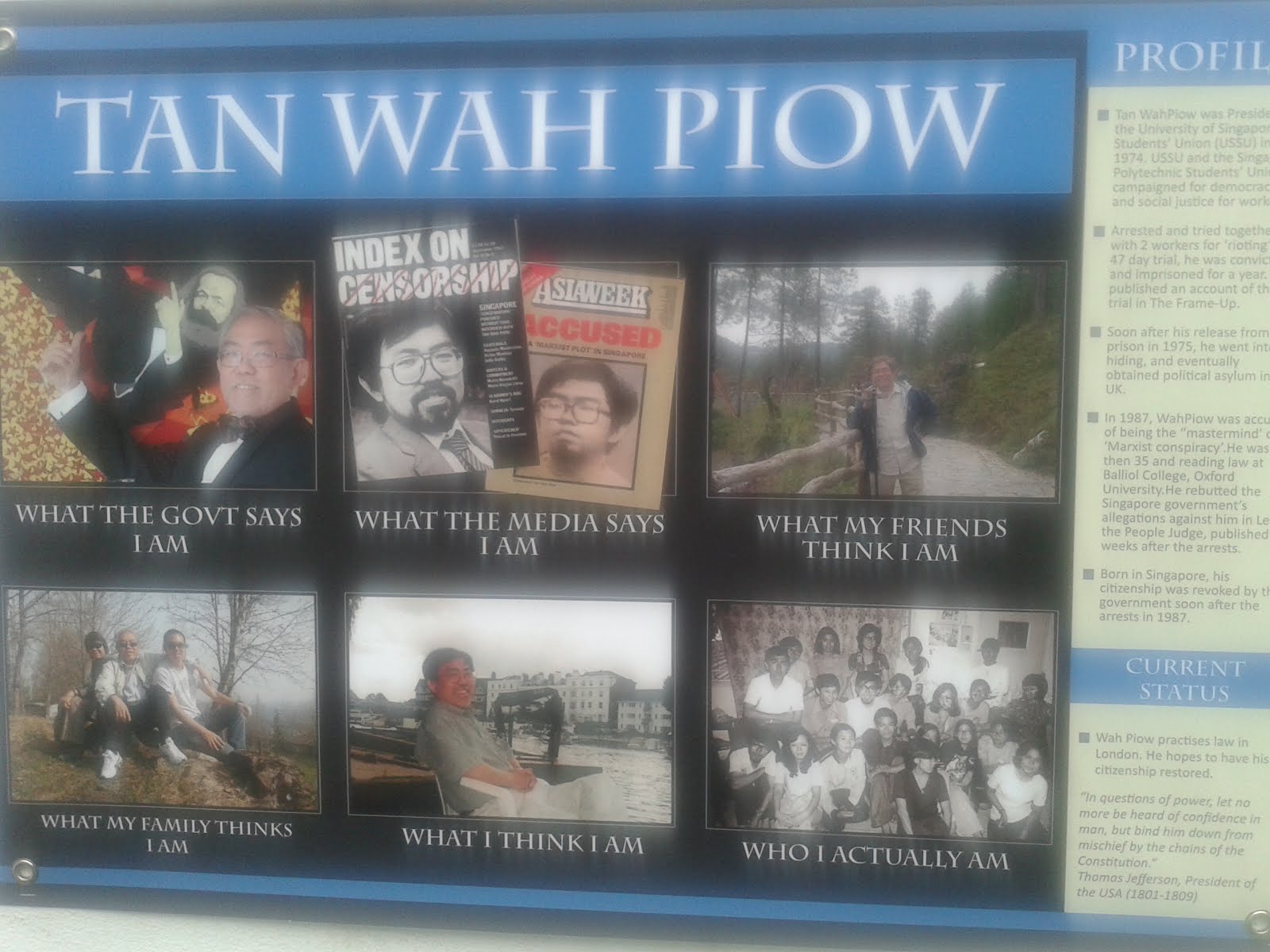


AS I arrived at the event rather late, I missed most of the speeches and was in time to listen to part of Vincent Wijeysinha's speech.

I support the call for the abolition of the Internal Security Act. However, I can't agree with his suggestion of replacing it with a specific act targeting terrorists and presumably therefore permitting some form of preventive detention. The issue that I have with any form of detention without trial is that it becomes a tool in the hands of politicans that tempts them to abuse power. Detention without trial would deprive the person of any opportunity to present his case to an independent judiciary. The very problem that arose with Operation Coldstore and Operation Spectrum would arise in the context of persons alleged to be terrorists.
Amongst many people that support the cause of the 1987 detainees, there are a significant proportion that are convinced of the guilt of the JI detainees and the guilt of Mas Selamat. But, how do we so confidently assert that these men are guilty? How do we presume for ourselves the right to deny these men a fair trial before an open court. Let the state produce the evidence against a person alleged to be a terrorist in a court of law and let the court find him guilty. If the state did not have such evidence in the first place, then is mere suspicion and conjecture permissible as the basis for the arrest and indefinite detention of individuals?
Anyone calling for the repeal of the ISA on a principled basis must not be calling for some sort of preventive detention law targetted at alleged terrorists. Let those terrorists be charged and convicted in a court of law for the offences that they have committed and the offences that they are conspiring to commit. We cannot, simply on the basis that we have a gut feeling that the 1987 detainees were do-gooders, engage in a form of exceptionalism for persons that we deem to be political detainees and persons that we deem to be terrorists. That's just another label. How arbitrary is that?


