For too long, too many Singaporeans have lived in fear of voting for the opposition. This is not the kind of fear that involves wondering if an opposition candidate can run a Town Council or if the opposition can form the government. This is the kind of fear that involves an irrational belief that one might lose his/her job or business deals, that one would not receive priority treatment in school admissions, licensing applications or any variety of activities that require government approval.
The reason why I am blogging about this now is that I just had a conversation with a person that openly stated that he is afraid to vote against the PAP. He is fearful that 'they' will find out and his rice bowl will be affected. After GE 2011, one would think that most Singaporeans would have risen above such fears. But, it looks like such fears still persist.
So, this is a public service announcement for all voters in Punggol East. Your vote is secret. They can't find out for whom you voted. Even if it is not secret, grow a spine! 803,482 of your countrymen have done just that in 2011. Voting against the PAP has not cost them anything. There are many civil servants amongst them that are openly vocal as well. Nothing has happened to them. Cast away your fear. Vote for more checks and balances. Vote for a healthy democracy. Vote wisely (without fear).
http://wp.sg/your-vote-is-secret/
http://maruah.org/2011/05/03/votewithoutfear/
Showing posts with label election. Show all posts
Showing posts with label election. Show all posts
Thursday, January 24, 2013


Wednesday, January 23, 2013
If I were a Punggol East resident...
Firstly, I am not a Punggol East resident. But, the dynamics of this by-election is quite different from the Hougang by-election and I was wondering how I would vote if I were a Punggol East resident.
I have voted in three general elections so far and each time my vote was an anti-PAP vote rather than a genuine vote for the opposition party itself. It is probably true to say that most Singaporean voters that vote for the opposition do so as a direct result of the need to keep the PAP's unbridled power under check.
Judging from the online discussions, it is clear that this by-election is turning out to be as much about a vote in favour of an opposition party as it is about a vote against the PAP. A developing issue of WP's performance in Parliament since the 2011 GE is capable of turning out to be the decider for some voters. The issues as raised during the hustings have focused on PAP's policies, WP's performance in Parliament and the question of what SDA and RP might bring to the table if elected.
PAP has clearly benefitted from this four-cornered fight as there has been (arguably) more discussion (amongst opposition supporters) about which opposition candidate to vote for rather than about the PAP's policies. There is a possibility that enough disarray has been created within the opposition ranks to secure a PAP win even if the PAP polls less than 50% of the votes.
If I were a Punggol East resident, I'd be worried about how my vote might affect the outcome. All Singaporeans have experienced the effect of vote splitting in the First Past the Post system. The Presidential Election in 2011 was a painful lesson for many of us. Clearly, in a two-horse race, the non-PAP endorsed candidate would have won. A resident in Punggol East voting for the opposition would be very wary about voting for either SDA or RP. In the 2011 GE, WP had already picked up a sizeable chunk of the opposition vote in that ward with SDA's candidate losing his deposit.
The only reason why a voter that voted for WP might vote otherwise in this by-election is because of the repeated noise in the mainstream media as well as online about the poor performance of WP in Parliament. Much has been made about how they backed away from issues and failed to be combative or to provide ideas and about the fact that they have not tabled any motions for debate and have been satisfied with tabling Parliamentary questions. (I have my reservations about some of the anti-WP rhetoric that is floating around on the net and although WP's performance can be improved, it is not as bad as it is made out to be.)
Some postings online (especially by individuals claiming to be Punggol East residents) seem to indicate that there's a possibility that SDA or RP would pick up some votes at the expense of the WP and also that there may be an increase in spoilt votes. An increase in spoilt votes is a distinct possibility. I was talking to a taxi driver yesterday and he was complaining about WP's performance and said that if he could vote, he would spoil his vote as a protest. I chided him for his attitude and gave him a lecture about the importance of the vote. We complain so much about the PAP. But, when it comes to exercising the right to vote, we cop out. That might have been just one taxi driver. But, I think that it is indicative of a certain disenchantment that some voters are feeling about the WP.
So, how would I vote? Gaining opposition seats in Parliament as quickly as possible is of paramount importance if we are to claw back the PAP's total grip on power. The magic number is 30 opposition seats to deprive PAP of its 2/3 majority. Realistically, this should be the short-term goal (to be achieved by next GE or the one after that). Every seat that is capable of turning opposition must be made to count. Punggol East was close in the last GE. PAP received 16,994. The combined opposition vote was 14,164. In terms of absolute numbers, that is a small difference to make up. If every opposition vote goes to the WP, there is a realistic chance of displacing the PAP.
Amongst the candidates fielded, I have to admit that Kenneth Jeyaratnam from the RP would be a very useful addition to Parliament. (I was initially upset to see a multi-cornered fight developing and like many Singaporeans I considered RP, SDA and SDP as spoilers before changing my view on that http://www.article14.blogspot.sg/2013/01/punggol-east-opposition-win.html) Given his background and with the budget debates coming up, one can expect some serious questions to be asked about our Executive's spending. Personally, I'd like to have someone with finance background from the opposition to be in Parliament. But, clearly, it is unlikely that RP would garner sufficient votes. (Sometimes I feel that KJ needs some PR guidance.) WP and PAP would be the frontrunners. So, as a natural progression in the first past the post system, there will be a tendency to vote tactically. That, in fact, is what I will do. http://www.youtube.com/watch?v=s7tWHJfhiyo
I'd go for WP, not because I am thoroughly convinced that their candidate is the best, but because they have the most realistic chance of winning the seat. Tactical voting. (In any event, they do have a down-to-earth, likeable candidate.)
In the end, if Punggol East were to turn against White, it would be because of a significant amount of tactical voting that turned the vote blue.
What do I expect to see on Saturday? There will be a swing against the PAP. The question is as to how much of a swing it would be. There might be an increase in the number of spoilt votes. Who's going to win? That is anybody's guess. But, I'd be rooting for the Hammer.

I have voted in three general elections so far and each time my vote was an anti-PAP vote rather than a genuine vote for the opposition party itself. It is probably true to say that most Singaporean voters that vote for the opposition do so as a direct result of the need to keep the PAP's unbridled power under check.
Judging from the online discussions, it is clear that this by-election is turning out to be as much about a vote in favour of an opposition party as it is about a vote against the PAP. A developing issue of WP's performance in Parliament since the 2011 GE is capable of turning out to be the decider for some voters. The issues as raised during the hustings have focused on PAP's policies, WP's performance in Parliament and the question of what SDA and RP might bring to the table if elected.
PAP has clearly benefitted from this four-cornered fight as there has been (arguably) more discussion (amongst opposition supporters) about which opposition candidate to vote for rather than about the PAP's policies. There is a possibility that enough disarray has been created within the opposition ranks to secure a PAP win even if the PAP polls less than 50% of the votes.
If I were a Punggol East resident, I'd be worried about how my vote might affect the outcome. All Singaporeans have experienced the effect of vote splitting in the First Past the Post system. The Presidential Election in 2011 was a painful lesson for many of us. Clearly, in a two-horse race, the non-PAP endorsed candidate would have won. A resident in Punggol East voting for the opposition would be very wary about voting for either SDA or RP. In the 2011 GE, WP had already picked up a sizeable chunk of the opposition vote in that ward with SDA's candidate losing his deposit.
The only reason why a voter that voted for WP might vote otherwise in this by-election is because of the repeated noise in the mainstream media as well as online about the poor performance of WP in Parliament. Much has been made about how they backed away from issues and failed to be combative or to provide ideas and about the fact that they have not tabled any motions for debate and have been satisfied with tabling Parliamentary questions. (I have my reservations about some of the anti-WP rhetoric that is floating around on the net and although WP's performance can be improved, it is not as bad as it is made out to be.)
Some postings online (especially by individuals claiming to be Punggol East residents) seem to indicate that there's a possibility that SDA or RP would pick up some votes at the expense of the WP and also that there may be an increase in spoilt votes. An increase in spoilt votes is a distinct possibility. I was talking to a taxi driver yesterday and he was complaining about WP's performance and said that if he could vote, he would spoil his vote as a protest. I chided him for his attitude and gave him a lecture about the importance of the vote. We complain so much about the PAP. But, when it comes to exercising the right to vote, we cop out. That might have been just one taxi driver. But, I think that it is indicative of a certain disenchantment that some voters are feeling about the WP.
So, how would I vote? Gaining opposition seats in Parliament as quickly as possible is of paramount importance if we are to claw back the PAP's total grip on power. The magic number is 30 opposition seats to deprive PAP of its 2/3 majority. Realistically, this should be the short-term goal (to be achieved by next GE or the one after that). Every seat that is capable of turning opposition must be made to count. Punggol East was close in the last GE. PAP received 16,994. The combined opposition vote was 14,164. In terms of absolute numbers, that is a small difference to make up. If every opposition vote goes to the WP, there is a realistic chance of displacing the PAP.
Amongst the candidates fielded, I have to admit that Kenneth Jeyaratnam from the RP would be a very useful addition to Parliament. (I was initially upset to see a multi-cornered fight developing and like many Singaporeans I considered RP, SDA and SDP as spoilers before changing my view on that http://www.article14.blogspot.sg/2013/01/punggol-east-opposition-win.html) Given his background and with the budget debates coming up, one can expect some serious questions to be asked about our Executive's spending. Personally, I'd like to have someone with finance background from the opposition to be in Parliament. But, clearly, it is unlikely that RP would garner sufficient votes. (Sometimes I feel that KJ needs some PR guidance.) WP and PAP would be the frontrunners. So, as a natural progression in the first past the post system, there will be a tendency to vote tactically. That, in fact, is what I will do. http://www.youtube.com/watch?v=s7tWHJfhiyo
I'd go for WP, not because I am thoroughly convinced that their candidate is the best, but because they have the most realistic chance of winning the seat. Tactical voting. (In any event, they do have a down-to-earth, likeable candidate.)
In the end, if Punggol East were to turn against White, it would be because of a significant amount of tactical voting that turned the vote blue.
What do I expect to see on Saturday? There will be a swing against the PAP. The question is as to how much of a swing it would be. There might be an increase in the number of spoilt votes. Who's going to win? That is anybody's guess. But, I'd be rooting for the Hammer.

Tuesday, January 15, 2013
A poll during the blackout period? What was ST thinking?
Fact: Straits Times published on 10 June 2013, the results of a poll it claimed to have conducted amongst Punggol East residents after the Writ of Election had been issued. The best part about it was that ST openly stated that the poll was 'after' the Writ of Election.
Fact: It is an offence under the Parliamentary Elections Act to publish the results of a survey during the 'blackout period' (from Writ of Election to polling day). The relevant statutory provision is:
78C. —(1) No person shall publish or permit or cause to be published the results of any election survey during the period beginning with the day the writ of election is issued for an election and ending with the close of all polling stations on polling day at the election.
(3) In this section, “election survey” means an opinion survey of how electors will vote at an election or of the preferences of electors respecting any candidate or group of candidates or any political party or issue with which an identifiable candidate or group of candidates is associated at an election.
Having been exposed by some netizens, the ST's article is now being investigated by the police. Today ran an article on 13 Jan 2013: http://www.todayonline.com/Singapore/EDC130113-0000046/Police-looking-into-ST-publication-of-by-election-poll. Warren Fernandez's response is classic:
In response to TODAY, Editor of The Straits Times Warren Fernandez said: "Our reporters spoke with residents in Punggol East to get their comments and a sense of the ground for our election reports. This was not a full-scale survey, or scientific poll, by any means.
"The headline for our story overstated the significance of the information gathered by calling it a poll. We are sorry for this lapse. We will, of course, co-operate with the Police for any investigation," he said.
The editor of ST has inspired me to come up with some pseudo-reasons for not prosecuting ST. By the way, if you think any of this sounds impossible, you haven't come across the case of the parachuting candidates.
Argument No. 1
The Parliamentary Elections Act deals with election offences committed by individuals and not corporations. Though ordinarily the word 'person' is often associated in other areas of the law with both 'legal persons' (e.g. companies) as well as 'natural persons' (you and I), it is specifically a reference to 'natural persons' for the purpose of electoral law.
SPH is a company. It is not a natural person. The offence refers a 'person' that publishes election surveys. SPH published the survey. But, SPH is not a 'person' for the purposes of the Act.
It is not an offence to conduct a survey. The reporters conducted the survey. Publishing is an offence. Conducting the survey is not.
Causing or permitting the publication of an election survey is an offence. Arguably, Mr Warren Fernandez could be stated to have caused or permitted the publication. But, at all material times, Mr Fernandez was acting in his capacity as the servant or agent of SPH. Any act of 'causing' or 'permiting' was done by Fernandez as agent of the principal, SPH. The causing & permitting was by SPH. SPH is a company and therefore a legal person as opposed to a natural person. Therefore, SPH cannot be charged as reasoned out earlier.
The reporters did not commit any offence. Mr Fernandez did not commit any offence. SPH did not commit offence.
Alternatively Argument No. 2
SPH published the results of a poll. It did not publish the results of a survey. 'Election survey' is referred to in the statute as an 'opinion survey of how electors would vote'. According to the freeonline dictionary a 'survey' is a 'detailed inspection or investigation'.
SPH did not carry out a detailed inspection or investigation. It did a straw poll in a haphazzard manner. A survey is not a poll. It is not an offence to publish the results of a poll. It is only an offence to publish the results of a survey. Since what was done was not a survey, the publication of the information stated in the ST article was not an offence.
Alternatively Argument No. 3
SPH lied. A survey was conducted. It didn't suit SPH to publish the results of the survey. So, SPH published 'fake' results of the survey. It is true that SPH published the results of a supposed survey. . But, SPH did not publish the results of the actual survey that had been conducted. In order for an offence to be committed, the results published must be accurate results. Otherwise, they do not qualify as results of a survey.
Alternatively Argument No. 4
SPH lied. No survey was conducted. If no survey was conducted, no results could be published. The publication of results of a fake survey is not an offence. It is a lie but since when is lying an offence? In fact, since SPH's detractors are so into free speech, lying is a form of free speech. Check out this American case and you will realise that we are not wrong: http://www.projectcensored.org/top-stories/articles/11-the-media-can-legally-lie/
Alternatively Argument No. 5
It was an honest mistake. We are sorry. Let's move on.
(Note: Nothing referred to herein by way of an argument or the suggestion of an argument is to be construed as being logically and/or legally tenable.)
Fact: It is an offence under the Parliamentary Elections Act to publish the results of a survey during the 'blackout period' (from Writ of Election to polling day). The relevant statutory provision is:
78C. —(1) No person shall publish or permit or cause to be published the results of any election survey during the period beginning with the day the writ of election is issued for an election and ending with the close of all polling stations on polling day at the election.
(3) In this section, “election survey” means an opinion survey of how electors will vote at an election or of the preferences of electors respecting any candidate or group of candidates or any political party or issue with which an identifiable candidate or group of candidates is associated at an election.
Having been exposed by some netizens, the ST's article is now being investigated by the police. Today ran an article on 13 Jan 2013: http://www.todayonline.com/Singapore/EDC130113-0000046/Police-looking-into-ST-publication-of-by-election-poll. Warren Fernandez's response is classic:
In response to TODAY, Editor of The Straits Times Warren Fernandez said: "Our reporters spoke with residents in Punggol East to get their comments and a sense of the ground for our election reports. This was not a full-scale survey, or scientific poll, by any means.
"The headline for our story overstated the significance of the information gathered by calling it a poll. We are sorry for this lapse. We will, of course, co-operate with the Police for any investigation," he said.
The editor of ST has inspired me to come up with some pseudo-reasons for not prosecuting ST. By the way, if you think any of this sounds impossible, you haven't come across the case of the parachuting candidates.
Argument No. 1
The Parliamentary Elections Act deals with election offences committed by individuals and not corporations. Though ordinarily the word 'person' is often associated in other areas of the law with both 'legal persons' (e.g. companies) as well as 'natural persons' (you and I), it is specifically a reference to 'natural persons' for the purpose of electoral law.
SPH is a company. It is not a natural person. The offence refers a 'person' that publishes election surveys. SPH published the survey. But, SPH is not a 'person' for the purposes of the Act.
It is not an offence to conduct a survey. The reporters conducted the survey. Publishing is an offence. Conducting the survey is not.
Causing or permitting the publication of an election survey is an offence. Arguably, Mr Warren Fernandez could be stated to have caused or permitted the publication. But, at all material times, Mr Fernandez was acting in his capacity as the servant or agent of SPH. Any act of 'causing' or 'permiting' was done by Fernandez as agent of the principal, SPH. The causing & permitting was by SPH. SPH is a company and therefore a legal person as opposed to a natural person. Therefore, SPH cannot be charged as reasoned out earlier.
The reporters did not commit any offence. Mr Fernandez did not commit any offence. SPH did not commit offence.
Alternatively Argument No. 2
SPH published the results of a poll. It did not publish the results of a survey. 'Election survey' is referred to in the statute as an 'opinion survey of how electors would vote'. According to the freeonline dictionary a 'survey' is a 'detailed inspection or investigation'.
SPH did not carry out a detailed inspection or investigation. It did a straw poll in a haphazzard manner. A survey is not a poll. It is not an offence to publish the results of a poll. It is only an offence to publish the results of a survey. Since what was done was not a survey, the publication of the information stated in the ST article was not an offence.
Alternatively Argument No. 3
SPH lied. A survey was conducted. It didn't suit SPH to publish the results of the survey. So, SPH published 'fake' results of the survey. It is true that SPH published the results of a supposed survey. . But, SPH did not publish the results of the actual survey that had been conducted. In order for an offence to be committed, the results published must be accurate results. Otherwise, they do not qualify as results of a survey.
Alternatively Argument No. 4
SPH lied. No survey was conducted. If no survey was conducted, no results could be published. The publication of results of a fake survey is not an offence. It is a lie but since when is lying an offence? In fact, since SPH's detractors are so into free speech, lying is a form of free speech. Check out this American case and you will realise that we are not wrong: http://www.projectcensored.org/top-stories/articles/11-the-media-can-legally-lie/
Alternatively Argument No. 5
It was an honest mistake. We are sorry. Let's move on.
(Note: Nothing referred to herein by way of an argument or the suggestion of an argument is to be construed as being logically and/or legally tenable.)
Thursday, January 10, 2013
Punggol East: An opposition win?
Let me first declare that I am a Son of Bukit Ho Swee (or maybe Son of Kandang Kerbau), whatever relevance that might have to my credibility, credentials or character. http://www.todayonline.com/Hotnews/EDC130110-0000082/PAP-unveils-son-of-Punggol-Koh-as-Punggol-East-by-election-candidate
The Prime Minister has decided to call for a by-election at Punggol East and I think instead of criticising him, we should all welcome this move. Given the fact that in the Mdm Vellamma case (Hougang by-election) the High Court has ruled that it is the PM's absolute discretion to decide on whether to call for a by-election, it is heartening that the PM is exercising his discretion in a fair manner by calling for a by-election early on. (I disagree with the legal reasoning in the Hougang by-election case. My analysis is set out here: http://www.article14.blogspot.sg/2012/12/the-hougang-by-election-case-belated.html)
I have read some nasty comments online about how this decision by the PM is a sudden move. So what if it is sudden? It would have been sudden anyway if it happened after Chinese New Year or after the budget debate or for that matter if it happened later in the year. In fact, the earlier that the vacancy is filled, the better. I am glad that it only took the PM 3 weeks to make a decisive move on this one.
So, whilst we are quick to criticise when there is a flaw, let's be quick to give the man a pat on the back when he does the right thing.
WHAT ARE THE CHANCES OF AN OPPOSITION WIN IN PUNGGOL EAST?
On the assumption that it is a straight fight between PAP and WP.
The first observation that must be made is that if this was a General Election, there would be very little movement of votes away from the PAP to the WP. A 5% swing in less than 2 years would be difficult to accomplish. One could safely bet that Punggol East would remain with the PAP.
This is a by-election and we have to consider one important factor that often influences a not-too-insignificant proportion of the Singaporean electorate. Nationwide, I would guess that about 20% to 25% of voters belong to a category that is unhappy with the current government's policies and yet wouldn't want the PAP government to be replaced. Note that in the Presidential Election (PE) in 2011 barely a few months after the General Elections (GE), only 35% voted for the PAP 'endorsed' candidate. 25% of the electorate had switched from voting for PAP in the GE to voting for an alternative candidate in the PE. Given the fact that the issue of whether the PAP would form the government was not at stake, many voters chose an alternative candidate in the PE.
Would the entire 25% be a potential vote bank for the opposition parties? I don't think so. During the PE, one attraction away from the PAP endorsed candidate was the existence of an ex-PAP MP (a highly likeable doctor and one that has the reputation of playing the role of an opposing voice within the ruling party) in the form of Dr Tan Cheng Bock. I do not think that all of the 25% would have been persuaded by an outright opposition candidate. Perhaps, we could take it that between a third to half of these voters would be open to voting for a credible opposition candidate if they were sure that PAP's rule was not going to be terminated.
These voters would be prepared to vote in an opposition candidate to voice their concerns without the potential 'threat' that PAP would go out of power. This is the potential voter base that can be persuaded to vote for the opposition in a by-election. By working on the assumption that the nationwide voter behaviour is more or less similar, we can conservatively estimate this category of voters to be about 10% in Punggol East (making allowance for potential variation from the norm in that ward.) There is, to my mind, a realistic possibility of a more than 5% swing against the PAP. If the issues are pitched in the right way and if recent failures are highlighted appropriately and frequently, there are enough votes up for grabs in Punggol East to turn the seat 'blue'.
In a previous blog post, I estimated a vote swing of about 2% to 3% without factoring in the by-election effect. I am revising this now after taking into account the above factors. http://article14.blogspot.sg/2012/12/by-election-in-punggol-east.html
On the assumption that it is a multi-cornered fight
There will be an inevitable split of the opposition vote. Voters do not disuss amongst themselves, collaborate or guide each other in voting. Whatever opposition votes that may be up for grabs would inevitably be split. This is where the PAP probably stands to gain.
Firstly, opposition disunity may put off some of the potentially persuadable voters. If we work on the assumption of 10% being persuadable, there is bound to be a significant proportion of those voters being put off by a multi-cornered battle in the constituency. On the assumption that half of them swing over to the opposition, it is still difficult to predict whether they would all head in the direction of the same opposition party.
The two strongest contenders would be WP and SDP. Each have their relative merits and, of course, much will depend on the candidates that they field. (WP has arguably a better branding and SDP has more charismatic and vocal candidates.) Out of a potential 51% that might vote for the opposition in the by-election, there is bound to be a split in the votes. That would hand the seat back to the PAP. If there is an overall swing of 10% to the opposition, a split in the opposition vote may narrowly hand the seat to an opposition candidate. This candidate is more likely to be the WP candidate. The result could be 46% for WP, 9% for SDP (and others) and 45% for PAP.
A three-conered or multi-cornered fight could theoretically end in a WP victory. Considering the way that most people seem to think, there seems to be an entitlement mentality about contesting this by-election. Many people seem to think of Punggol East as WP turf. I wouldn't be surprised (given the impossibility of collusion) voters planning to vote for the opposition would err on the side of caution and vote for the WP. In fact, the other opposition parties might not even garner more than 2% to 3% of the vote. Against this logic, the only reason why an opposition voter in Punggol East would vote for a non-WP candidate would be because the alternative candidate is a charismatic individual holding the promise of being a genuine vocal element in Parliament (e.g. Vincent Wijeysingha).
It is quite probable that between WP's strong branding and SDP's potentially charismatic candidate, the votes could be split in such a way that the PAP still wins the seat with about 45% of the votes.
My preference
Personally, I'd like to see another seat fall into the hands of the opposition. By-elections represent the golden opportunity to reduce PAP's almost total dominance of Parliament. My knee-jerk reaction to the possibility of a by-election in Punggol was to feel that the opposition should cooperate to ensure a straight fight instead of a multi-cornered fight. Like many, I too felt instinctively that the other opposition parties should yield to the WP as they contested Punggol East in the GE.
But, the more I think about it, the more i realise that there is no inherent logic behind the argument that somehow that constituency has become WP's turf. Ideally, the opposition parties should come to an agreement as to the fielding of a single opposition candidate. This candidate should be one that is intelligent, articulate and passionate. This candidate should be one that is vocal enough to ask the tough questions.
If the ideal situation cannot be accomplished, then there is no real loss in a multi-cornered fight. Perhaps, this is the best opportunity that we have for a free contest of ideas to be staged for voters and for opposition parties to test the level of support that they have in such a multi-cornered fight. We are transitioning from a one-party state. WP has managed to build itself into the largest opposition party. SDP is arguably a close competitor even though it does not hold on to any Parliamentary seat. It is clear that SDP attracts a particular type of audience. WP is seen in some circles as PAP-lite. The other politcal parties may take offence at the fact that I have not even mentioned them. But, let's be realistic about the perception at the national level. It is SDP and WP that have a realistic chance of picking up the larger share of opposition votes.
In a multi-cornered fight that eventually delivers the seat to the PAP, there is nothing that would be lost. Many lessons could be learned about voter preferences. So, if there is going to be a multi-cornered fight in Punggol East, I'd say, "Bring it on!"
(I wouldn't be surprised if part of the PM's calculation in terms of the timing of the by-election would have involved the fact that very little time should be given to the opposition parties to work out a deal. By announcing the by-election within 3 weeks of the vacancy of the seat, he has caught the opposition flat-footed. If the by-election were to be called after the Budget, the opposition parties would have had enough time to do their posturing and walkabouts and eventually work out some kind of collaboration. With the 16th of Jan being Nomination Day, any likelihood of an opposition agreement to ensure a straight fight is remote.)
The Prime Minister has decided to call for a by-election at Punggol East and I think instead of criticising him, we should all welcome this move. Given the fact that in the Mdm Vellamma case (Hougang by-election) the High Court has ruled that it is the PM's absolute discretion to decide on whether to call for a by-election, it is heartening that the PM is exercising his discretion in a fair manner by calling for a by-election early on. (I disagree with the legal reasoning in the Hougang by-election case. My analysis is set out here: http://www.article14.blogspot.sg/2012/12/the-hougang-by-election-case-belated.html)
I have read some nasty comments online about how this decision by the PM is a sudden move. So what if it is sudden? It would have been sudden anyway if it happened after Chinese New Year or after the budget debate or for that matter if it happened later in the year. In fact, the earlier that the vacancy is filled, the better. I am glad that it only took the PM 3 weeks to make a decisive move on this one.
So, whilst we are quick to criticise when there is a flaw, let's be quick to give the man a pat on the back when he does the right thing.
WHAT ARE THE CHANCES OF AN OPPOSITION WIN IN PUNGGOL EAST?
On the assumption that it is a straight fight between PAP and WP.
The first observation that must be made is that if this was a General Election, there would be very little movement of votes away from the PAP to the WP. A 5% swing in less than 2 years would be difficult to accomplish. One could safely bet that Punggol East would remain with the PAP.
This is a by-election and we have to consider one important factor that often influences a not-too-insignificant proportion of the Singaporean electorate. Nationwide, I would guess that about 20% to 25% of voters belong to a category that is unhappy with the current government's policies and yet wouldn't want the PAP government to be replaced. Note that in the Presidential Election (PE) in 2011 barely a few months after the General Elections (GE), only 35% voted for the PAP 'endorsed' candidate. 25% of the electorate had switched from voting for PAP in the GE to voting for an alternative candidate in the PE. Given the fact that the issue of whether the PAP would form the government was not at stake, many voters chose an alternative candidate in the PE.
Would the entire 25% be a potential vote bank for the opposition parties? I don't think so. During the PE, one attraction away from the PAP endorsed candidate was the existence of an ex-PAP MP (a highly likeable doctor and one that has the reputation of playing the role of an opposing voice within the ruling party) in the form of Dr Tan Cheng Bock. I do not think that all of the 25% would have been persuaded by an outright opposition candidate. Perhaps, we could take it that between a third to half of these voters would be open to voting for a credible opposition candidate if they were sure that PAP's rule was not going to be terminated.
These voters would be prepared to vote in an opposition candidate to voice their concerns without the potential 'threat' that PAP would go out of power. This is the potential voter base that can be persuaded to vote for the opposition in a by-election. By working on the assumption that the nationwide voter behaviour is more or less similar, we can conservatively estimate this category of voters to be about 10% in Punggol East (making allowance for potential variation from the norm in that ward.) There is, to my mind, a realistic possibility of a more than 5% swing against the PAP. If the issues are pitched in the right way and if recent failures are highlighted appropriately and frequently, there are enough votes up for grabs in Punggol East to turn the seat 'blue'.
In a previous blog post, I estimated a vote swing of about 2% to 3% without factoring in the by-election effect. I am revising this now after taking into account the above factors. http://article14.blogspot.sg/2012/12/by-election-in-punggol-east.html
On the assumption that it is a multi-cornered fight
There will be an inevitable split of the opposition vote. Voters do not disuss amongst themselves, collaborate or guide each other in voting. Whatever opposition votes that may be up for grabs would inevitably be split. This is where the PAP probably stands to gain.
Firstly, opposition disunity may put off some of the potentially persuadable voters. If we work on the assumption of 10% being persuadable, there is bound to be a significant proportion of those voters being put off by a multi-cornered battle in the constituency. On the assumption that half of them swing over to the opposition, it is still difficult to predict whether they would all head in the direction of the same opposition party.
The two strongest contenders would be WP and SDP. Each have their relative merits and, of course, much will depend on the candidates that they field. (WP has arguably a better branding and SDP has more charismatic and vocal candidates.) Out of a potential 51% that might vote for the opposition in the by-election, there is bound to be a split in the votes. That would hand the seat back to the PAP. If there is an overall swing of 10% to the opposition, a split in the opposition vote may narrowly hand the seat to an opposition candidate. This candidate is more likely to be the WP candidate. The result could be 46% for WP, 9% for SDP (and others) and 45% for PAP.
A three-conered or multi-cornered fight could theoretically end in a WP victory. Considering the way that most people seem to think, there seems to be an entitlement mentality about contesting this by-election. Many people seem to think of Punggol East as WP turf. I wouldn't be surprised (given the impossibility of collusion) voters planning to vote for the opposition would err on the side of caution and vote for the WP. In fact, the other opposition parties might not even garner more than 2% to 3% of the vote. Against this logic, the only reason why an opposition voter in Punggol East would vote for a non-WP candidate would be because the alternative candidate is a charismatic individual holding the promise of being a genuine vocal element in Parliament (e.g. Vincent Wijeysingha).
It is quite probable that between WP's strong branding and SDP's potentially charismatic candidate, the votes could be split in such a way that the PAP still wins the seat with about 45% of the votes.
My preference
Personally, I'd like to see another seat fall into the hands of the opposition. By-elections represent the golden opportunity to reduce PAP's almost total dominance of Parliament. My knee-jerk reaction to the possibility of a by-election in Punggol was to feel that the opposition should cooperate to ensure a straight fight instead of a multi-cornered fight. Like many, I too felt instinctively that the other opposition parties should yield to the WP as they contested Punggol East in the GE.
But, the more I think about it, the more i realise that there is no inherent logic behind the argument that somehow that constituency has become WP's turf. Ideally, the opposition parties should come to an agreement as to the fielding of a single opposition candidate. This candidate should be one that is intelligent, articulate and passionate. This candidate should be one that is vocal enough to ask the tough questions.
If the ideal situation cannot be accomplished, then there is no real loss in a multi-cornered fight. Perhaps, this is the best opportunity that we have for a free contest of ideas to be staged for voters and for opposition parties to test the level of support that they have in such a multi-cornered fight. We are transitioning from a one-party state. WP has managed to build itself into the largest opposition party. SDP is arguably a close competitor even though it does not hold on to any Parliamentary seat. It is clear that SDP attracts a particular type of audience. WP is seen in some circles as PAP-lite. The other politcal parties may take offence at the fact that I have not even mentioned them. But, let's be realistic about the perception at the national level. It is SDP and WP that have a realistic chance of picking up the larger share of opposition votes.
In a multi-cornered fight that eventually delivers the seat to the PAP, there is nothing that would be lost. Many lessons could be learned about voter preferences. So, if there is going to be a multi-cornered fight in Punggol East, I'd say, "Bring it on!"
(I wouldn't be surprised if part of the PM's calculation in terms of the timing of the by-election would have involved the fact that very little time should be given to the opposition parties to work out a deal. By announcing the by-election within 3 weeks of the vacancy of the seat, he has caught the opposition flat-footed. If the by-election were to be called after the Budget, the opposition parties would have had enough time to do their posturing and walkabouts and eventually work out some kind of collaboration. With the 16th of Jan being Nomination Day, any likelihood of an opposition agreement to ensure a straight fight is remote.)
Friday, May 25, 2012
This is Hougang
I am a Liverpool fan. There is a famous sign at Liverpool's stadium that reads: "This is Anfield". It is awe-inspiring for every football player that has worn that famous red jersey and for every fan around the world that has seen that sign. In the days when Liverpool dominated the league, piling up victory after victory, "This is Anfield" was an intimidating statement to be confronted with as opposing teams entered the couldron.
Our politicians are fond of footballing analogies. This is my footballing analogy:
THIS IS HOUGANG!

When it comes to election statistics, the national norm does not apply to Hougang. When it comes to voter behaviour, the national norm does not apply to Hougang. When it comes to standing up to intimidation, the national norm does not apply to Hougang. There is something strong, resilient and courageous about the people of Hougang. I know a few Hougang residents personally. The ones that I know have been voting for the Workers' Party repeatedly. Why did these friends vote for WP? Check and balance in Parliament! That is the answer. What is particularly sophisticated about this way of voting is that these friends did not consider their local municipal issues as the key determinant for voting during a Parliamentary election. They understand that essentially in our system of democracy, we are voting for representatives in Parliament so that if there is a sufficient majority, that party could form the government and if not, those representatives could act as an effective check and balance. These friends are fully aware that the PAP's parliamentary majority is not under any threat. These friends are also uncomfortable with the size of the PAP's Parliamentary majority where Constitutional amendments can be pushed through. For these friends of mine, a strong opposition presence in Parliament of between 20 to 30 members would serve as a way to push the PAP to implement more people friendly policies and to monitor the way that the government functions.
So, what do they think about upgrading and other bullying tactics? It doesn't figure in their voting. In fact, I suspect that it enrages them and entrenches the WP vote.
As I observed the campaign by the two sides during this by-election, I can't help but realise that the PAP has lost the plot when it comes to the 'new normal'. Here was a perfect opportunity to show everyone that they have emerged from GE 2011 wiser and are now willing to go down the road of clean politics. But, this has become an opportunity squandered with them attempting to make an issue out of Yaw Shin Leong's selection and then making an issue out of Png Eng Huat's non-selection for the NCMP position in the last GE. What we saw was the same old tactics. I doubt that the campaign approach is going to go down well with Hougang voters.
What do I think will be the outcome of this by-election? WP will win, of course. I am sure that if this was open for a bet, even the PAP leaders would bet on a WP win. What would be interesting is the % of the win. How wide a margin would the WP get? Would they lose some ground? Would they gain more?
Firstly, I always assume a core group of PAP supporters and opposition supporters exist in every constituency. These voters would not change their vote. Yaw-gate and NCMP-gate will not move the strong WP supporter in Hougang to vote for the PAP. PAP's bullying and dirty campaign tactics will not move the hardcore PAP suporter into feeling disgusted and voting for the WP.
So, it is the middle ground that we are looking at.
I also suspect that most of the middle ground had already voted for WP in GE 2011. The PAP's 35% in Hougang (during GE 2011) represents the hardcore PAP support that exists throughout the country. (I use the Dr Tony Tan voters during the PResidential election as a gauge of the 'PAP-whatever-the-situation' vote in Singapore.)
In GE 2011, WP was scraping the bottom of the barrel in terms of middle ground voters. It will be an uphill task to convert more of them, unless new voters added onto the register this year turn overwhelmingly towards the WP. Even then, it would be a small number. Maybe, we might tweak the national average a little bit since this is Hougang. So, instead of a hardcore 35% PAP supporters, we might assume that there is a 30% hardcore support for PAP in Hougang. If that is the case, there may be some votes to be scraped away from the PAP by the WP.
The probability of an increase in WP's percentage is very low. On the other hand, there is a reasonably high probability of WP's vote share going down. Any shift downwards would be by 1% to 3%. Any shift upwards would be 1% at the most. Anyone seeking to get the impact of a referrendum out of this by-election would be severely disappointed. The way that the campaign has been reported in the media and the way the online media has focused attention on 'NCMP-gate', the more important national issues have not been given any prominence and I am pretty certain that this is not going to turn out to be a referendum on the policies of the PAP over the last year.
WP was attempting to make this into an election about national issues at its rallies. Personally, I felt at the outset that in a small country like ours, the national and the local gets merged together inextricably. But, the loudest news filtering through the media is about Png Eng Huat's selection (or non-selection for the NCMP post). (And inexplicably the loudest 'political' social media shared event today is the XiaXue fight back against some pretty nasty comments by Facebookers.) The middle ground voters in Hougang may be swayed against Png Eng Huat. But, this is bound to be marginal.
Whatever the outcome, Hougang will remain with the WP. Hougang residents will continue to shout out loud and proud:
THIS IS HOUGANG!

UPDATE:
In GE 2011, the voter turnout was 23,176 out of 24,560 eligible voters. 1,384 did not turn up for voting. WP had 14850 votes (64.8% of valid votes) and PAP had 8065 votes (35.2% of valid votes). 261 spoilt votes.
Based on a Channelnewsasia report today, there are 23,368 eligible voters. Those 1,384 that did not vote would have been removed from the electoral register. New voters added onto the register would therefore be: 23,368 - 23,176 = 192 (bearing in mind that a small segment of the 192 would be those that got themselves reinstated in the register)
If everyone voted without changing their votes and if WP picked up all 192 of the new votes, the result would be 15,042 for WP and 8065 for PAP. That would be 65.1% for WP and 34.9% for PAP.
Similarly, if PAP picks up all the 192 votes, the result would be 14,850 for WP and 8,257 for PAP. That would be 64.2% for WP and 35.8% for PAP.
Our politicians are fond of footballing analogies. This is my footballing analogy:
THIS IS HOUGANG!

When it comes to election statistics, the national norm does not apply to Hougang. When it comes to voter behaviour, the national norm does not apply to Hougang. When it comes to standing up to intimidation, the national norm does not apply to Hougang. There is something strong, resilient and courageous about the people of Hougang. I know a few Hougang residents personally. The ones that I know have been voting for the Workers' Party repeatedly. Why did these friends vote for WP? Check and balance in Parliament! That is the answer. What is particularly sophisticated about this way of voting is that these friends did not consider their local municipal issues as the key determinant for voting during a Parliamentary election. They understand that essentially in our system of democracy, we are voting for representatives in Parliament so that if there is a sufficient majority, that party could form the government and if not, those representatives could act as an effective check and balance. These friends are fully aware that the PAP's parliamentary majority is not under any threat. These friends are also uncomfortable with the size of the PAP's Parliamentary majority where Constitutional amendments can be pushed through. For these friends of mine, a strong opposition presence in Parliament of between 20 to 30 members would serve as a way to push the PAP to implement more people friendly policies and to monitor the way that the government functions.
So, what do they think about upgrading and other bullying tactics? It doesn't figure in their voting. In fact, I suspect that it enrages them and entrenches the WP vote.
As I observed the campaign by the two sides during this by-election, I can't help but realise that the PAP has lost the plot when it comes to the 'new normal'. Here was a perfect opportunity to show everyone that they have emerged from GE 2011 wiser and are now willing to go down the road of clean politics. But, this has become an opportunity squandered with them attempting to make an issue out of Yaw Shin Leong's selection and then making an issue out of Png Eng Huat's non-selection for the NCMP position in the last GE. What we saw was the same old tactics. I doubt that the campaign approach is going to go down well with Hougang voters.
What do I think will be the outcome of this by-election? WP will win, of course. I am sure that if this was open for a bet, even the PAP leaders would bet on a WP win. What would be interesting is the % of the win. How wide a margin would the WP get? Would they lose some ground? Would they gain more?
Firstly, I always assume a core group of PAP supporters and opposition supporters exist in every constituency. These voters would not change their vote. Yaw-gate and NCMP-gate will not move the strong WP supporter in Hougang to vote for the PAP. PAP's bullying and dirty campaign tactics will not move the hardcore PAP suporter into feeling disgusted and voting for the WP.
So, it is the middle ground that we are looking at.
I also suspect that most of the middle ground had already voted for WP in GE 2011. The PAP's 35% in Hougang (during GE 2011) represents the hardcore PAP support that exists throughout the country. (I use the Dr Tony Tan voters during the PResidential election as a gauge of the 'PAP-whatever-the-situation' vote in Singapore.)
In GE 2011, WP was scraping the bottom of the barrel in terms of middle ground voters. It will be an uphill task to convert more of them, unless new voters added onto the register this year turn overwhelmingly towards the WP. Even then, it would be a small number. Maybe, we might tweak the national average a little bit since this is Hougang. So, instead of a hardcore 35% PAP supporters, we might assume that there is a 30% hardcore support for PAP in Hougang. If that is the case, there may be some votes to be scraped away from the PAP by the WP.
The probability of an increase in WP's percentage is very low. On the other hand, there is a reasonably high probability of WP's vote share going down. Any shift downwards would be by 1% to 3%. Any shift upwards would be 1% at the most. Anyone seeking to get the impact of a referrendum out of this by-election would be severely disappointed. The way that the campaign has been reported in the media and the way the online media has focused attention on 'NCMP-gate', the more important national issues have not been given any prominence and I am pretty certain that this is not going to turn out to be a referendum on the policies of the PAP over the last year.
WP was attempting to make this into an election about national issues at its rallies. Personally, I felt at the outset that in a small country like ours, the national and the local gets merged together inextricably. But, the loudest news filtering through the media is about Png Eng Huat's selection (or non-selection for the NCMP post). (And inexplicably the loudest 'political' social media shared event today is the XiaXue fight back against some pretty nasty comments by Facebookers.) The middle ground voters in Hougang may be swayed against Png Eng Huat. But, this is bound to be marginal.
Whatever the outcome, Hougang will remain with the WP. Hougang residents will continue to shout out loud and proud:
THIS IS HOUGANG!

UPDATE:
In GE 2011, the voter turnout was 23,176 out of 24,560 eligible voters. 1,384 did not turn up for voting. WP had 14850 votes (64.8% of valid votes) and PAP had 8065 votes (35.2% of valid votes). 261 spoilt votes.
Based on a Channelnewsasia report today, there are 23,368 eligible voters. Those 1,384 that did not vote would have been removed from the electoral register. New voters added onto the register would therefore be: 23,368 - 23,176 = 192 (bearing in mind that a small segment of the 192 would be those that got themselves reinstated in the register)
If everyone voted without changing their votes and if WP picked up all 192 of the new votes, the result would be 15,042 for WP and 8065 for PAP. That would be 65.1% for WP and 34.9% for PAP.
Similarly, if PAP picks up all the 192 votes, the result would be 14,850 for WP and 8,257 for PAP. That would be 64.2% for WP and 35.8% for PAP.
Monday, May 21, 2012
Any food, drinks or vouchers at the by-election rallies?

I am just wondering out aloud... Did either the WP or PAP rally involve any supply of free food, drinks, vouchers or other gifts?
Political parties should be aware that treating is an offence under the Parliamentary Elections Act.
58. —(1) A person shall be guilty of treating if he corruptly, by himself or by any other person, either before, during or after an election, directly or indirectly gives or provides, or pays wholly or in part the expense of giving, any meat, drink, refreshment, cigarette, entertainment or other provision or thing or any money or ticket or other means or device to enable the procuring of any such meat, drink, refreshment, cigarette, entertainment or other provision or thing, to or for any person —
(a) for the purpose of corruptly influencing that person or any other person to vote or refrain from voting;
(b) for the purpose of inducing that person to attend or remain at any election meeting;
(c) on account of any such person or any other person having voted or refrained from voting or being about to vote or refrain from voting at the election; or
(d) on account of any such person having attended an election meeting.
(2) A person shall also be guilty of treating if he corruptly accepts or takes any such meat, drink, refreshment, cigarette, entertainment or other provision or thing or any such money or ticket or who adopts any other means or device to enable the procuring of such meat, drink, refreshment, cigarette, entertainment or other provision or thing
It is clear that treating for the purpose inducing persons to attend a rally or to remain at the rally is an offence. So, has anyone attended these rallies? Do you have knowledge of infringement of this law?
Monday, May 14, 2012
Did Subhas Anandan really say that?
It was reported in Temasek Times that Subhas Anandan has made an offer of setting up a Legal Bureau at the Hougang Community Club if the PAP candidate wins the Hougang by-election. ( http://temasektimes.wordpress.com/2012/05/11/subhas-anandan-to-offer-free-legal-aid-to-hougang-residents-if-desmond-choo-is-elected/ )
It appears that this information has been taken from a Chinese newspaper. I do not know Mandarin. But, I am given to understand that the article does not actually say that Subhas Anandan will set up a Legal Bureau at Hougang if Desmond Choo wins the by-election.
In fact, I should add that it would be shocking if Subhas Anandan actually made such an assertion as it could run counter to the Parliamentary Elections Act (Cap 218):
Temasek Times ought to have been more careful in reporting the statement considering that it translates into a potential election offence. As we hurtle towards the new reality that more and more people are relying on online news, 'new media' must exercise some degree of responsibility in reporting information this like. True. We may put up such info hurriedly. But, if there are errors, we must be willing to acknowledge them. I am given to understand from a friend that the mistake could have been a result of poor translation. Does anyone with a good command of Mandarin care to comment?
It appears that this information has been taken from a Chinese newspaper. I do not know Mandarin. But, I am given to understand that the article does not actually say that Subhas Anandan will set up a Legal Bureau at Hougang if Desmond Choo wins the by-election.

In fact, I should add that it would be shocking if Subhas Anandan actually made such an assertion as it could run counter to the Parliamentary Elections Act (Cap 218):
60. The following persons shall be deemed guilty of the offence of bribery:
(a) every person who, directly or indirectly, by himself or by any other person on his behalf, gives, lends, or agrees to give or lend, or offers, promises, or promises to procure or to endeavour to procure, any money or valuable consideration to or for any elector or voter, or to or for any person on behalf of any elector or voter or to or for any other person, in order to induce any elector or voter to vote or refrain from voting, or corruptly does any such act on account of that elector or voter having voted or refrained from voting at any election under this Act;
(b) every person who, directly or indirectly, by himself or by any other person on his behalf, gives or procures, or agrees to give or procure, or offers, promises, or promises to procure or to endeavour to procure, any office, place or employment to or for any elector or voter or to or for any person on behalf of any elector or voter, or to or for any other person, in order to induce that elector or voter to vote or refrain from voting, or corruptly does any such act on account of that elector or voter having voted or refrained from voting at any election under this Act;
(c) every person who, directly or indirectly, by himself or by any other person on his behalf, makes any such gift, loan, offer, promise, procurement or agreement referred to in paragraph ( a) or (b) to or for any person in order to induce that person to procure or endeavour to procure the return of any person as a Member of Parliament, or the vote of any elector or voter at any election under this Act;
Temasek Times ought to have been more careful in reporting the statement considering that it translates into a potential election offence. As we hurtle towards the new reality that more and more people are relying on online news, 'new media' must exercise some degree of responsibility in reporting information this like. True. We may put up such info hurriedly. But, if there are errors, we must be willing to acknowledge them. I am given to understand from a friend that the mistake could have been a result of poor translation. Does anyone with a good command of Mandarin care to comment?
Friday, May 11, 2012
Hougang by-election case may be withdrawn from the Court
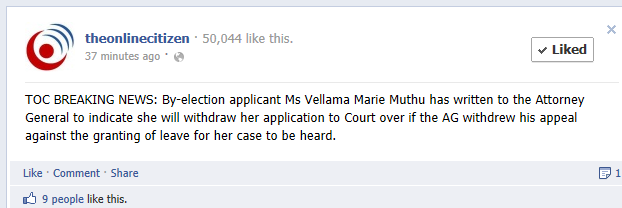
It appears that Mdm Vellama Marie Muthu is seeking to withdraw her case if the AG were to drop the appeal. A proposal has been forwarded to the Attorney General's office by Mdm Vellama's lawyer that upon withdrawal of her application and the AG's appeal, a consent order be drafted and recorded in Court.
Firstly, I believe that the application for the mandatory order has become unsustainable by virtue of the PM's decision to call for the by-election. If at all there is a live issue for the Court to determine, it is in relation to the declaratory orders sought by Mdm Vellama.
Mdm Vellama's application involved the following:
(a) Declaratory orders:
(i) That the Prime Minister does not have unfettered discretion in deciding whether to announce by-elections in Hougang SMC; and
(ii) That the Prime Minister does not have unfettered discretion to decide when to announce by-elections in Hougang SMC and must do so within three months or within such reasonable time as this Honourable Court deems fit; and
(b) A Mandatory Order
- enjoining the Prime Minister to advise the President to issue a Writ of Election mandating by-elections in Hougang SMC pursuant to Article 49(1) of the Constitution of the Republic of Singapore (1985 Rev Ed, 1999 Reprint) and Section 24(1) of the Parliamentary Elections Act (Cap 218, 2011 Rev Ed) and to tender such advice within three months or within such reasonable time as the Honourable Court deems fit.
As the PM has already advised the President to issue the Writ of Election, (b) above is rendered nugatory.
The question of whether the PM has unfettered discretion in deciding whether to announce by-election or in deciding when to announce such by-elections still remains an important Constitutional issue that is undefined and speculative given the gap in our Constitutional and statutory provisions on by-elections. This being the case, I do not think that the declaratory orders are less significant now that the PM has called for the by-election. (Of course, the wording of the declaratory order should be amended in the application to remove the reference to Hougang SMC. There is a generic question as to whether the PM has unfettered discretion in relation to whether and when to announce by-elections in any single member constituency.)
What would happen if the matter proceeds? The application for leave is in the first place being made on account of the mandatory order sought and by virtue of Order 53 of the Rules of Court. The declaratory orders are also being sought under Order 53 and they ride on the mandatory order. If the Court of Appeal rules that leave to appeal would not be granted on the mndatory order, then the application would fail and Mdm Vellama's Counsel has the option of filing a fresh application for the declaratory orders under Order 15 Rule 16 of the Rules of Court. This application, being solely for declaratory orders, would not require the leave of court.
This could be one way to proceed. However, I understand that the letter sent by Mdm Vellama's lawyer alludes to the fact that the Constitutional clarification must await some future date when such matter may arise. That is as good an indication as one may get on whether a fresh application would be made for the declaratory orders. It is plain that Mdm Vellama would not be pursuing any clarification via a fresh set of proceedings.
Since Mdm Vellama has proposed withdrawal, I would expect that the AG (and presumably the PM) would decide to take up the offer and drop the appeal. That would be the politically prudent step to take to avoid any possible fallout.
In any event, I think that Mdm Vellama deserves the respect of every citizen in Singapore. There are some people commenting online about her wasting time in making the Court application in the first place. This is what I have to say: Even if she has been put up to it by some others with a political interest in this situation, it takes a lot of guts to stick one's neck out like this. For that alone she deserves respect. She is a Singaporean that has shown that she meant every word of the pledge that we unashamedly take... "to build a democratic society based on justice and equality". In fact, those people that choose to take our national pledge and still deride the efforts of Mdm Vellama are hypocrites of the highest order. The rest of us, proud citizens, salute her!
In a way, this is our own little Bersih... A cleaner takes the PM to court to clean up our electoral law.
Wednesday, May 09, 2012
Hougang by-election: 26 May 2012

I am very happy to hear that President Tony Tan has today at 4.05pm issued the Writ of Elections for a by-election at the Hougang single member constitutency. Nomination papers for candidates have to be filed by 16th May 2012 and the most likely date for elections would be the 26th of May 2012.
This is definitely good news. Many people have shown skepticism about the PM's willingness to recognise the new reality of the post 2011 political universe in Singapore. When I blogged about the Hougang by-election in an earlier post and expressed my hope that the PM would call for the election expeditiously, there were comments left on this blog and comments from my friends that expressed serious doubt as to whether a by-election would be held at all. I feel that my hope was not misplaced. I do still feel that the current cabinet is willing to go along with the process of re-thinking its approach to governance.
This current decision to call for a by-election has to be seen positively. Yaw Shin Leong was expelled from his party on 15 Feb 2012 and his seat became vacant. The 3 month time-frame that used to exist in our former Federal Constitution would have kicked in on 15 May 2012. (This requirement does not exist in our Constitution today and the timing is discretionary.) By issuing the Writ of Election today, the President under the advise of the Cabinet has clearly acted expeditiously.
What we need in the future is for such expeditious by-elections to be a norm. If a seat becomes vacant, we need a strong political convention that it would be filled expeditiously. A 3 to 6 month timeframe is reasonable. The PM has exceeded my expectation by calling for the by-election within 3 months.
Another small step in the direction of a more democratic Singapore.
(I can imagine that there would be those that take a cynical view about this. The PAP is bound to lose in Hougang anyway. They have nothing to lose, therefore, by calling for an early election. They have tremendous political capital to gain by acting responsibly on this occasion. That would explain the early date. But, I don't mind giving credit where it is due.)
The following is the PM's statement in relation to the Hougang by-election:
"In the General Election in May 2011, nearly all seats were contested. Many important issues were aired and debated. In the outcome, Singaporeans gave the PAP team a clear mandate to form the Government.
Over the past year, the Government has worked hard together with Singaporeans to implement its programme to build an inclusive Singapore, and improve the lives of all.
We set the broad directions when Parliament opened last October. In the Budget in February we followed up with effective schemes to help the poor, the elderly and the disabled. We are also upgrading our companies’ and workers’ skills, so that our economy can grow and Singaporeans can improve their incomes year by year.
However, much work remains ahead to translate good policies and programmes into actions on the ground, and to deliver the results that we all look forward to.
In January this year, news surfaced of personal indiscretions by Mr Yaw Shin Leong, the Workers’ Party (WP) Member of Parliament for Hougang constituency. The WP first kept totally silent, then supported Mr Yaw, and then three weeks later suddenly expelled him from the party. Until now the WP has not given Singaporeans a full and proper account of what happened, or why it acted in this way. Mr Yaw himself has said nothing, either to explain or to apologise for his behaviour, and has reportedly left the country. Both the WP and Mr Yaw have let down all those who voted for him. As a result of Mr Yaw’s expulsion from the WP, the Hougang constituency seat fell vacant.
I hope these events will not distract us from focussing on our national priorities, and building an inclusive Singapore. Although the Constitution does not require me to call a by-election within any fixed timeframe, I said in Parliament that I intended to call a by-election in Hougang. This morning I advised the President to issue the Writ of Election.
The by-election will give Hougang residents the chance to elect a new MP to serve them. I encourage Hougang voters to use this opportunity wisely, to elect the best candidate with commitment and integrity: someone they can rely upon to express their hopes and concerns, address their needs, and make a real difference to their lives."
Thursday, April 12, 2012
The Houngang by-election case - The decision to grant leave

Justice Philip Pillai has given his written reasons for the decision to grant leave for judicial review in the case of Vellama d/o Marie Muthu v AG.
Having read the court's reasoning, what I can gather is that the judge has stated that he is satisfied that the 'low threshold' for granting leave has been crossed. Exactly why the Court is satisfied as such is not stated (or at least I can't find it.
In his conclusion, the judge states:
"Based on what was presented and submitted to me for the purposes of the leave application, without making any comment or decision on the merits or the substantive legal issues, I granted leave for a judicial review hearing as I was of the view that the very low threshold for leave has been met."
I suspect that this might be a problem during the appeal. What was the judge's reason for coming to the 'view that the very low threshold for leave has been met?
Paragraphs 1 to 3 of the decision set out the orders sought by Applicant (Ms Vellama) and the fact that the Court granted leave for judicial review on 2nd April 2012.
Paragraphs 4 to 8 set out the factual background to the application.
Paragraphs 9 to 13 set out the law relating to the threshold to be crossed for the granting of leave for judicial review. The law here is uncontroversial and it is as follows:
(i) the matter complained of is susceptible to judicial review;
(ii) the applicant has sufficient interest in the matter; and
(iii) the material before the court discloses an arguable or prima facie case of reasonable suspicion in favour of granting leave.
Points No.(i) and (ii) were not disputed. The issue before the court was, therefore, whether there's a "prima facie case of reasonable suspicion"
Paragraphs 14 to 16 deal with the relationship between Order 53 and Order 15 Rule 16. This relates to the question of whether leave for judicial review is required for declaratory orders (as opposed to mandatory orders for which leave is clearly required). (A declaratory order is one that is in the form of a clarification of the legal position without ordering any government body to do anything. A mandatory order requires the government body to comply with the court's direction to carry out a particular act.)
The discussion in these paragraphs did not relate to the issue of whether there was a "prima facie case of reasonable suspicion." It was more on the question of whether leave was required in the first place for the declaratory orders.
Paragraphs 19 to 23 involve a narration by the judge of the arguments put forward by the respective lawyers on the mandatory order sought by the applicant. The judge did not express his opinion on these arguments.
Paragraphs 24 to 27 involve a narration of the arguments by the parties on the declarations requested by the applicant. The judge states the following:
"Counsel for the applicant earlier informed the AG’s counsel and the court that he would if necessary immediately apply under O 15 r 16 for the First and Second Declarations to be considered as standalone declarations for which the leave of court is not required. In light of this, the question of whether the quite separate requirements for standalone declarations have beenThe judge therefore appears to have taken the view that the issue of leave requirement for the declaratory orders did not need to be addressed.
met would have to be determined at a substantive hearing, which this O 53 leave hearing is not."
Finally, at paragraph 29, the Judge concludes:
"Based on what was presented and submitted to me for the purposes of the leave application, without making any comment or decision on the merits or the substantive legal issues, I granted leave for a judicial review hearing as I was of the view that the very low threshold for leave has been met."
I am unable to ascertain from the decision the specific reason that led to his assessment that the "low threshold for leave has been met" apart from his assertion that the threshold has been met (Unless, one is to assume that he accepted the arguments put forward by the Counsel for the appellant and that constituted his reason for stating that the low threshold had been met.)
I hope that the Court of Appeal does not find this problematic. To be fair, the judge has no duty to examine the substantive merits of the application. But, I would have expected that something was stated as to why he made the finding that the threshold had been met.
Wednesday, May 18, 2011
Change from within?
The catchword for GE 2011 has become ‘change’. Whatever else may or may not have happened and whatever change may be due to take place, the political landscape in Singapore has changed irrevocably in a noticeably powerful way. Our collective fear of the PAP has been smashed in a dramatic fashion. I know that a significant number of people still experience that fear. However, thanks to the social media, for many of us this general election campaign has enabled us to find a voice and a very loud one at that.
All of this noise making has, it appears, forced the PAP leadership to re-examine itself. It is too early to tell if the PAP leaders would in fact change their policies and modify their authoritarian style of government. I am still skeptical. We have heard before about the supposed change in the style of government. But, past actions do not bear out any real attempt at fulfilling those promises.
As it stands right now, it appears to me still that the leadership is engaged in perception management more than anything else. I am not convinced that they are really going to look at their policies to see how they may be changed. I suspect that they may try to explain their policies in a more palatable fashion.
The following is an article that appeared in the Today paper on 13th May 2011 entitled “I wondered how leaders would react: Tan Chuan-Jin”:
BG Tan said what needs to be done is to change the perception that the PAP is a long—time ruling party that is quick to look past public views — even though it has made policy decisions with the best of intentions.
"It’s sometimes hard to pinpoint what exactly sparked that perception. But perception is reality and it’s important because if that perception is widespread, it will erode that sense of support ... and the mandate where the people trust you to make long—term strategic decisions," he said.
My worry is that in the end, the next five years becomes an endless exercise in underlining the official narratives that continue to keep the majority of Singaporeans convinced that this country cannot survive without the PAP. We are a small island with no natural resources. We are surrounded by hostile or potentially hostile neighbours. Our economic progress was solely due to the enlightened economic policies of the PAP. That such economic progress is not compatible with ‘confrontational’ politics. That our society is so fragile that it is just poised to break into chaos if freedoms are given to Singaporeans. That the past track record of a previous generation of leaders is indicative of the present and future performance of PAP leaders. I could go on.
The election campaign on the last day and the subsequent comments by the PAP leaders as well as forum page letters in the Straits Times all indicate a trend where:
a) the PAP leadership has realised that the level of unhappiness on the ground borders on anger and hatred;
b) they have decided that an apology and a promise to change would be the best way to limit the fallout;
c) they don’t appear thoroughly or even mildly convinced that their policies are wrong or may be wrong;
d) they seem to have a sense that Singaporeans have not fully understood government policies and explanations and that there is a breakdown in the communication
What I worry the most is that the campaign of perception management that the PAP leadership may engage in over the next few years might achieve the objective of pulling back the popular vote in PAP’s favour without any real change that the some of us desire; i.e. a change in failed policies, greater accountability for policy decisions and transparency through an effective system of Parliamentary checks and balances.
All of this noise making has, it appears, forced the PAP leadership to re-examine itself. It is too early to tell if the PAP leaders would in fact change their policies and modify their authoritarian style of government. I am still skeptical. We have heard before about the supposed change in the style of government. But, past actions do not bear out any real attempt at fulfilling those promises.
As it stands right now, it appears to me still that the leadership is engaged in perception management more than anything else. I am not convinced that they are really going to look at their policies to see how they may be changed. I suspect that they may try to explain their policies in a more palatable fashion.
The following is an article that appeared in the Today paper on 13th May 2011 entitled “I wondered how leaders would react: Tan Chuan-Jin”:
BG Tan said what needs to be done is to change the perception that the PAP is a long—time ruling party that is quick to look past public views — even though it has made policy decisions with the best of intentions.
"It’s sometimes hard to pinpoint what exactly sparked that perception. But perception is reality and it’s important because if that perception is widespread, it will erode that sense of support ... and the mandate where the people trust you to make long—term strategic decisions," he said.
My worry is that in the end, the next five years becomes an endless exercise in underlining the official narratives that continue to keep the majority of Singaporeans convinced that this country cannot survive without the PAP. We are a small island with no natural resources. We are surrounded by hostile or potentially hostile neighbours. Our economic progress was solely due to the enlightened economic policies of the PAP. That such economic progress is not compatible with ‘confrontational’ politics. That our society is so fragile that it is just poised to break into chaos if freedoms are given to Singaporeans. That the past track record of a previous generation of leaders is indicative of the present and future performance of PAP leaders. I could go on.
The election campaign on the last day and the subsequent comments by the PAP leaders as well as forum page letters in the Straits Times all indicate a trend where:
a) the PAP leadership has realised that the level of unhappiness on the ground borders on anger and hatred;
b) they have decided that an apology and a promise to change would be the best way to limit the fallout;
c) they don’t appear thoroughly or even mildly convinced that their policies are wrong or may be wrong;
d) they seem to have a sense that Singaporeans have not fully understood government policies and explanations and that there is a breakdown in the communication
What I worry the most is that the campaign of perception management that the PAP leadership may engage in over the next few years might achieve the objective of pulling back the popular vote in PAP’s favour without any real change that the some of us desire; i.e. a change in failed policies, greater accountability for policy decisions and transparency through an effective system of Parliamentary checks and balances.
Thursday, May 12, 2011
GRCs – where do we go from here?
The Group Representation Constituency system was introduced in the 1988 elections ostensibly for the purpose of ensuring minority representation in Parliament. In the 2011 general elections, the PAP has lost 2 of its ministers through the loss of Aljunied GRC. The Workers’ Party raised the stakes by placing its best candidates in Aljunied knowing that the closet election battle in the last election was fought in this GRC. They won the bet.
Now, more than ever before, there is an urgent need to talk about the GRC system. There is an urgency to deal with this system whilst PAP supporters themselves are bitter with the loss of George Yeo. For a long time, opposition supporters have maintained that the GRC system unfairly disadvantages opposition parties and favours the incumbent. Well, it is equally dangerous for the PAP: the loss of a GRC means the loss of at least one or two ministers depending on the particular GRC.
Let us examine the stated rationale for the GRC system and whether it has any merits:
Minority representation
The official reason for the introduction of the GRC system in 1988 was to ensure that candidates from minority races can still be represented in Parliament. Was Singapore in danger of voting along racial lines back then in the 1980s? The evidence shows that PAP candidates of Indian and Malay origin had little difficulty in defeating Chinese opponents from opposition parties. Equally true is the fact that the first opposition MP to enter into Parliament was JB Jeyaretnam of the Workers’ Party in a constituency where the majority of residents were Chinese. The truth is that Singaporeans had not been voting along racial lines as at 1998 and it remains true that Singaporeans have not been voting along racial lines since then.
Indeed, one would be hard pressed to find a Singaporean who would vote along racial lines. Most Singaporeans can be classified into pro-PAP, anti-PAP, pro-a-particular-opposition party or just simply apathetic or unconcerned.
People vote along racial lines? Here in Singapore? We don’t buy that.
We may be told to rewind the clock back to the 1950s and 1960s. We may be told that racial divisions were real and were about to tear our society apart. We may be told that even though we notice such divisions today, they are still there below the surface waiting to blow up in our face at the slightest instigation.
If we are to believe that, then we must accept that 4 decades of nation building has been a failure; 4 decades of talking about racial harmony has been a failure; 4 decades of attempting to build a Singaporean identity has been a failure. But, I find that hard to accept.
Sure. There are racists in Singapore. There is racial discrimination here and there. Singaporeans have racial stereotypes about each other. But, to the credit of the Chinese majority in Singapore, they have never derided their politicians because of their race. Many minority race candidates from the PAP and the opposition have been received well by the Chinese majority. We are not in danger of slipping into a race based voting pattern. I know of so many Chinese friends who speak adoringly of JBJ and have a lot of contempt for LKY. Race has not been a factor in the way that the majority race votes in Singapore and with the high degree of tolerance and integration that we have amongst Singaporeans, it is unlikely that race will become a factor in the foreseeable.
So, the need to ensure minority race protection is nothing more than a hypothetical argument. In 1988, the PAP government was trying to ‘solve’ a hypothetical problem. Now, let us assume for a moment that minority race representation in Parliament is an issue to be catered for. Is the GRC system necessarily the best way to deal with it? Can’t such protection be ensured through a minimum quota of seats in Parliament? Under the present system, there are 15 GRCs. That translates into a reservation of 15 minority race seats in Parliament. If minority race representation is the true reason for introducing the GRC system, I suggest that a better system of ensuring minority race representation would be to reserve 15 constituencies as minority race seats. Any political party fielding candidates in those constituencies must field a person from a minority race. (I am personally opposed to this idea of creating a quota. But, playing ball with the PAP’s officially stated rationale, an alternative and better approach to the GRC would be a SMC system with a fixed quota for minorities)
What the GRC system really does is that it shields weaker candidates from electoral defeat. Back in 2009 I had blogged about manipulation of the electoral system and in that context the following analysis of Eunos GRC is something stand by still:
“Given the lack of proportionality that is inherent in the system, layering the GRC over it helps to aggravate the disproportionality. With the introduction of the GRC system, it is possible that some MPs that may have lost their individual seats are rescued by stronger candidates in other constituencies. The practice of having a Minister head a GRC team places an apprehension in the minds of voters that if the team loses, the Minister would no longer be able to serve in his office. Weak candidates within the GRC would benefit from the presence of a Minister on their team.
Let us take the Eunos GRC example. In the 1988 elections, Eunos GRC was a 3 member ward. The votes in favour of PAP – 36,500. The votes in favour of WP – 35,221. If the 3 constituencies that were a part of the GRC were single member constituencies in that elections, it is highly likely that at least one of the PAP candidates would have lost his seat. It is likely that Francis Seow would have won a seat in his constituency. In fact, with a vote difference of 1,279 votes, I would not be surprised if 2 PAP MPs had in fact lost to the opposition in the Eunos GRC(if only the Elections Department were to release the detailed results).
The same analysis can be applied to the Eunos GRC of the 1991 elections. This time around it was composed of 4 constituencies. PAP obtained 45,833 votes as opposed to 41,673 for the WP. With a vote difference of 4,160, again it is likely that at least one of the PAP candidates would have lost the seat in a conventional single member seat.
Through the GRC system, the PAP has managed to keep some of its MPs in Parliament where they would otherwise have found it tough going in a single member constituency. The growth in the size and number of GRCs was accompanied by the disappearance of most of the single member constituencies. This is another unique form of electoral management that has ensured the PAP’s continued super-majority in Parliament.”
The fact is that through the GRC system PAP had managed in the early years of its introduction to avoid losing seats in Parliament to candidates that would have posed a serious threat in Parliament such as Francis Seow and Tang Liang Hong. Single member constituencies that were too hot for the PAP to handle such as Bukit Batok, Bukit Gombak and Ulu Pandan (amongst others) were quickly obsorbed into GRCs. The GRCs started growing in size from the original 3 member groups to 5 and 6 member groups. Over time, it has also become evident that the GRC system is a useful way by which the PAP is able to regenerate itself and to train newbies. Every new candidate introduced in a general election by the PAP is shielded by a Minister or two in a GRC. People would generally not dare to vote out a minister and the new candidate would effectively be protected that way. This rationale has been evident in the PAP rhetoric in the last two elections and in fact it was elevated to a new level in this election this year.
PAP ministers have been repeating the warning that a Minister could be lost if voters went against the PAP in a GRC. In the 2006 election, much was made about George Yeo’s experience and credentials as a Foreign Minister. In the 2011 election, we have seen again how the PAP made much ado about the possibility of losing a Minister if Aljunied GRC were to be lost.
So, it has come to pass. Aljunied has been lost to the Workers’ Party. The residents of Aljunied have rejected the PAP’s arguments. The desire for a voice in Parliament has been so overwhelming that the WP team in Aljunied pulled off a vote swing of 10% in a GRC where precincts were moved out into Ang Mo Kio GRC and precincts were brought in from Marine Parade in an attempt by the incumbent to dilute pro-opposition votes.
Low Thia Khiang said on nomination day that it is time to teach the PAP a lesson. Well, the lesson has been delivered. But, has the PAP learnt anything?
And there is one more thing. This election has really exposed the GRC system in a big way. Tin Pei Ling can become an MP. Half a dozen faceless individuals in the PAP ranks can become MPs. But, George Yeo, Tan Jee Say, Vincent Wijeysinha and several other credible individuals can be left out of Parliament. The net effect: the GRC system is inherently inefficient in delivering the best outcome. The most credible candidates would enter Parliament in a straight one to one contest. But, in a system that shields the incompetent, Parliament suffers in quality.
To summarise:
1. I don’t buy the argument that GRCs protect minorities.
2. If we really want to protect minorities, we could have a fixed quota of SMCs for that purpose.
3. GRCs have favoured the PAP because of the all-or-nothing effect that they produce
4. GRCs permit less than competent candidates to enter Parliament through the presence of Ministers
5. When a GRC is lost due to backlash, a good PAP candidate can be lost along with the whole team
There is one more point that I did not make above. The first past the post system that we have inherited from the British is not representative of the votes of the people. The GRC system amplifies this problem and our Parliament has become dramatically unrepresentative. 6 seats out of 87 seats as representation for 40% of the population that voted for the opposition? That is atrocious.
Now, more than ever before, there is an urgent need to talk about the GRC system. There is an urgency to deal with this system whilst PAP supporters themselves are bitter with the loss of George Yeo. For a long time, opposition supporters have maintained that the GRC system unfairly disadvantages opposition parties and favours the incumbent. Well, it is equally dangerous for the PAP: the loss of a GRC means the loss of at least one or two ministers depending on the particular GRC.
Let us examine the stated rationale for the GRC system and whether it has any merits:
Minority representation
The official reason for the introduction of the GRC system in 1988 was to ensure that candidates from minority races can still be represented in Parliament. Was Singapore in danger of voting along racial lines back then in the 1980s? The evidence shows that PAP candidates of Indian and Malay origin had little difficulty in defeating Chinese opponents from opposition parties. Equally true is the fact that the first opposition MP to enter into Parliament was JB Jeyaretnam of the Workers’ Party in a constituency where the majority of residents were Chinese. The truth is that Singaporeans had not been voting along racial lines as at 1998 and it remains true that Singaporeans have not been voting along racial lines since then.
Indeed, one would be hard pressed to find a Singaporean who would vote along racial lines. Most Singaporeans can be classified into pro-PAP, anti-PAP, pro-a-particular-opposition party or just simply apathetic or unconcerned.
People vote along racial lines? Here in Singapore? We don’t buy that.
We may be told to rewind the clock back to the 1950s and 1960s. We may be told that racial divisions were real and were about to tear our society apart. We may be told that even though we notice such divisions today, they are still there below the surface waiting to blow up in our face at the slightest instigation.
If we are to believe that, then we must accept that 4 decades of nation building has been a failure; 4 decades of talking about racial harmony has been a failure; 4 decades of attempting to build a Singaporean identity has been a failure. But, I find that hard to accept.
Sure. There are racists in Singapore. There is racial discrimination here and there. Singaporeans have racial stereotypes about each other. But, to the credit of the Chinese majority in Singapore, they have never derided their politicians because of their race. Many minority race candidates from the PAP and the opposition have been received well by the Chinese majority. We are not in danger of slipping into a race based voting pattern. I know of so many Chinese friends who speak adoringly of JBJ and have a lot of contempt for LKY. Race has not been a factor in the way that the majority race votes in Singapore and with the high degree of tolerance and integration that we have amongst Singaporeans, it is unlikely that race will become a factor in the foreseeable.
So, the need to ensure minority race protection is nothing more than a hypothetical argument. In 1988, the PAP government was trying to ‘solve’ a hypothetical problem. Now, let us assume for a moment that minority race representation in Parliament is an issue to be catered for. Is the GRC system necessarily the best way to deal with it? Can’t such protection be ensured through a minimum quota of seats in Parliament? Under the present system, there are 15 GRCs. That translates into a reservation of 15 minority race seats in Parliament. If minority race representation is the true reason for introducing the GRC system, I suggest that a better system of ensuring minority race representation would be to reserve 15 constituencies as minority race seats. Any political party fielding candidates in those constituencies must field a person from a minority race. (I am personally opposed to this idea of creating a quota. But, playing ball with the PAP’s officially stated rationale, an alternative and better approach to the GRC would be a SMC system with a fixed quota for minorities)
What the GRC system really does is that it shields weaker candidates from electoral defeat. Back in 2009 I had blogged about manipulation of the electoral system and in that context the following analysis of Eunos GRC is something stand by still:
“Given the lack of proportionality that is inherent in the system, layering the GRC over it helps to aggravate the disproportionality. With the introduction of the GRC system, it is possible that some MPs that may have lost their individual seats are rescued by stronger candidates in other constituencies. The practice of having a Minister head a GRC team places an apprehension in the minds of voters that if the team loses, the Minister would no longer be able to serve in his office. Weak candidates within the GRC would benefit from the presence of a Minister on their team.
Let us take the Eunos GRC example. In the 1988 elections, Eunos GRC was a 3 member ward. The votes in favour of PAP – 36,500. The votes in favour of WP – 35,221. If the 3 constituencies that were a part of the GRC were single member constituencies in that elections, it is highly likely that at least one of the PAP candidates would have lost his seat. It is likely that Francis Seow would have won a seat in his constituency. In fact, with a vote difference of 1,279 votes, I would not be surprised if 2 PAP MPs had in fact lost to the opposition in the Eunos GRC(if only the Elections Department were to release the detailed results).
The same analysis can be applied to the Eunos GRC of the 1991 elections. This time around it was composed of 4 constituencies. PAP obtained 45,833 votes as opposed to 41,673 for the WP. With a vote difference of 4,160, again it is likely that at least one of the PAP candidates would have lost the seat in a conventional single member seat.
Through the GRC system, the PAP has managed to keep some of its MPs in Parliament where they would otherwise have found it tough going in a single member constituency. The growth in the size and number of GRCs was accompanied by the disappearance of most of the single member constituencies. This is another unique form of electoral management that has ensured the PAP’s continued super-majority in Parliament.”
The fact is that through the GRC system PAP had managed in the early years of its introduction to avoid losing seats in Parliament to candidates that would have posed a serious threat in Parliament such as Francis Seow and Tang Liang Hong. Single member constituencies that were too hot for the PAP to handle such as Bukit Batok, Bukit Gombak and Ulu Pandan (amongst others) were quickly obsorbed into GRCs. The GRCs started growing in size from the original 3 member groups to 5 and 6 member groups. Over time, it has also become evident that the GRC system is a useful way by which the PAP is able to regenerate itself and to train newbies. Every new candidate introduced in a general election by the PAP is shielded by a Minister or two in a GRC. People would generally not dare to vote out a minister and the new candidate would effectively be protected that way. This rationale has been evident in the PAP rhetoric in the last two elections and in fact it was elevated to a new level in this election this year.
PAP ministers have been repeating the warning that a Minister could be lost if voters went against the PAP in a GRC. In the 2006 election, much was made about George Yeo’s experience and credentials as a Foreign Minister. In the 2011 election, we have seen again how the PAP made much ado about the possibility of losing a Minister if Aljunied GRC were to be lost.
So, it has come to pass. Aljunied has been lost to the Workers’ Party. The residents of Aljunied have rejected the PAP’s arguments. The desire for a voice in Parliament has been so overwhelming that the WP team in Aljunied pulled off a vote swing of 10% in a GRC where precincts were moved out into Ang Mo Kio GRC and precincts were brought in from Marine Parade in an attempt by the incumbent to dilute pro-opposition votes.
Low Thia Khiang said on nomination day that it is time to teach the PAP a lesson. Well, the lesson has been delivered. But, has the PAP learnt anything?
And there is one more thing. This election has really exposed the GRC system in a big way. Tin Pei Ling can become an MP. Half a dozen faceless individuals in the PAP ranks can become MPs. But, George Yeo, Tan Jee Say, Vincent Wijeysinha and several other credible individuals can be left out of Parliament. The net effect: the GRC system is inherently inefficient in delivering the best outcome. The most credible candidates would enter Parliament in a straight one to one contest. But, in a system that shields the incompetent, Parliament suffers in quality.
To summarise:
1. I don’t buy the argument that GRCs protect minorities.
2. If we really want to protect minorities, we could have a fixed quota of SMCs for that purpose.
3. GRCs have favoured the PAP because of the all-or-nothing effect that they produce
4. GRCs permit less than competent candidates to enter Parliament through the presence of Ministers
5. When a GRC is lost due to backlash, a good PAP candidate can be lost along with the whole team
There is one more point that I did not make above. The first past the post system that we have inherited from the British is not representative of the votes of the people. The GRC system amplifies this problem and our Parliament has become dramatically unrepresentative. 6 seats out of 87 seats as representation for 40% of the population that voted for the opposition? That is atrocious.
Thursday, June 12, 2008
Ron Paul drops out of Republican race
Ron Paul, the Libertarian leaning Republican, has officially dropped out of the Republican race. Although realistically he was not going to get the necessary delegates to vote for him at the Republican Convention later this year, Ron PAul kept the hopes of his supporters alive by keeping himself in the race.
There was a stage towards the end of last year and the beginning of this year when the net was abuzz with the Ron Paul Revolution. There appeared to be this new hope on the horizon. He was the most popular candidate on the internet. But, the MSM hardly gave him any credence. They won in the end. They succeeded in muzzling his voice and his message. He is, in my view, the person best suited to be President and the one person whose uncompromising and principled views would have done a great deal of good for America and the world.
Well, Ron PAul has announced that he will shift his focus now to maintain a long term campaign for liberty. I guess in the larger scheme of things the Presidential campaign is not the be all and end all.
There was a stage towards the end of last year and the beginning of this year when the net was abuzz with the Ron Paul Revolution. There appeared to be this new hope on the horizon. He was the most popular candidate on the internet. But, the MSM hardly gave him any credence. They won in the end. They succeeded in muzzling his voice and his message. He is, in my view, the person best suited to be President and the one person whose uncompromising and principled views would have done a great deal of good for America and the world.
Well, Ron PAul has announced that he will shift his focus now to maintain a long term campaign for liberty. I guess in the larger scheme of things the Presidential campaign is not the be all and end all.
Subscribe to:
Posts (Atom)