2011 was a watershed year in the politics of Singapore. With the General Elections and Presidential Elections sending strong signals to the ruling PAP and with the empowering effect of social media, the scene was set for an interesting 2012.
Much has happened in the political arena. The PAP would probably place emphasis on the National Conversation as a major political highlight. Most citizens would probably remember this year as the year of sex in politics and the civil service. I am sure there must be plenty of other mainstream and social media perspectives on the year that has just whizzed past us. I don't plan to cover the same ground. Perhaps a survey of Constitutional developments might be of some interest.
From a Constitutional standpoint, this has been an interesting year. There have been some developments in the law and not all of them are positive from the perspective of citizens' rights.
THE HOUGANG BY-ELECTION CASE
This was a case that was waiting to happen. There have been several instances in the past when the ruling PAP has avoided by-elections. Ever since the dramatic loss of the Anson seat to the Workers' Party in 1981, the default mode of the PAP has been to resist any calls for a by-election when a seat became vacant.
Prior to the Hougang by-election case, there was one attempted Constitutional challenge when the Bukit Batok seat fell vacant in 2008 due to the death of Dr Ong Chit Chung. A claim was filed in Court and eventually withdrawn when the claimant (a Bukit Batok resident) decided not to proceed with the case after his lawyer J.B Jeyaretnam passed away. Bukit Batok was part of a GRC and so the legal issues there were slightly different.
http://article14.blogspot.sg/2008/07/is-constitution-redundant.html
When Mdm Vellamma instituted judicial review proceedings in relation to the PM's discretion in calling for by-elections, it is probably true to say that tremendous political pressure fell on the PM's shoulders. In a GRC it was possible for the PM to claim that the other MPs would 'cover' the responsibilities of Dr Ong. But, Hougang is a single member constituency and clearly the PM could not go on a default mode of givng a template response. http://article14.blogspot.sg/2012/02/bye-yaw-and-now-for-by-election.html
With the application for leave being granted by the High Court and the attempt by the government to have the case thrown out being unsuccessful, there must have been a significant fear in the PM's office that the Constitutional interpretation would work to constrain the PM's discretion. A by-election was called and I honestly expected that Mdm Vellamma would drop the case. But, the case proceeded nevertheless. http://article14.blogspot.sg/2012/04/houngang-by-election-case-decision-to.html
http://article14.blogspot.sg/2012/05/hougang-by-election-26-may-2012.html
http://article14.blogspot.sg/2012/05/hougang-by-election-case-may-be.html
The final judgment by the High Court is most unfortunate for the citizens of Singapore and for the status of our country as a democracy. In a highly technical approach to the reading of our Constitution, the High Court ruled that the PM has unfettered discretion in deciding on whether to hold a by-election. I disagree with the Court's reasoning and I have set that out my views here: http://article14.blogspot.sg/2012/12/the-hougang-by-election-case-belated.html
As a direct consequence of the decision, the legal position today is that a vacant Parliamentary seat need not be filled and it can remain vacant till the next general election.
Since Mdm Vellamma lost her case, the AG requested for an order of costs against her. The default mode in the Court is that 'costs follow the event'. That is just lawyers' language for 'legal costs to be paid by the losing party to the winning party.' Incindentally, judges do have discretion to deviate from this norm and this has been done in the United Kingdom. (Our Rules of Court are modelled on the English Rules.)
In a landmark ruling the same High Court judge that dismissed Mdm Vellamma's case found in favour of Mdm Vellamma on the costs issue. As her case involved a matter of public interest, the Court saw it fit to rule that no costs would be payable even though she lost the case.
As a consequence of this ruling, Singaporeans have been given the hope that they can safely proceed with judicial review on matters of general public interest and will not be penalised in costs if they lose the case eventually.
THE IMF LOAN CASE
There is something seriously wrong about the politico-legal order in our country when we have an official rationale for the existence of an Elected President (as an additional check against potential Executive abuse of the reserves) and at the same time a rather cavelier attitude on the government's part when it comes to giving out loans to foreign institutions.
Most observers reading our Constitution would walk away with the impression that any loan given by our government to a foreign entity is required to be subject to Presidential scrutiny. But, what appears logical to an ordinary individual can often be seen very differently by lawyers. This was one such instance. Though personally I am in favour of subjecting loans by the Singapore government to Parliamentary scrutiny (at the very least), the truth is that the High Court judgment in this case is one that is, at least, consistent with the background to Art 144 of the Constitution. I would have preferred a different approach by the Court by relying on the need for restrictive interpretation of the Constitution when it comes to Executive powers so that the Rule of Law can be preserved.
Today, as a result of the IMF loan case, our government needs to seek Presidential approval for the giving of a guarantee and the raising of a loan. But, there is no need for such approaval for the giving of a loan and the raising of a guarantee.
Another issue arising out of the High Court's decision in this case concerns 'locus standi'. The Court has ruled that the applicant Kenneth Jeyaretnam had no locus standi to bring this claim because the claim was in relation to a public right and the claimant had to show that he suffered some special damage. This is effectively a bar on any future claim by a citizen alleging any breach of Article 144.
http://article14.blogspot.sg/2012/10/the-day-constitution-died-again.html
The effect of this case is that in future, the Executive might breach Article 144 by raising a loan or giving a guarantee without Presidential or Parliamentary scrutiny and citizens would be left without legal recourse.
THE GAY RIGHTS CASE
Tan Eng Hong v AG as decided by the Court of Appeal represents a significant postive step in the interpretation of our Constitution. At the present stage of the proceedings, there hasn't been any final determination on the Constitutionality of s.377A of the Penal Code. But, the Court of Appeal has made two rulings of significance.
S.377A is a pre-independance provision and it pre-dates our Constitution. The AG attempted to argue that s.377A cannot be declared to be void because it is a pre-1965 law. The Court of Appeal has rejected this. http://article14.blogspot.sg/2012/08/from-gay-rights-to-rights-of-all.html
It is now clear that all statutes that violate the Constitution can be declared to be void and it does not matter whether the statute existed prior to the Constitution.
The second significance of this case is that the very existence of an unconstitutional statute can sometimes give rise to the violation of the rights of an individual. So, even if a person has not been prosecuted under s.377A, that person can still bring an action to challenge the Constitutionality of the law.
The case has general significance in all cases involving the validity of statutes (where there has been a contravention of the Constitution). A citizen does not have to wait to have his rights violated before bringing a challenge against the statute.
http://article14.blogspot.sg/2012/08/rights-come-alive-tan-eng-hong-v-ag.html
All of these three cases are still alive. The decisions in the Hougang by-election case and the IMF case have been appealed against. Tan Eng Hong will go before the High Court for a determination on the constitutionality of s.377A.
There is much to watch out for in 2013.
Happy new year.
Showing posts with label hougang. Show all posts
Sunday, December 30, 2012
Wednesday, December 26, 2012
Not profiteering. But politicking?
Social media has been abuzz with questions relating to the role of Action Information Management Pte Ltd in the leaseback agreement with 14 PAP Town Councils. There have been suggestions by some netizens that there should be a CPIB investigation and other suggestions that AIM is but an example of profiteering at the expense of citizens.
Based on information that is so far available:
1. The 3 directors of AIM are PAP members. Two of those 3 are also shareholders of AIM
2. Dr Teo Ho Pin, the coordinating chairman is reported to have claimed that AIM is a PAP owned company. (technically, the company is owned by Chandra Das and Lau Ping Sum and not PAP, the political party.)
3. The company has a paid up capital of $2.
4. Dr Teo has stated that there was a tender process for the sale and leaseback of the computer systems and that only AIM made a bid even though there were 5 companies that collected the forms.
5. Dr Teo also confirmed that only the software was sold to AIM at $140,000 and the terms of the leaseback was for the Town Councils to pay $785 per month per Town Council.
6. Chandra Das (Director of AIM) has stated that he and his fellow directors do not receive any directors' remuneration.
7. It has also been confirmed that the original service provider (NCS) that developed and maintained the system for the 14 Town councils is still providing the services under the leaseback arrangement as AIM has engaged NCS to maintain and develop the system.
I am going to take all the facts above as true and accept Dr Teo and Mr Chandra Das' statements as true. In fact, I am going to give Mr Chandra Das the benefit of the doubt. Let us assume that the shareholders of AIM have not and will not be given any dividend. AIM has entered into a transaction that is clearly profitable. However, the Directors do not get any remuneration and the shareholders do not get any dividends. In such an arrangement, there is a potential for profits to accumulate year on year. What is going to be done with these profits eventually?
A quick calculation of the rate of returns has alerted many people to the possibility of profiteering by AIM. But, I do not think that this is an instance of profiteering. After all, AIM has engaged NCS to maintain and develop the system. In all likelihood, the $785 per month per Town Council is entirely channeled towards payments to be made to NCS as the service provider. There is a high probability that AIM (having, presumably, no skilled personnel or infrastructure) is a middle man that is not deriving any profit at all.
This is a leaseback arrangement that probably produces no profit for AIM and one where NCS continues to be the ultimate service provider at arguably more or less the same rate as before the leaseback. After accepting Chandra Das' assertion as true and giving further benefit of the doubt so as to remove any suggestion of impropriety, we have to render the leaseback agreement as a zero profit venture for AIM.
Why would a company go through a tender process and choose to make no profit at all unless there was some other purpose for the transaction? I suspect that this transaction had nothing to do with profiteering and everything to do with politicking. Nothing illegal. Just dirty politics.
The new contract with AIM containing the termination clause in the event of change in management was most probably intended to frustrate opposition parties in the event that a Town Council management ended up in the hands of the opposition. Given the fact that Town Council management runs parallel to the seats won by MPs, the possibility of a change in management is always going to be inevitable. The termination clause was probably inserted in anticipation of electoral defeat in some constituencies. Probably.
Anyway, for good measure, in order to eliminate the possibility of profits being made by AIM, I tried to do an online search through ACRA for the audited accounts of AIM. This is what I found:
The Annual Returns (AR) filed by the company is without accounts. I didn't bother clicking through to purchase the AR. I backtracked to look at the business profile of the company that is available here http://www.tremeritus.com/wp-content/uploads/2012/12/Action-Information-Management.pdf?9804ec
AIM is an Exempt Private Company. There is thus no legal requirement for Audited accounts to be filed at the registry.
The PAP has to come forward and give a proper detailed explanation on this whole transaction before the online speculations grow completely out of hand. As it stands there are questions being thrown around as to the propriety of the tender process and the profits possibly being made by AIM. With social media setting the agenda on this issue and MSM playing catch-up and the Town Councils and AIM being patchy with information, there is an urgent need for thorough explanation.
What a way to end the year!
Based on information that is so far available:
1. The 3 directors of AIM are PAP members. Two of those 3 are also shareholders of AIM
2. Dr Teo Ho Pin, the coordinating chairman is reported to have claimed that AIM is a PAP owned company. (technically, the company is owned by Chandra Das and Lau Ping Sum and not PAP, the political party.)
3. The company has a paid up capital of $2.
4. Dr Teo has stated that there was a tender process for the sale and leaseback of the computer systems and that only AIM made a bid even though there were 5 companies that collected the forms.
5. Dr Teo also confirmed that only the software was sold to AIM at $140,000 and the terms of the leaseback was for the Town Councils to pay $785 per month per Town Council.
6. Chandra Das (Director of AIM) has stated that he and his fellow directors do not receive any directors' remuneration.
7. It has also been confirmed that the original service provider (NCS) that developed and maintained the system for the 14 Town councils is still providing the services under the leaseback arrangement as AIM has engaged NCS to maintain and develop the system.
I am going to take all the facts above as true and accept Dr Teo and Mr Chandra Das' statements as true. In fact, I am going to give Mr Chandra Das the benefit of the doubt. Let us assume that the shareholders of AIM have not and will not be given any dividend. AIM has entered into a transaction that is clearly profitable. However, the Directors do not get any remuneration and the shareholders do not get any dividends. In such an arrangement, there is a potential for profits to accumulate year on year. What is going to be done with these profits eventually?
A quick calculation of the rate of returns has alerted many people to the possibility of profiteering by AIM. But, I do not think that this is an instance of profiteering. After all, AIM has engaged NCS to maintain and develop the system. In all likelihood, the $785 per month per Town Council is entirely channeled towards payments to be made to NCS as the service provider. There is a high probability that AIM (having, presumably, no skilled personnel or infrastructure) is a middle man that is not deriving any profit at all.
This is a leaseback arrangement that probably produces no profit for AIM and one where NCS continues to be the ultimate service provider at arguably more or less the same rate as before the leaseback. After accepting Chandra Das' assertion as true and giving further benefit of the doubt so as to remove any suggestion of impropriety, we have to render the leaseback agreement as a zero profit venture for AIM.
Why would a company go through a tender process and choose to make no profit at all unless there was some other purpose for the transaction? I suspect that this transaction had nothing to do with profiteering and everything to do with politicking. Nothing illegal. Just dirty politics.
The new contract with AIM containing the termination clause in the event of change in management was most probably intended to frustrate opposition parties in the event that a Town Council management ended up in the hands of the opposition. Given the fact that Town Council management runs parallel to the seats won by MPs, the possibility of a change in management is always going to be inevitable. The termination clause was probably inserted in anticipation of electoral defeat in some constituencies. Probably.
Anyway, for good measure, in order to eliminate the possibility of profits being made by AIM, I tried to do an online search through ACRA for the audited accounts of AIM. This is what I found:
AIM is an Exempt Private Company. There is thus no legal requirement for Audited accounts to be filed at the registry.
The PAP has to come forward and give a proper detailed explanation on this whole transaction before the online speculations grow completely out of hand. As it stands there are questions being thrown around as to the propriety of the tender process and the profits possibly being made by AIM. With social media setting the agenda on this issue and MSM playing catch-up and the Town Councils and AIM being patchy with information, there is an urgent need for thorough explanation.
What a way to end the year!
Wednesday, December 12, 2012
By-election in Punggol East?
The Speaker of Parliament and MP for Punggol East, Michael Palmer has resigned from his post as Speaker, his position as the member of Parliament and his membership in the PAP. It appears that he has had a relationship with a member of the Peoples' Association.
I had blogged earlier this year about the Yaw Shin Leong affair and my stance on the extra marital affairs and the duties and functions of elected representatives. I don't think that Parliamentarians and ministers should be judged on the basis of what goes on in their private lives. What is important is the way in which the public official conducts his duties. http://www.article14.blogspot.sg/2012/02/politics-of-affairs.html
Now that Palmer's seat is vacant, we again get to visit the question of whether a by-election should or would be held. After Yaw Shin Leong's resignation, several members of the PAP made public statements about how the calling of a by-election is entirely at the discretion of the PM. At that time, my view of the Constitutional provision on the filling of vacancies in Parliament was pretty much straightforward. Article 49 states that the vacancy "shall be filled by election" and that to me (and most observers) was clearly denying any discretion for the PM. The only discretion that he could have was to delay the time within which the by-election had to be called. http://article14.blogspot.sg/2012/02/by-election-when-not-whether.html .
However, the Vellama case that sought to obtain a determinative pronouncement on the interpretation of Art 49, has complicated matters somewhat. When the Hougang seat became vacant, the PAP leadership was getting heat from the people and also from the Court application. Eventually, it relented and called for a by-election. As it turned out, the High Court ruled against Vellama and the current legally affirmed interpretation is that the PM has discretion to decide whether and when to call a by-election. I disagree with the Court's reasoning in that case and I blogged about this a few days ago.
http://www.article14.blogspot.sg/2012/12/the-hougang-by-election-case-belated.html
With Michael Palmer's resignation, there will be renewed calls for a by-election. There are already facebook postings calling for a by-election in Punggol. Workers Party (which was slow to comment on the SMRT drivers' strike) has already issued a comment on Palmer's resignation and called for by-elections to be held. The Worker's Party's facebook posting states:
The PAP government's reaction to calls for a by-election would be interesting to watch. Previously, without the benefit of the High Court judgment, they were already adament about the existence of a discretion. Now, it would be easy for the PM to hide behind the legal interpretation and state that there is no legal requirement for him to call for a by election.
But, what the PM must remind himself about is the fact that if indeed it is legally the PM's discretion, then politically he must exercise that discretion in a fair and reasonable manner in order not to contribute to a further reduction in the PAP's political capital. GE 2011 may seem like a distant memory to the political leadership of the PAP. They must remind themselves that part of the reason why they did not lose more of the popular vote was that an apology was extended midway through the election campaign. There must have been a sizeable number of voters that were swayed by the apology. But, 18 months after the general elections, people are beginning to get a sense that no major policy changes are lined up. There has been more of an attempt at perception management rather than genuine policy adjustment. I am sure that as we stand today the PAP has less political capital than it did during the general elections.
A decision by the PM not to call for by-elections at Punggol East would add to the loss of political capital. It is not prudent for the by-election to be postponed indefinitely. That would be one more issue for the opposition to raise at the next GE about the high-handedness of the PAP.
Of course, calling for a by-election at Punggol East represents a high risk for the PAP in terms of losing another seat in Parliament. Palmer won Punggol East with 54.54% of the vote. A vote swing of 5% would be needed for PAP to lose this seat. In the last GE, there were a few constituencies that witnessed vote swings of between 10% to 14% (e.g. Joo Chiat = 14%) against the PAP. But, that swing has to be seen in the light of the general election cycle (spanning 5 years) and the unusually strong anti-PAP sentiments on the ground. It is possible that this sentiment had already been fully milked during GE 2011 and in Punggol East today we might just see a marginal swing away from the PAP of 2% to 3%.
PAP could make the prudent calculation that there is a possibility of retaining Punggol East and at the same time coming across as not doing business as usual by doing the democratic thing: calling for by-elections. The ball is in your court Prime Minister.
(Meanwhile, Mdm Vellama's appeal in the Court of Appeal is still pending. Things could still play out very differently and the court could rule that a by-election is mandatory.)
I had blogged earlier this year about the Yaw Shin Leong affair and my stance on the extra marital affairs and the duties and functions of elected representatives. I don't think that Parliamentarians and ministers should be judged on the basis of what goes on in their private lives. What is important is the way in which the public official conducts his duties. http://www.article14.blogspot.sg/2012/02/politics-of-affairs.html
Now that Palmer's seat is vacant, we again get to visit the question of whether a by-election should or would be held. After Yaw Shin Leong's resignation, several members of the PAP made public statements about how the calling of a by-election is entirely at the discretion of the PM. At that time, my view of the Constitutional provision on the filling of vacancies in Parliament was pretty much straightforward. Article 49 states that the vacancy "shall be filled by election" and that to me (and most observers) was clearly denying any discretion for the PM. The only discretion that he could have was to delay the time within which the by-election had to be called. http://article14.blogspot.sg/2012/02/by-election-when-not-whether.html .
However, the Vellama case that sought to obtain a determinative pronouncement on the interpretation of Art 49, has complicated matters somewhat. When the Hougang seat became vacant, the PAP leadership was getting heat from the people and also from the Court application. Eventually, it relented and called for a by-election. As it turned out, the High Court ruled against Vellama and the current legally affirmed interpretation is that the PM has discretion to decide whether and when to call a by-election. I disagree with the Court's reasoning in that case and I blogged about this a few days ago.
http://www.article14.blogspot.sg/2012/12/the-hougang-by-election-case-belated.html
With Michael Palmer's resignation, there will be renewed calls for a by-election. There are already facebook postings calling for a by-election in Punggol. Workers Party (which was slow to comment on the SMRT drivers' strike) has already issued a comment on Palmer's resignation and called for by-elections to be held. The Worker's Party's facebook posting states:
"The Workers' Party has noted the announcement today that the Speaker of Parliament, Mr Michael Palmer, has resigned from the People's Action Party.
By virtue of Article 46 of the Constitution, Mr Palmer's Parliamentary seat for Punggol East Single Member Constituency (SMC) has become vacant.
In order that the residents of Punggol East SMC are properly represented, the Workers' Party urges the Prime Minister to call a by-election in the constituency as soon as possible.
In the last General Election, the Workers' Party contested Punggol East SMC. The Workers' Party is ready to offer a choice to the voters of Punggol East SMC again in the by-election."
The PAP government's reaction to calls for a by-election would be interesting to watch. Previously, without the benefit of the High Court judgment, they were already adament about the existence of a discretion. Now, it would be easy for the PM to hide behind the legal interpretation and state that there is no legal requirement for him to call for a by election.
But, what the PM must remind himself about is the fact that if indeed it is legally the PM's discretion, then politically he must exercise that discretion in a fair and reasonable manner in order not to contribute to a further reduction in the PAP's political capital. GE 2011 may seem like a distant memory to the political leadership of the PAP. They must remind themselves that part of the reason why they did not lose more of the popular vote was that an apology was extended midway through the election campaign. There must have been a sizeable number of voters that were swayed by the apology. But, 18 months after the general elections, people are beginning to get a sense that no major policy changes are lined up. There has been more of an attempt at perception management rather than genuine policy adjustment. I am sure that as we stand today the PAP has less political capital than it did during the general elections.
A decision by the PM not to call for by-elections at Punggol East would add to the loss of political capital. It is not prudent for the by-election to be postponed indefinitely. That would be one more issue for the opposition to raise at the next GE about the high-handedness of the PAP.
Of course, calling for a by-election at Punggol East represents a high risk for the PAP in terms of losing another seat in Parliament. Palmer won Punggol East with 54.54% of the vote. A vote swing of 5% would be needed for PAP to lose this seat. In the last GE, there were a few constituencies that witnessed vote swings of between 10% to 14% (e.g. Joo Chiat = 14%) against the PAP. But, that swing has to be seen in the light of the general election cycle (spanning 5 years) and the unusually strong anti-PAP sentiments on the ground. It is possible that this sentiment had already been fully milked during GE 2011 and in Punggol East today we might just see a marginal swing away from the PAP of 2% to 3%.
PAP could make the prudent calculation that there is a possibility of retaining Punggol East and at the same time coming across as not doing business as usual by doing the democratic thing: calling for by-elections. The ball is in your court Prime Minister.
(Meanwhile, Mdm Vellama's appeal in the Court of Appeal is still pending. Things could still play out very differently and the court could rule that a by-election is mandatory.)
Friday, July 20, 2012
What's wrong with you Mr Wong?
During the time that I was practising (and even thereafter), I had not come across any instance where a Law Society representive turned up in a court to raise the issue of the competency of a lawyer to carry on with the proceedings. As lawyers, we are hung up (more than anything else) on procedural rules. Being mindful of procedure is second nature to lawyers. It was, therefore, surprising to find out that Mr Wong Siew Hong (the head of the sub-committee for Member Care in the Law Society), turned up in court with a letter written by a medical professional. (The propriety of that disclosure by the medical professional is a separate issue and ought to be properly examined by the Singapore Medical Council. But, there might be justification based on a pre-existing direction for M Ravi to be examined by a medical professional in relation to his condition.)
What shocked me the most was the fact that whilst Mr Wong might be characterised as having had "good intentions" (as stated by the Law Society), it is unpardonable that after being rebuffed by Justice Pillai in the morning, he still proceeded to adopt the same method of interfering with proceedings in two other matters involving M Ravi's firm. It does not help that the 3 cases that he attempted to intervene in were political cases. Public perception of the Law Society is bound to get seriously damaged by these actions of Wong.
The three attempted interventions (based on reports that have surfaced so far):
a) The Hougang by-election case
b) The SDP illegal assembly case
c) The IMF loan judicial review case
Of course, it might have in all probability been a mere coincidence that on the day that Wong received information of M Ravi's condition, there were legal proceedings with political overtones going on. But, the problem is that as a matter of public perception, Wong's real intention doesn't matter. He should have addressed his mind to this and not acted hastily. Fine. He may have lapsed somewhat when he turned up before Justice Pillai. He might have sincerely felt that he was duty bound to alert the court of Ravi's condition so as to protect the interest of the litigant. But, after Justice Pillai had rightly pointed out that Ravi has a valid practising certificate and the Court would not enquire beyond that, Wong should have gotten back to the LS Council to take the proper procedural steps. Instead, Wong attempted (reportedly) on two further occasions to intervene in Ravi's court proceedings.
I am glad that the President of the Law Society has come forward to clarify that Wong acted on his own volition. At this stage I do not expect the Law Society to publicly chastise Wong. But, after thoroughly investigating this fiasco, the Law Society must in some way take Wong to task. The legal profession does not look very good when a Law Society representative goes on a frolic of his own to intervene in court proceedings without making any formal application. The fact that Wong did not cease in his intervention attempt despite a rebuff from Justice Pillai is unacceptable whichever way one might try to justify it as a case of 'good intentions'.
The Law Society itself got its facts wrong initially (which was itself somewhat comedic). But, I am willing to cut the Society some slack on that. But, some action is needed to drive home the point that Wong's repeated attempts at intervention in Ravi's proceedings is not the kind of conduct that the Law Society is willing to condone.
What shocked me the most was the fact that whilst Mr Wong might be characterised as having had "good intentions" (as stated by the Law Society), it is unpardonable that after being rebuffed by Justice Pillai in the morning, he still proceeded to adopt the same method of interfering with proceedings in two other matters involving M Ravi's firm. It does not help that the 3 cases that he attempted to intervene in were political cases. Public perception of the Law Society is bound to get seriously damaged by these actions of Wong.
The three attempted interventions (based on reports that have surfaced so far):
a) The Hougang by-election case
b) The SDP illegal assembly case
c) The IMF loan judicial review case
Of course, it might have in all probability been a mere coincidence that on the day that Wong received information of M Ravi's condition, there were legal proceedings with political overtones going on. But, the problem is that as a matter of public perception, Wong's real intention doesn't matter. He should have addressed his mind to this and not acted hastily. Fine. He may have lapsed somewhat when he turned up before Justice Pillai. He might have sincerely felt that he was duty bound to alert the court of Ravi's condition so as to protect the interest of the litigant. But, after Justice Pillai had rightly pointed out that Ravi has a valid practising certificate and the Court would not enquire beyond that, Wong should have gotten back to the LS Council to take the proper procedural steps. Instead, Wong attempted (reportedly) on two further occasions to intervene in Ravi's court proceedings.
I am glad that the President of the Law Society has come forward to clarify that Wong acted on his own volition. At this stage I do not expect the Law Society to publicly chastise Wong. But, after thoroughly investigating this fiasco, the Law Society must in some way take Wong to task. The legal profession does not look very good when a Law Society representative goes on a frolic of his own to intervene in court proceedings without making any formal application. The fact that Wong did not cease in his intervention attempt despite a rebuff from Justice Pillai is unacceptable whichever way one might try to justify it as a case of 'good intentions'.
The Law Society itself got its facts wrong initially (which was itself somewhat comedic). But, I am willing to cut the Society some slack on that. But, some action is needed to drive home the point that Wong's repeated attempts at intervention in Ravi's proceedings is not the kind of conduct that the Law Society is willing to condone.
Labels:
by-election,
hougang,
IMF,
law society,
M Ravi,
SDP,
Wong Siew Hong
Wednesday, July 04, 2012
Treating a person to induce him to attend an election rally is an offence
I know that for some time now, during election season, we have heard stories about residents being transported to PAP rallies and being given food and drinks. There was even one youtube video (originating from the 2011 general elections) that appears to contain a "testimony" by a rally goer that she was asked to come to the rally and that food would be given to those that came.
When the Hougang by-election campaign was going on, I blogged about whether something similar had taken place at the rallies. Let me be clear on this. My question is meant for both the PAP and the WP. http://article14.blogspot.sg/2012/05/any-food-drinks-or-vouchers-at-by.html
In my conversations with friends, and arising out of some comments that I have read online, it appears that many people consider 'treating' rally goers or voters as being underhanded and sometimes comically desperate. Many people appear not to be aware of the fact that treating a person by providing food or drinks for the purpose of influencing that person's vote or inducing him to attend a rally is in fact an offence under s.58 of the Parliamentary Elections Act:
58. —(1) A person shall be guilty of treating if he corruptly, by himself or by any other person, either before, during or after an election, directly or indirectly gives or provides, or pays wholly or in part the expense of giving, any meat, drink, refreshment, cigarette, entertainment or other provision or thing or any money or ticket or other means or device to enable the procuring of any such meat, drink, refreshment, cigarette, entertainment or other provision or thing, to or for any person —
(a) for the purpose of corruptly influencing that person or any other person to vote or refrain from voting;
(b) for the purpose of inducing that person to attend or remain at any election meeting;
(c) on account of any such person or any other person having voted or refrained from voting or being about to vote or refrain from voting at the election; or
(d) on account of any such person having attended an election meeting.
As required under the law, Desmond Choo and Png Eng Huat have filed their respective Returns on election expenses. On 2nd July 2012, the Returning Officer issued a notice under s.75 of the Parlimentary Elections Act stating that the Returns are available for inspection. http://www.eld.gov.sg/gazette/G_ParE2012/2012-07-02%20Notice%20under%20section%2075.pdf
Ordinarily, I wouldn't have been too concerned or curious about the expenses. But, my eyebrows were raised when I read a ChannelNewsAsia article: http://www.channelnewsasia.com/stories/singaporelocalnews/view/1210457/1/.html
There's a line in there that states: "Mr Choo said the main expenses incurred were for the rallies and meals."
Meals? I hope that those were meals eaten by Mr Choo and his party workers that worked on the by-election campaign. If these meal expenses went towards feeding rally goers, s.58 of the Parliamentary Elections Act could be triggered. The Returns are available for inspection at the Elections department for a 6 month period. I might just pop down to take a look at the expenses if I can get away from work commitments. (or some other blogger/reporter from TOC or TRE might do it. :-) It would be interesting to see what sum of money was involved in relation to meals. Similarly, it would be interesting to see if Png Eng Huat had expended such sums.
Incidentally, for those that might be crying foul instantly and calling for the prosecution of Desmond Choo, take note of the fact that there is sufficient wriggle room in s.58 to argue that no offence was committed. These phrases could afford some room for the benefit of doubt to be given: "for the purpose of corruptly influencing", "for the purpose of inducing". An individual could argue innocence on account of having provided the food or drink independant of the purposes in s.58(1)(a) or s.58(1)(b).
Well, let us see what the explanation would be.
When the Hougang by-election campaign was going on, I blogged about whether something similar had taken place at the rallies. Let me be clear on this. My question is meant for both the PAP and the WP. http://article14.blogspot.sg/2012/05/any-food-drinks-or-vouchers-at-by.html
In my conversations with friends, and arising out of some comments that I have read online, it appears that many people consider 'treating' rally goers or voters as being underhanded and sometimes comically desperate. Many people appear not to be aware of the fact that treating a person by providing food or drinks for the purpose of influencing that person's vote or inducing him to attend a rally is in fact an offence under s.58 of the Parliamentary Elections Act:
58. —(1) A person shall be guilty of treating if he corruptly, by himself or by any other person, either before, during or after an election, directly or indirectly gives or provides, or pays wholly or in part the expense of giving, any meat, drink, refreshment, cigarette, entertainment or other provision or thing or any money or ticket or other means or device to enable the procuring of any such meat, drink, refreshment, cigarette, entertainment or other provision or thing, to or for any person —
(a) for the purpose of corruptly influencing that person or any other person to vote or refrain from voting;
(b) for the purpose of inducing that person to attend or remain at any election meeting;
(c) on account of any such person or any other person having voted or refrained from voting or being about to vote or refrain from voting at the election; or
(d) on account of any such person having attended an election meeting.
As required under the law, Desmond Choo and Png Eng Huat have filed their respective Returns on election expenses. On 2nd July 2012, the Returning Officer issued a notice under s.75 of the Parlimentary Elections Act stating that the Returns are available for inspection. http://www.eld.gov.sg/gazette/G_ParE2012/2012-07-02%20Notice%20under%20section%2075.pdf
Ordinarily, I wouldn't have been too concerned or curious about the expenses. But, my eyebrows were raised when I read a ChannelNewsAsia article: http://www.channelnewsasia.com/stories/singaporelocalnews/view/1210457/1/.html
There's a line in there that states: "Mr Choo said the main expenses incurred were for the rallies and meals."
Meals? I hope that those were meals eaten by Mr Choo and his party workers that worked on the by-election campaign. If these meal expenses went towards feeding rally goers, s.58 of the Parliamentary Elections Act could be triggered. The Returns are available for inspection at the Elections department for a 6 month period. I might just pop down to take a look at the expenses if I can get away from work commitments. (or some other blogger/reporter from TOC or TRE might do it. :-) It would be interesting to see what sum of money was involved in relation to meals. Similarly, it would be interesting to see if Png Eng Huat had expended such sums.
Incidentally, for those that might be crying foul instantly and calling for the prosecution of Desmond Choo, take note of the fact that there is sufficient wriggle room in s.58 to argue that no offence was committed. These phrases could afford some room for the benefit of doubt to be given: "for the purpose of corruptly influencing", "for the purpose of inducing". An individual could argue innocence on account of having provided the food or drink independant of the purposes in s.58(1)(a) or s.58(1)(b).
Well, let us see what the explanation would be.
Labels:
by-election,
desmond choo,
elections,
hougang,
PAP,
parliamentary elections act,
Png Eng Huat,
WP
Friday, May 25, 2012
This is Hougang
I am a Liverpool fan. There is a famous sign at Liverpool's stadium that reads: "This is Anfield". It is awe-inspiring for every football player that has worn that famous red jersey and for every fan around the world that has seen that sign. In the days when Liverpool dominated the league, piling up victory after victory, "This is Anfield" was an intimidating statement to be confronted with as opposing teams entered the couldron.
Our politicians are fond of footballing analogies. This is my footballing analogy:
THIS IS HOUGANG!
When it comes to election statistics, the national norm does not apply to Hougang. When it comes to voter behaviour, the national norm does not apply to Hougang. When it comes to standing up to intimidation, the national norm does not apply to Hougang. There is something strong, resilient and courageous about the people of Hougang. I know a few Hougang residents personally. The ones that I know have been voting for the Workers' Party repeatedly. Why did these friends vote for WP? Check and balance in Parliament! That is the answer. What is particularly sophisticated about this way of voting is that these friends did not consider their local municipal issues as the key determinant for voting during a Parliamentary election. They understand that essentially in our system of democracy, we are voting for representatives in Parliament so that if there is a sufficient majority, that party could form the government and if not, those representatives could act as an effective check and balance. These friends are fully aware that the PAP's parliamentary majority is not under any threat. These friends are also uncomfortable with the size of the PAP's Parliamentary majority where Constitutional amendments can be pushed through. For these friends of mine, a strong opposition presence in Parliament of between 20 to 30 members would serve as a way to push the PAP to implement more people friendly policies and to monitor the way that the government functions.
So, what do they think about upgrading and other bullying tactics? It doesn't figure in their voting. In fact, I suspect that it enrages them and entrenches the WP vote.
As I observed the campaign by the two sides during this by-election, I can't help but realise that the PAP has lost the plot when it comes to the 'new normal'. Here was a perfect opportunity to show everyone that they have emerged from GE 2011 wiser and are now willing to go down the road of clean politics. But, this has become an opportunity squandered with them attempting to make an issue out of Yaw Shin Leong's selection and then making an issue out of Png Eng Huat's non-selection for the NCMP position in the last GE. What we saw was the same old tactics. I doubt that the campaign approach is going to go down well with Hougang voters.
What do I think will be the outcome of this by-election? WP will win, of course. I am sure that if this was open for a bet, even the PAP leaders would bet on a WP win. What would be interesting is the % of the win. How wide a margin would the WP get? Would they lose some ground? Would they gain more?
Firstly, I always assume a core group of PAP supporters and opposition supporters exist in every constituency. These voters would not change their vote. Yaw-gate and NCMP-gate will not move the strong WP supporter in Hougang to vote for the PAP. PAP's bullying and dirty campaign tactics will not move the hardcore PAP suporter into feeling disgusted and voting for the WP.
So, it is the middle ground that we are looking at.
I also suspect that most of the middle ground had already voted for WP in GE 2011. The PAP's 35% in Hougang (during GE 2011) represents the hardcore PAP support that exists throughout the country. (I use the Dr Tony Tan voters during the PResidential election as a gauge of the 'PAP-whatever-the-situation' vote in Singapore.)
In GE 2011, WP was scraping the bottom of the barrel in terms of middle ground voters. It will be an uphill task to convert more of them, unless new voters added onto the register this year turn overwhelmingly towards the WP. Even then, it would be a small number. Maybe, we might tweak the national average a little bit since this is Hougang. So, instead of a hardcore 35% PAP supporters, we might assume that there is a 30% hardcore support for PAP in Hougang. If that is the case, there may be some votes to be scraped away from the PAP by the WP.
The probability of an increase in WP's percentage is very low. On the other hand, there is a reasonably high probability of WP's vote share going down. Any shift downwards would be by 1% to 3%. Any shift upwards would be 1% at the most. Anyone seeking to get the impact of a referrendum out of this by-election would be severely disappointed. The way that the campaign has been reported in the media and the way the online media has focused attention on 'NCMP-gate', the more important national issues have not been given any prominence and I am pretty certain that this is not going to turn out to be a referendum on the policies of the PAP over the last year.
WP was attempting to make this into an election about national issues at its rallies. Personally, I felt at the outset that in a small country like ours, the national and the local gets merged together inextricably. But, the loudest news filtering through the media is about Png Eng Huat's selection (or non-selection for the NCMP post). (And inexplicably the loudest 'political' social media shared event today is the XiaXue fight back against some pretty nasty comments by Facebookers.) The middle ground voters in Hougang may be swayed against Png Eng Huat. But, this is bound to be marginal.
Whatever the outcome, Hougang will remain with the WP. Hougang residents will continue to shout out loud and proud:
THIS IS HOUGANG!
UPDATE:
In GE 2011, the voter turnout was 23,176 out of 24,560 eligible voters. 1,384 did not turn up for voting. WP had 14850 votes (64.8% of valid votes) and PAP had 8065 votes (35.2% of valid votes). 261 spoilt votes.
Based on a Channelnewsasia report today, there are 23,368 eligible voters. Those 1,384 that did not vote would have been removed from the electoral register. New voters added onto the register would therefore be: 23,368 - 23,176 = 192 (bearing in mind that a small segment of the 192 would be those that got themselves reinstated in the register)
If everyone voted without changing their votes and if WP picked up all 192 of the new votes, the result would be 15,042 for WP and 8065 for PAP. That would be 65.1% for WP and 34.9% for PAP.
Similarly, if PAP picks up all the 192 votes, the result would be 14,850 for WP and 8,257 for PAP. That would be 64.2% for WP and 35.8% for PAP.
Our politicians are fond of footballing analogies. This is my footballing analogy:
THIS IS HOUGANG!
When it comes to election statistics, the national norm does not apply to Hougang. When it comes to voter behaviour, the national norm does not apply to Hougang. When it comes to standing up to intimidation, the national norm does not apply to Hougang. There is something strong, resilient and courageous about the people of Hougang. I know a few Hougang residents personally. The ones that I know have been voting for the Workers' Party repeatedly. Why did these friends vote for WP? Check and balance in Parliament! That is the answer. What is particularly sophisticated about this way of voting is that these friends did not consider their local municipal issues as the key determinant for voting during a Parliamentary election. They understand that essentially in our system of democracy, we are voting for representatives in Parliament so that if there is a sufficient majority, that party could form the government and if not, those representatives could act as an effective check and balance. These friends are fully aware that the PAP's parliamentary majority is not under any threat. These friends are also uncomfortable with the size of the PAP's Parliamentary majority where Constitutional amendments can be pushed through. For these friends of mine, a strong opposition presence in Parliament of between 20 to 30 members would serve as a way to push the PAP to implement more people friendly policies and to monitor the way that the government functions.
So, what do they think about upgrading and other bullying tactics? It doesn't figure in their voting. In fact, I suspect that it enrages them and entrenches the WP vote.
As I observed the campaign by the two sides during this by-election, I can't help but realise that the PAP has lost the plot when it comes to the 'new normal'. Here was a perfect opportunity to show everyone that they have emerged from GE 2011 wiser and are now willing to go down the road of clean politics. But, this has become an opportunity squandered with them attempting to make an issue out of Yaw Shin Leong's selection and then making an issue out of Png Eng Huat's non-selection for the NCMP position in the last GE. What we saw was the same old tactics. I doubt that the campaign approach is going to go down well with Hougang voters.
What do I think will be the outcome of this by-election? WP will win, of course. I am sure that if this was open for a bet, even the PAP leaders would bet on a WP win. What would be interesting is the % of the win. How wide a margin would the WP get? Would they lose some ground? Would they gain more?
Firstly, I always assume a core group of PAP supporters and opposition supporters exist in every constituency. These voters would not change their vote. Yaw-gate and NCMP-gate will not move the strong WP supporter in Hougang to vote for the PAP. PAP's bullying and dirty campaign tactics will not move the hardcore PAP suporter into feeling disgusted and voting for the WP.
So, it is the middle ground that we are looking at.
I also suspect that most of the middle ground had already voted for WP in GE 2011. The PAP's 35% in Hougang (during GE 2011) represents the hardcore PAP support that exists throughout the country. (I use the Dr Tony Tan voters during the PResidential election as a gauge of the 'PAP-whatever-the-situation' vote in Singapore.)
In GE 2011, WP was scraping the bottom of the barrel in terms of middle ground voters. It will be an uphill task to convert more of them, unless new voters added onto the register this year turn overwhelmingly towards the WP. Even then, it would be a small number. Maybe, we might tweak the national average a little bit since this is Hougang. So, instead of a hardcore 35% PAP supporters, we might assume that there is a 30% hardcore support for PAP in Hougang. If that is the case, there may be some votes to be scraped away from the PAP by the WP.
The probability of an increase in WP's percentage is very low. On the other hand, there is a reasonably high probability of WP's vote share going down. Any shift downwards would be by 1% to 3%. Any shift upwards would be 1% at the most. Anyone seeking to get the impact of a referrendum out of this by-election would be severely disappointed. The way that the campaign has been reported in the media and the way the online media has focused attention on 'NCMP-gate', the more important national issues have not been given any prominence and I am pretty certain that this is not going to turn out to be a referendum on the policies of the PAP over the last year.
WP was attempting to make this into an election about national issues at its rallies. Personally, I felt at the outset that in a small country like ours, the national and the local gets merged together inextricably. But, the loudest news filtering through the media is about Png Eng Huat's selection (or non-selection for the NCMP post). (And inexplicably the loudest 'political' social media shared event today is the XiaXue fight back against some pretty nasty comments by Facebookers.) The middle ground voters in Hougang may be swayed against Png Eng Huat. But, this is bound to be marginal.
Whatever the outcome, Hougang will remain with the WP. Hougang residents will continue to shout out loud and proud:
THIS IS HOUGANG!
UPDATE:
In GE 2011, the voter turnout was 23,176 out of 24,560 eligible voters. 1,384 did not turn up for voting. WP had 14850 votes (64.8% of valid votes) and PAP had 8065 votes (35.2% of valid votes). 261 spoilt votes.
Based on a Channelnewsasia report today, there are 23,368 eligible voters. Those 1,384 that did not vote would have been removed from the electoral register. New voters added onto the register would therefore be: 23,368 - 23,176 = 192 (bearing in mind that a small segment of the 192 would be those that got themselves reinstated in the register)
If everyone voted without changing their votes and if WP picked up all 192 of the new votes, the result would be 15,042 for WP and 8065 for PAP. That would be 65.1% for WP and 34.9% for PAP.
Similarly, if PAP picks up all the 192 votes, the result would be 14,850 for WP and 8,257 for PAP. That would be 64.2% for WP and 35.8% for PAP.
Labels:
by-election,
election,
hougang,
PAP,
workers' party,
Yaw Shin Leong
Monday, May 21, 2012
Any food, drinks or vouchers at the by-election rallies?
I am just wondering out aloud... Did either the WP or PAP rally involve any supply of free food, drinks, vouchers or other gifts?
Political parties should be aware that treating is an offence under the Parliamentary Elections Act.
58. —(1) A person shall be guilty of treating if he corruptly, by himself or by any other person, either before, during or after an election, directly or indirectly gives or provides, or pays wholly or in part the expense of giving, any meat, drink, refreshment, cigarette, entertainment or other provision or thing or any money or ticket or other means or device to enable the procuring of any such meat, drink, refreshment, cigarette, entertainment or other provision or thing, to or for any person —
(a) for the purpose of corruptly influencing that person or any other person to vote or refrain from voting;
(b) for the purpose of inducing that person to attend or remain at any election meeting;
(c) on account of any such person or any other person having voted or refrained from voting or being about to vote or refrain from voting at the election; or
(d) on account of any such person having attended an election meeting.
(2) A person shall also be guilty of treating if he corruptly accepts or takes any such meat, drink, refreshment, cigarette, entertainment or other provision or thing or any such money or ticket or who adopts any other means or device to enable the procuring of such meat, drink, refreshment, cigarette, entertainment or other provision or thing
It is clear that treating for the purpose inducing persons to attend a rally or to remain at the rally is an offence. So, has anyone attended these rallies? Do you have knowledge of infringement of this law?
Labels:
by-election,
election,
hougang,
parliamentary elections act
Thursday, May 17, 2012
Why is the PAP anxious to keep national issues out of the Hougang by-election?
For starters, let us not kid ourselves. WP is going to win in Hougang. This is an opposition stronghold and I am sure the PAP leadership and their candidate for Hougang, Desmond Choo, are under no illusions as to the outcome on 26th May 2012. The Hougang constituency has gone to the Workers' Party since 1991 and the election statistics are as follows:
1991 - 52.8% for WP
1997 - 58% for WP
2001 - 55% for WP
2006 - 62.7% for WP
2011 - 64.8% for WP
The demographic change between the last General Elections and this by-election is going to be miniscule and unlikely to have any impact on the voting pattern. There is no reason to believe that voters that went for WP last year would change their minds. There is not much that has changed in the national socio-political arena to suggest that significant change could take place in the voting pattern. There is no doubt that the PAP will put up a fight. But, they would be fully prepared for defeat on 26th May.
So, why are they keen to make this out to be an election about 'local' issues and not 'national'. (Incidentally, I don't buy into that 'local' v 'national' dichotomy. This is a false dichotomy in a country like ours where the 'national' morphs into, overlaps with and is indistinguishable from the 'local' in many instances.) I suspect that the PAP is worried about the prospect of a further swing towards the WP. Even a marginal 2 to 3% increase for WP can be interpreted as growing voter disapproval of the PAP government's performance in the last year. Though it is not fair to consider the Hougang outcome (whichever way the swing of votes goes) as a referrendum on PAP's policies, it is inevitable that WP MPs will attempt to paint the by-election as a referrendum in order to push the PAP on certain policies. For instance, transportation could be made into a major issue during this by-election and if there is a vote increase in WP's favour, WP would use that a leverage in its Parliamentary arguments on that issue.
I am pretty sure that the PAP does not want to be pushed into decision making on policy matters on the basis of the outcome in a by-election. It is therefore anxious to paint this election as one that concerns itself with constituency representation and about effectively taking care of Hougang residents. A by-election as a referrendum is clearly not in the PAP's best interest.
Monday, May 14, 2012
Did Subhas Anandan really say that?
It was reported in Temasek Times that Subhas Anandan has made an offer of setting up a Legal Bureau at the Hougang Community Club if the PAP candidate wins the Hougang by-election. ( http://temasektimes.wordpress.com/2012/05/11/subhas-anandan-to-offer-free-legal-aid-to-hougang-residents-if-desmond-choo-is-elected/ )
It appears that this information has been taken from a Chinese newspaper. I do not know Mandarin. But, I am given to understand that the article does not actually say that Subhas Anandan will set up a Legal Bureau at Hougang if Desmond Choo wins the by-election.
In fact, I should add that it would be shocking if Subhas Anandan actually made such an assertion as it could run counter to the Parliamentary Elections Act (Cap 218):
Temasek Times ought to have been more careful in reporting the statement considering that it translates into a potential election offence. As we hurtle towards the new reality that more and more people are relying on online news, 'new media' must exercise some degree of responsibility in reporting information this like. True. We may put up such info hurriedly. But, if there are errors, we must be willing to acknowledge them. I am given to understand from a friend that the mistake could have been a result of poor translation. Does anyone with a good command of Mandarin care to comment?
It appears that this information has been taken from a Chinese newspaper. I do not know Mandarin. But, I am given to understand that the article does not actually say that Subhas Anandan will set up a Legal Bureau at Hougang if Desmond Choo wins the by-election.
In fact, I should add that it would be shocking if Subhas Anandan actually made such an assertion as it could run counter to the Parliamentary Elections Act (Cap 218):
60. The following persons shall be deemed guilty of the offence of bribery:
(a) every person who, directly or indirectly, by himself or by any other person on his behalf, gives, lends, or agrees to give or lend, or offers, promises, or promises to procure or to endeavour to procure, any money or valuable consideration to or for any elector or voter, or to or for any person on behalf of any elector or voter or to or for any other person, in order to induce any elector or voter to vote or refrain from voting, or corruptly does any such act on account of that elector or voter having voted or refrained from voting at any election under this Act;
(b) every person who, directly or indirectly, by himself or by any other person on his behalf, gives or procures, or agrees to give or procure, or offers, promises, or promises to procure or to endeavour to procure, any office, place or employment to or for any elector or voter or to or for any person on behalf of any elector or voter, or to or for any other person, in order to induce that elector or voter to vote or refrain from voting, or corruptly does any such act on account of that elector or voter having voted or refrained from voting at any election under this Act;
(c) every person who, directly or indirectly, by himself or by any other person on his behalf, makes any such gift, loan, offer, promise, procurement or agreement referred to in paragraph ( a) or (b) to or for any person in order to induce that person to procure or endeavour to procure the return of any person as a Member of Parliament, or the vote of any elector or voter at any election under this Act;
Temasek Times ought to have been more careful in reporting the statement considering that it translates into a potential election offence. As we hurtle towards the new reality that more and more people are relying on online news, 'new media' must exercise some degree of responsibility in reporting information this like. True. We may put up such info hurriedly. But, if there are errors, we must be willing to acknowledge them. I am given to understand from a friend that the mistake could have been a result of poor translation. Does anyone with a good command of Mandarin care to comment?
Friday, May 11, 2012
Hougang by-election case may be withdrawn from the Court
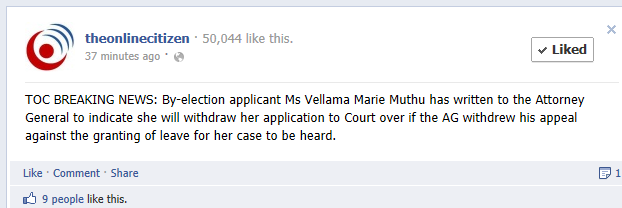
It appears that Mdm Vellama Marie Muthu is seeking to withdraw her case if the AG were to drop the appeal. A proposal has been forwarded to the Attorney General's office by Mdm Vellama's lawyer that upon withdrawal of her application and the AG's appeal, a consent order be drafted and recorded in Court.
Firstly, I believe that the application for the mandatory order has become unsustainable by virtue of the PM's decision to call for the by-election. If at all there is a live issue for the Court to determine, it is in relation to the declaratory orders sought by Mdm Vellama.
Mdm Vellama's application involved the following:
(a) Declaratory orders:
(i) That the Prime Minister does not have unfettered discretion in deciding whether to announce by-elections in Hougang SMC; and
(ii) That the Prime Minister does not have unfettered discretion to decide when to announce by-elections in Hougang SMC and must do so within three months or within such reasonable time as this Honourable Court deems fit; and
(b) A Mandatory Order
- enjoining the Prime Minister to advise the President to issue a Writ of Election mandating by-elections in Hougang SMC pursuant to Article 49(1) of the Constitution of the Republic of Singapore (1985 Rev Ed, 1999 Reprint) and Section 24(1) of the Parliamentary Elections Act (Cap 218, 2011 Rev Ed) and to tender such advice within three months or within such reasonable time as the Honourable Court deems fit.
As the PM has already advised the President to issue the Writ of Election, (b) above is rendered nugatory.
The question of whether the PM has unfettered discretion in deciding whether to announce by-election or in deciding when to announce such by-elections still remains an important Constitutional issue that is undefined and speculative given the gap in our Constitutional and statutory provisions on by-elections. This being the case, I do not think that the declaratory orders are less significant now that the PM has called for the by-election. (Of course, the wording of the declaratory order should be amended in the application to remove the reference to Hougang SMC. There is a generic question as to whether the PM has unfettered discretion in relation to whether and when to announce by-elections in any single member constituency.)
What would happen if the matter proceeds? The application for leave is in the first place being made on account of the mandatory order sought and by virtue of Order 53 of the Rules of Court. The declaratory orders are also being sought under Order 53 and they ride on the mandatory order. If the Court of Appeal rules that leave to appeal would not be granted on the mndatory order, then the application would fail and Mdm Vellama's Counsel has the option of filing a fresh application for the declaratory orders under Order 15 Rule 16 of the Rules of Court. This application, being solely for declaratory orders, would not require the leave of court.
This could be one way to proceed. However, I understand that the letter sent by Mdm Vellama's lawyer alludes to the fact that the Constitutional clarification must await some future date when such matter may arise. That is as good an indication as one may get on whether a fresh application would be made for the declaratory orders. It is plain that Mdm Vellama would not be pursuing any clarification via a fresh set of proceedings.
Since Mdm Vellama has proposed withdrawal, I would expect that the AG (and presumably the PM) would decide to take up the offer and drop the appeal. That would be the politically prudent step to take to avoid any possible fallout.
In any event, I think that Mdm Vellama deserves the respect of every citizen in Singapore. There are some people commenting online about her wasting time in making the Court application in the first place. This is what I have to say: Even if she has been put up to it by some others with a political interest in this situation, it takes a lot of guts to stick one's neck out like this. For that alone she deserves respect. She is a Singaporean that has shown that she meant every word of the pledge that we unashamedly take... "to build a democratic society based on justice and equality". In fact, those people that choose to take our national pledge and still deride the efforts of Mdm Vellama are hypocrites of the highest order. The rest of us, proud citizens, salute her!
In a way, this is our own little Bersih... A cleaner takes the PM to court to clean up our electoral law.
Wednesday, May 09, 2012
Hougang by-election: 26 May 2012
I am very happy to hear that President Tony Tan has today at 4.05pm issued the Writ of Elections for a by-election at the Hougang single member constitutency. Nomination papers for candidates have to be filed by 16th May 2012 and the most likely date for elections would be the 26th of May 2012.
This is definitely good news. Many people have shown skepticism about the PM's willingness to recognise the new reality of the post 2011 political universe in Singapore. When I blogged about the Hougang by-election in an earlier post and expressed my hope that the PM would call for the election expeditiously, there were comments left on this blog and comments from my friends that expressed serious doubt as to whether a by-election would be held at all. I feel that my hope was not misplaced. I do still feel that the current cabinet is willing to go along with the process of re-thinking its approach to governance.
This current decision to call for a by-election has to be seen positively. Yaw Shin Leong was expelled from his party on 15 Feb 2012 and his seat became vacant. The 3 month time-frame that used to exist in our former Federal Constitution would have kicked in on 15 May 2012. (This requirement does not exist in our Constitution today and the timing is discretionary.) By issuing the Writ of Election today, the President under the advise of the Cabinet has clearly acted expeditiously.
What we need in the future is for such expeditious by-elections to be a norm. If a seat becomes vacant, we need a strong political convention that it would be filled expeditiously. A 3 to 6 month timeframe is reasonable. The PM has exceeded my expectation by calling for the by-election within 3 months.
Another small step in the direction of a more democratic Singapore.
(I can imagine that there would be those that take a cynical view about this. The PAP is bound to lose in Hougang anyway. They have nothing to lose, therefore, by calling for an early election. They have tremendous political capital to gain by acting responsibly on this occasion. That would explain the early date. But, I don't mind giving credit where it is due.)
The following is the PM's statement in relation to the Hougang by-election:
"In the General Election in May 2011, nearly all seats were contested. Many important issues were aired and debated. In the outcome, Singaporeans gave the PAP team a clear mandate to form the Government.
Over the past year, the Government has worked hard together with Singaporeans to implement its programme to build an inclusive Singapore, and improve the lives of all.
We set the broad directions when Parliament opened last October. In the Budget in February we followed up with effective schemes to help the poor, the elderly and the disabled. We are also upgrading our companies’ and workers’ skills, so that our economy can grow and Singaporeans can improve their incomes year by year.
However, much work remains ahead to translate good policies and programmes into actions on the ground, and to deliver the results that we all look forward to.
In January this year, news surfaced of personal indiscretions by Mr Yaw Shin Leong, the Workers’ Party (WP) Member of Parliament for Hougang constituency. The WP first kept totally silent, then supported Mr Yaw, and then three weeks later suddenly expelled him from the party. Until now the WP has not given Singaporeans a full and proper account of what happened, or why it acted in this way. Mr Yaw himself has said nothing, either to explain or to apologise for his behaviour, and has reportedly left the country. Both the WP and Mr Yaw have let down all those who voted for him. As a result of Mr Yaw’s expulsion from the WP, the Hougang constituency seat fell vacant.
I hope these events will not distract us from focussing on our national priorities, and building an inclusive Singapore. Although the Constitution does not require me to call a by-election within any fixed timeframe, I said in Parliament that I intended to call a by-election in Hougang. This morning I advised the President to issue the Writ of Election.
The by-election will give Hougang residents the chance to elect a new MP to serve them. I encourage Hougang voters to use this opportunity wisely, to elect the best candidate with commitment and integrity: someone they can rely upon to express their hopes and concerns, address their needs, and make a real difference to their lives."
Thursday, April 12, 2012
The Houngang by-election case - The decision to grant leave
Justice Philip Pillai has given his written reasons for the decision to grant leave for judicial review in the case of Vellama d/o Marie Muthu v AG.
Having read the court's reasoning, what I can gather is that the judge has stated that he is satisfied that the 'low threshold' for granting leave has been crossed. Exactly why the Court is satisfied as such is not stated (or at least I can't find it.
In his conclusion, the judge states:
"Based on what was presented and submitted to me for the purposes of the leave application, without making any comment or decision on the merits or the substantive legal issues, I granted leave for a judicial review hearing as I was of the view that the very low threshold for leave has been met."
I suspect that this might be a problem during the appeal. What was the judge's reason for coming to the 'view that the very low threshold for leave has been met?
Paragraphs 1 to 3 of the decision set out the orders sought by Applicant (Ms Vellama) and the fact that the Court granted leave for judicial review on 2nd April 2012.
Paragraphs 4 to 8 set out the factual background to the application.
Paragraphs 9 to 13 set out the law relating to the threshold to be crossed for the granting of leave for judicial review. The law here is uncontroversial and it is as follows:
(i) the matter complained of is susceptible to judicial review;
(ii) the applicant has sufficient interest in the matter; and
(iii) the material before the court discloses an arguable or prima facie case of reasonable suspicion in favour of granting leave.
Points No.(i) and (ii) were not disputed. The issue before the court was, therefore, whether there's a "prima facie case of reasonable suspicion"
Paragraphs 14 to 16 deal with the relationship between Order 53 and Order 15 Rule 16. This relates to the question of whether leave for judicial review is required for declaratory orders (as opposed to mandatory orders for which leave is clearly required). (A declaratory order is one that is in the form of a clarification of the legal position without ordering any government body to do anything. A mandatory order requires the government body to comply with the court's direction to carry out a particular act.)
The discussion in these paragraphs did not relate to the issue of whether there was a "prima facie case of reasonable suspicion." It was more on the question of whether leave was required in the first place for the declaratory orders.
Paragraphs 19 to 23 involve a narration by the judge of the arguments put forward by the respective lawyers on the mandatory order sought by the applicant. The judge did not express his opinion on these arguments.
Paragraphs 24 to 27 involve a narration of the arguments by the parties on the declarations requested by the applicant. The judge states the following:
"Counsel for the applicant earlier informed the AG’s counsel and the court that he would if necessary immediately apply under O 15 r 16 for the First and Second Declarations to be considered as standalone declarations for which the leave of court is not required. In light of this, the question of whether the quite separate requirements for standalone declarations have beenThe judge therefore appears to have taken the view that the issue of leave requirement for the declaratory orders did not need to be addressed.
met would have to be determined at a substantive hearing, which this O 53 leave hearing is not."
Finally, at paragraph 29, the Judge concludes:
"Based on what was presented and submitted to me for the purposes of the leave application, without making any comment or decision on the merits or the substantive legal issues, I granted leave for a judicial review hearing as I was of the view that the very low threshold for leave has been met."
I am unable to ascertain from the decision the specific reason that led to his assessment that the "low threshold for leave has been met" apart from his assertion that the threshold has been met (Unless, one is to assume that he accepted the arguments put forward by the Counsel for the appellant and that constituted his reason for stating that the low threshold had been met.)
I hope that the Court of Appeal does not find this problematic. To be fair, the judge has no duty to examine the substantive merits of the application. But, I would have expected that something was stated as to why he made the finding that the threshold had been met.
Sunday, February 19, 2012
Bye Yaw, and now for the By-Election
Anson was a long time ago. CV Devan Nair vacated his seat in Parliament before his elevation to the position of President. J B Jeyaretnam participated in the by-election for the Anson constituency and recorded that historic win against the PAP. 1981 seems like a distant memory now. The PAP stranglehold on Parliament had been punctured. There was a lone voice catapulted into the legislature willing to champion the cause of the people against the mammoth PAP government.
We had not progressed that much from then. At the very best (before 2011), the opposition managed 4 seats in Parliament. But, for the most part, it was just 2 seats. It was, therefore, fitting that last year (being the 30th anniversary of the Anson victory) another milestone was crossed in Singapore's electoral history. The fall of a GRC was a big psychological boost for the opposition and its supporters. It has also ushered in an unprecedented boldness and a willingness express views fearlessly.
The GRC itself was one of the methods by which the ruling party managed to keep the opposition at bay. There is no doubt in my mind that if the GRC system had never been introduced, the PAP would have lost more seats in earlier elections. (My views on the mechanics of domination exercised through the GRC..... http://article14.blogspot.com/2009/06/uniquely-singapore-papmandering.html )
Throughout this period from the 1980s to the present, the PAP has also been careful to avoid by-elections. To me, the most disappointing moment was when the Bukit Batok MP, Ong Chit Chung, passed away. There was a conflict between the Constitution and a statutory provision and in my view the Constitution ought to prevail. They made no Constitutional amendment and they just gave elaborate excuses and convinced the masses that no by-election was necessary. (I had blogged about this before.... http://article14.blogspot.com/search/label/Bukit%20Batok ) In the end, Bukit Batok went without a member of parliament for nearly 3 years (July 2008 to May 2011).
And now, we have an opposition MP that has vacated his seat. A by-election has to be called. The problem is that our laws are silent as to the time limit for calling a by-election. Pursuant to the Constitution, when an MP is sacked by his Party, the MP's seat falls vacant. Under the Parliamentary Elections Act, the President has to issue a Writ of Election. No time limit is set for this. Under the Constitution, this is one of those powers of the President that does not come within his discretion and it is for the Cabinet to advise him. The problem now is the PM seems to think that there are pressing national issues and so he seems to suggest that a by-election is not within him immediate focus.
This is an area that has to be legislated. I hope that this issue is not left as a mere discretion and a certain timeline be set for by elections in the future. We could do it by legislation or if our politicians are mature enough a multi-party code can be devised where political parties can agree to hold by elections within a fixed time frame when there is a casual vacancy.
It is totally untenable to leave the question of a by-election hanging in the air and in fact it is irresponsible to let Hougang residents hanging in there without a member of parliament.
We had not progressed that much from then. At the very best (before 2011), the opposition managed 4 seats in Parliament. But, for the most part, it was just 2 seats. It was, therefore, fitting that last year (being the 30th anniversary of the Anson victory) another milestone was crossed in Singapore's electoral history. The fall of a GRC was a big psychological boost for the opposition and its supporters. It has also ushered in an unprecedented boldness and a willingness express views fearlessly.
The GRC itself was one of the methods by which the ruling party managed to keep the opposition at bay. There is no doubt in my mind that if the GRC system had never been introduced, the PAP would have lost more seats in earlier elections. (My views on the mechanics of domination exercised through the GRC..... http://article14.blogspot.com/2009/06/uniquely-singapore-papmandering.html )
Throughout this period from the 1980s to the present, the PAP has also been careful to avoid by-elections. To me, the most disappointing moment was when the Bukit Batok MP, Ong Chit Chung, passed away. There was a conflict between the Constitution and a statutory provision and in my view the Constitution ought to prevail. They made no Constitutional amendment and they just gave elaborate excuses and convinced the masses that no by-election was necessary. (I had blogged about this before.... http://article14.blogspot.com/search/label/Bukit%20Batok ) In the end, Bukit Batok went without a member of parliament for nearly 3 years (July 2008 to May 2011).
And now, we have an opposition MP that has vacated his seat. A by-election has to be called. The problem is that our laws are silent as to the time limit for calling a by-election. Pursuant to the Constitution, when an MP is sacked by his Party, the MP's seat falls vacant. Under the Parliamentary Elections Act, the President has to issue a Writ of Election. No time limit is set for this. Under the Constitution, this is one of those powers of the President that does not come within his discretion and it is for the Cabinet to advise him. The problem now is the PM seems to think that there are pressing national issues and so he seems to suggest that a by-election is not within him immediate focus.
This is an area that has to be legislated. I hope that this issue is not left as a mere discretion and a certain timeline be set for by elections in the future. We could do it by legislation or if our politicians are mature enough a multi-party code can be devised where political parties can agree to hold by elections within a fixed time frame when there is a casual vacancy.
It is totally untenable to leave the question of a by-election hanging in the air and in fact it is irresponsible to let Hougang residents hanging in there without a member of parliament.
Labels:
by-election,
constitution,
elections,
GRC,
hougang,
Yaw Shin Leong
Wednesday, July 15, 2009
Pork Barrel Politics: Good or Bad?
In the run up to the 1996 General Elections, the then Prime Minister Goh Chok Tong warned voters:
"Your estate, through your own choice, will be left behind. They'll become slums. That's my message."
The PAP then issued an open letter stating: "Please remember that the PAP government cannot upgrade all estates at the same time..... Our resources are limited. Which ones to upgrade first will depend on you. If you give strong support, you will be first in line."
The US State Department had some unkind words for the PAP with regard to the latter's 'threat' to the voters.
BG George Yeo retorted by stating that pork barrel politics had a long tradition in the USA.
so, I take it that pork barrel politics is good.
In 2005, at a luncheon organised by the Foreign Correspondants' Association, PM Lee Hsien Loong said the following with reference to Japan:
“...they landed into problems because of corruption, money politics, pork barreling, and then necessary changes were not made and the country, instead of making adjustments and prospering like America, just flew straight on and went into a storm. So how do we maintain our system and not end up like that?”
so, I take it that pork barrel politics is bad.
Good or bad, pork barrel politics continues. Whereas upgrading was delayed/withheld in the past, now upgrading has been promised for Hougang and Potong Pasir residents. A little sweetener before the elections. If the stick didn't work, perhaps the carrot would?
"Your estate, through your own choice, will be left behind. They'll become slums. That's my message."
The PAP then issued an open letter stating: "Please remember that the PAP government cannot upgrade all estates at the same time..... Our resources are limited. Which ones to upgrade first will depend on you. If you give strong support, you will be first in line."
The US State Department had some unkind words for the PAP with regard to the latter's 'threat' to the voters.
BG George Yeo retorted by stating that pork barrel politics had a long tradition in the USA.
so, I take it that pork barrel politics is good.
In 2005, at a luncheon organised by the Foreign Correspondants' Association, PM Lee Hsien Loong said the following with reference to Japan:
“...they landed into problems because of corruption, money politics, pork barreling, and then necessary changes were not made and the country, instead of making adjustments and prospering like America, just flew straight on and went into a storm. So how do we maintain our system and not end up like that?”
so, I take it that pork barrel politics is bad.
Good or bad, pork barrel politics continues. Whereas upgrading was delayed/withheld in the past, now upgrading has been promised for Hougang and Potong Pasir residents. A little sweetener before the elections. If the stick didn't work, perhaps the carrot would?
Subscribe to:
Posts (Atom)