Pages

Thursday, June 28, 2012

City Harvest saga - Satirists and Apologists

I am not going to waste any time blogging about whether Kong Hee and the 'gang of four' had indeed committed criminal breach of trust.  That matter is now clearly before the court.  If they are innocent, let them be cleared.  If they are guilty, let them be punished.  At this stage, without any indication of the extent of evidence at the Prosecution's disposal, it is hard to make any rational assessment of the strength of the Prosecution case. 

There is something about this saga that I find rather amusing:  the Pastor's wife and the "Crossover Project".  I know that sex sells and most marketing agencies will vouch for the effectiveness of sex appeal in advertising.  However, there is a certain incongruity when the conceptual underpinning in the "crossover project" is to appeal to baser instincts in man in order to spread the message of God. The claim being made by apologists of the Crossover Project is that the music career of Sun Ho is intended to reach out to a broader audience on behalf of the Church so that more could hear the message of Christ. 

I was totally amused by two articles that I read.  The first one appeared in New Nation (the self-proclaimed fake news site) and was presented as a letter from a member of the City Harvest Church.  The second is an article on The Online Citizen.  Although it is clear that the article in New Nation is meant to be a satire, it is both amusing and shocking to see how some comments from the faithful within the CHC appear to mirror the satirical piece.  I am, therefore, not suprised that some readers couldn't make out the fact that the New Nation piece is a satire.  Apologists sound just like satirists. 

The New Nation article:

Dear Editors,


I am deeply saddened by the reactions of netizens to the arrest of my dearest pastor Kong Hee. As a long time member of City Harvest Church, the public clearly does not understand the sacrifices he had to make in the name of God.

When I first received Sun Ho’s Chinese pop CD in 2003, I thought to myself: “what kind of devil’s music is this?” But as I listened more, it began to dawn on me that I was being overly prudish and she was actually spreading the word of God in the form of Satan-worshipping music to beat the devil at his own game.

Indeed, the more involved I became at the Church, the more I began to understand that I could not even begin to comprehend God’s plan and the plans pastor Kong had for me, and the church. You see, I am but mortal. Pastor Kong was the chosen one.

Without his light shining like a beacon of conscience, the gays, prostitutes, and the opposition would start to take over Singapore. Satan would then have a hub to take over the world.

So it was with deep love that I decided to dedicate 30% of my husband’s salary each month to help fund Sun Ho’s music career as part of the Crossover project.

As a good christian, I have an obligation to The Lord to spread his message: from Singapore to Malaysia, to Taiwan, China and even the town of sin, Hollywood.

It must have been extremely difficult for pastor Kong to see his wife in such disgusting states of undress in public, and for her to live in the heart of the most unholy places on earth, Beverly Hills. I’ve watched the TV series 90210 when I was younger. These people have no morals but like lepers, the Man and Woman of God must go to the sick to heal the sick.

People outside the church don’t understand us and are so quick to condemn when they haven’t experienced God through His music, sung to thumping beats and a negro man saying something intelligible at the beginning.

I do not understand how “China wine” or being a Geisha is related to God’s work, but as I said, I’m only mortal. God has a plan, even when I don’t understand. Even when it involves S$23 million. If pastor Kong was using that money, it must be God’s will.

Jesus preaches forgiveness, and therefore we must forgive even if we don’t want to.

So I forgive the government, and the public for misunderstanding and maligning the Church.

There’s a special place in hell for people who say nasty things about Kong Hee and an even worse one for those that framed God’s chosen workers.

I pray that it will be like Sodom and Gonorrhea.

Yours truly,


Conservative Nazi

The following is from TOC's site:
 
Mr Aries Zulkarnain, the Executive Pastor and a Founding Member of City Harvest Church (CHC) since its start 23 years ago says that the church stands with the members involved.


“The people currently in the news are pastors, trusted staff and leaders who have always put God and CHC first. As a church, we stand with them and I believe fully in their integrity. Pastor Kong is still our Senior Pastor.”

Mr Zulkarnain says that the Commissioner of Charities (CoC) has confirmed that Mr Kong Hee, the Senior Pastor, and Mr Tan Ye Peng, the Deputy Senior Pastor will continue to preach at the church.


He emphasises that church activities are not affected by the case. “CHC will continue to do its work. Our services and cell group meetings will carry on as usual. As a church we will continue to take care of our members and our community. We will not stop doing God’s work.”

With regard to the allegations, Mr Zulkarnain says, “It has been suggested that the church has been cheated of $50 million. This is not accurate. The $24 million, which went to investment bonds, was returned to the church in full, with interest. We didn’t lose $24 million, nor did we lose ‘another $26 million’ as alleged. The church did not lose any funds in the relevant transactions, and no personal profit was gained by the individuals concerned.”

Speaking on behalf of the Board, Bobby Chaw, the pastor in charge of missions at CHC, says that actions had been taken over the past two years in accordance with the MCYS’s code of governance.

“We replaced 50% of our Board with new members. We engaged RSM Chio Lim to do a full internal audit and we have been putting their recommendations into action, and will continue to do so,” says Mr Chaw. “We appreciate the need to maintain good corporate governance, and we are continuously working with MCYS to do so.”

However, Mr Chaw expressed his disappointment with some of the media’s coverage so far, particularly in relation to the CoC enquiry.

“In some instances, they seem to have pre-judged us. We will be dealing with this in due course,” he says.

He adds that the church was also surprised that CoC chose to implement the suspensions of the members involved without prior notice. “We have been co-operating with CoC for two years since the start of the case, so these sudden suspensions came as a surprise to us.”

CHC’s Advisory Pastor, Rev Dr Phil Pringle is in Singapore to stand by CHC. He is the Senior Pastor of C3 Church, Sydney, and the C3 Global Network of Churches. Dr Pringle expresses his support for the leadership.

“I have known CHC, Kong, Sun and Ye Peng for a long time. CHC is not just a local church in Singapore. It has 49 affiliated churches and 6 Bible Schools all across Asia. It has impact on international ground, and it has proven through many years that it serves the global community, both spiritually and practically through humanitarian works.”

Dr Pringle says he, along with CHC’s Advisory Chairman Dr A R Bernard, who is the Senior Pastor of Christian Cultural Center in Brooklyn, New York, fully believes in and endorses CHC’s Crossover Project as a mission to reach the world.

CHC states that the Crossover Project is not about one person’s singing career; it is a mission that is fundamental to the congregation of CHC. The Crossover Project is an outreach that uses Sun Ho’s singing and music to engage people and places that would never otherwise hear the Gospel. As a result of the Crossover Project, many churches have grown worldwide and the faith of many have been strengthened. Impact has been made on the needy in Haiti, disaster victims in China, the depressed and suicidal in Taiwan, and the sick children in Honduras, among others.

Dr Pringle says, “The Gospel is the Good News and Christians are meant to share it. CHC has done this through the Crossover Project, which lies at the very heart of our religious beliefs.”

The IMF Loan and the Office of the President

Much was debated during the Presidential Elections in 2011 about the power of the Elected President in Singapore.  There were those that argued for a fully intrusive and almost combative role for the President in scrutinising the executive arm of government.  There were those that argued that the Elected President's role was no more than that which is fulfilled by the Queen of England as the Head of State (with the exception of a constitutionally reserved discretion when it came to the use of our reserves).  Others (like myself) contended that where the constitution was silent, the President could take a pro-active role and that this may be politically necessitated by the fact that the President could carry the mandate of the electorate (giving rise to the evolution of a constitutional convention). 

Whatever the shades of argument, one thing was very clear: There was no dispute as to whether the President had discretionary powers in relation to the matters specifically stipulated in the Constitution. An example of such stipulations could be found in Article 144(1) of our Constitution.   

That brings us to the issue surrounding the IMF loan pledged by the Singapore government.  Firstly, this is not part of the current subscription payable to IMF.  It is clearly an additional loan.  Leaving aside the contentious issue of interpretation of whether or not a loan given by the government is required under Article 144(1) to be subject to the President's approval, it is clear that a circumstance that falls within the ambit of Article 144(1) triggers one of the discretionary powers of the President. 

When Kenneth Jeyaretnam recently wrote to the President to seek clarification as to whether his consent was sought, the President has reportedly responded by stating that his permission had not been sought. http://sonofadud.com/2012/06/21/the-truth-about-that-imf-loan/

Kenneth has also stated that the President has referred this matter to MAS.  I would have expected something more proactive from the President.  Several questions arise in my mind.  Was the President fully appraised of his powers under Article 144(1)?  What is the interpretation of that provision that the President himself subscribes to?  Does the President agree with the view expressed in 1997 by the AG that a loan received by the government has to be approved and that a loan given by the government does not need to be approved? (http://www.article14.blogspot.sg/2012/06/singapores-pledge-of-us-4-billion-to.html)  If he agrees with that interpretation, could he not have informed Kenneth Jeyaretnam that the Article 144(1) issue does not arise and that his consent was not necessary?  Did the President have any specific reaction to the government's decision to grant the loan to IMF?  Did he ponder about whether he had a role in the process?  Or was he only going to exercise the discretion to grant consent when consent was requested? 

This is an important point to ponder about when we consider the role of the President.  There is no doubt that Article 144(1) deals with an area of the President's discretionary power.  Since we do elect our President and since the bare minimum that we might expect him to do in relation to his responsibilities is the safeguarding of the reserves and since Article 144(1) deals with such express discretionary power, there should be a strong expectation on the part of the electorate that the President carry out his Constitutional duties actively.  So, I hope that President Tony Tan had a clear understanding of Article 144(1) and that he was aware of the potential for the IMF loan to fall foul of that Article and that he actively addressed his mind to it and then decided that his consent was not necessary as the issue did not fall within the ambit of the Article.  Nothing less than that will do. That is the minimum expectation that we as the electorate should have in relation to the Elected President. 

Sunday, June 17, 2012

Punishment must fit the crime

The issue of whether punishment fits the crime has been the flavour of the week for me with two previous posts dealing with the question of corporal punishment for vandalism.

Hot on the heels of that we have Dr Woffles Wu being fined $1000 for abetting in providing misleading information to the police in relation to a traffic offence. The facts as reported in the newspapers seem to suggest that after Woffles Wu had commited speeding offences, his elderly employee had admitted to the commission of the offences.

When I first read that I assumed that Dr Wu would have been charged under the Penal Code. The obvious provision that I had in mind was s.182 of the Penal Code.


False information, with intent to cause a public servant to use his lawful power to the injury of another person


182. Whoever gives to any public servant any information which he knows or believes to be false, intending thereby to cause, or knowing it to be likely that he will thereby cause, such public servant to use the lawful power of such public servant to the injury or annoyance of any person, or to do or omit anything which such public servant ought not to do or omit if the true state of facts respecting which such information is given were known by him, shall be punished with imprisonment for a term which may extend to one year, or with fine which may extend to $5,000, or with both.

The other likely provision was s.204A of the PEnal Code:

204A. Whoever intentionally obstructs, prevents, perverts or defeats the course of justice shall be punished with imprisonment for a term which may extend to 7 years, or with fine, or with both.

Giving false information to the police (and to some extent obstructing the course of justice) is ordinarily treated by the judiciary as being rather serious and in the past custodial sentences have been given for such offences. I was understandably surprised (and so were other friends of mine in the legal profession) that Woffles Wu did not get a custodial sentence.

I assumed that the mitigation plea by the counsel must have been really good. Of course, plenty of speculation arose as to whether he was treated leniently because of the fact that he was a well connected person. One blogger came up with a catchy line.... "In the land of the saggy, the man with the botox syringe is king." See: http://everythingalsocomplain.com/2012/06/13/woffles-wu-lying-to-the-police/
One PAP MP, Hri Kumar, joined in the fray by lamenting the inconsistency in our sentencing regime. I am very glad that he did. We seriously need to look at our criminal laws as a whole come up with a coherent approach to sentencing. In those areas where judges are given discretion, we need a clear and transparent sentencing policy for the courts.
http://hri-kumar.blogspot.sg/2012/06/crime-and-punishment.html

Something was not quite right with the sentence and I couldn't bring myself to believe that the court would have let Woffles Wu off so easily given existing sentencing precedent for similar offences. Charlie Lim Chau Lee was sentenced to imprisonment for 6 months for getting his friends to take the rap for a traffic offence committed by him. The difference in the sentencing is too stark to be dismissed as merely difference based on the facts of the individual cases.

The inevitable perception building up amongst the public is that the rich and the elite can get away with lighter punishment when compared to ordinary citizens. This is the general trend of commentary emerging on blogosphere right now. Up till this morning, I was having some difficulty reconciling the picture that was building up. I can't imagine that our judiciary will act so inconsistently that Woffles Wu could get away with a fine.

Finally, it dawned on me when I read the AG's Chamber's press statement as well as the Law Minister's comments that Woffles Wu was charged under S.81 of the Road Traffic Act and not the Penal Code. http://www.todayonline.com/Singapore/EDC120617-0000020/Law-Minister-explains-Woffles-Wu-sentencing

http://www.agc.gov.sg/documents/AGCPressRelease17Jun2012.pdf


So, it turns out that this is a case of prosecutorial discretion as opposed to judicial leniency. AGC explains in the press statement the reason for not charging Woffles Wu under s.204A. The provision was not enacted at the time that the offence had been committed. That is a valid legal position. But, of course, I can't help but wonder why he was not charged under s.182 of the Penal Code. That was, to me, the most obvious provision for an offence such as this.

The AGC in its press release has given its reason for not proceeding under s.182:

"The charge preferred against an accused person would be calibrated to reflect the seriousness of the criminal act and the fact situation, and whether the legislation in question provides a specific provision dealing with the criminal act or whether reliance has to be placed on general legislation such as the Penal Code. On the facts of this case, as there was no major accident or injury, it was considered appropriate to proceed under s 81(3) of the Road Traffic Act rather than invoke the general provisions of the Penal Code, such as s 182."

Firstly, I accept the AGC's position on s.204A. But, I find it hard to accept the position taken in relation to s.182. I am not convinced that the lack of injury should have been considered. The gravamen of the offence involving giving of false information is the falsity of the information and deliberately misleading public officials in their administration of justice. False information could have been given in relation to a littering offence. That does not detract from the seriousness of the fact that false information was given in the first place. The fact that there was no injury involved should not have been decisive in the decision not to prosecute under s.182 of the Penal Code.

I am pretty sure that if the charge was under s.182, the judge would have imposed a custodial sentence. I will cut some slack to the prosecution here though. Making a decision as to the offence to be charged is not an easy one and it is inevitable that tough decisions have to be made. It is unfortunate that the prosecution chose to charge Woffles Wu under the Road Traffic Act as it has sent a very wrong signal to the public. Too many people are now under the impression that the rich can get away with a light sentence. I am sure that this factor did not figure at all in the AGC's deliberation. But, this is the perception that has arisen.


Thursday, June 14, 2012

Singapore YOG & London Olympics: A Tale of 2 Budgets


The UK Sports Minister Hugh Robertson has revealed that the expenses for the London Olympics would be within the budget allocated for the games. A budget of 9.3 billion pounds was set in 2007. Hugh Robertson has indicated that about 500 million pounds would be returned to the Treasury as they are within the budget.

This is how you come out smelling like a rose. Set a high budget with a huge contingency in the budget (2 billion pounds) and then keep your spending within the budget. You get lauded for your fiscal responsibility.

Compare that to the heat receieved by Singapore's former Minister for Community Development, Youth and Sports, Vivian Balakrishnan. The budget set for the Youth Olympic Games was $104 million and the spending went up to $387 million.

Although the Olympic Games cannot be compared with the Youth Olympic Games in terms of logistics and expenses, I am trying to draw a comparison with the way expectation management is done. The organising committee for the YOG grossly underestimated the expenses and set a budget that was too low. In the end, given the nature of the event, $387 million was probably a reasonable sum.

But, in Singapore, the public conversation saw a mishmash of issues colliding together to form an overall anti-PAP rhetoric. (Incidentally, despite my long-standing stance against the PAP's authoritarian style of government, I did not see the YOG budget as an issue. If anything, the problem was in the initial estimate of the organising committee. It was not a case of fiscal irresponsibility.) 2010 was the year of the "once-in-50-years" flood. Singaporeans were becoming increasingly conscious of the presence of large number of foreigners. The plight of senior citizens fending for themselves by scavanging for tin cans was becoming more evident. For many, the YOG expenses became indicative of a government that had the wrong priorities.

I can imagine that the organising committee of the YOG could have estimated the budget at $500 million and kept the spending to $387 million leaving a balance of $113 million. I suspect that not much of a complaint would have been raised (and Vivian Balakrishnan might have kept his previous portfolio instead of being sent to fight floods).

From a public relations standpoint, the UK Sports Minister has scored a respectable point by keeping the Olympic Games expenses within the budget by 500 million pounds.

Tuesday, June 12, 2012

The politics of caning

Whilst the sticker lady issue rages on, I think this is an appropriate time to reconsider our sentencing philosophy.

I blogged about this two days ago. In the course of reading the Parliamentary debates in relation to the Punishment for Vandalism Bill 1966, it is clear that one concern was playing itself out. It appears that there were widespread instances of vandalism in Singapore and it is also evident that political slogans (anti-colonial, anti-american and pro-vietcong) were surfacing. I did not live through that period and it is hard to say if the events were as widespread as alleged or if this was just exaggeration to gain leverage for insisting on caning as a punishment.

Unrelated to the debate on the Vandalism Bill, other debates in Parliament in 1965 to 1967 reveal references to acts of vandalism that are politically motivated. There are references to Barisan Socialis being responsible for instigating these 'anti-nationalist' actions.

However, in the debate on the Vandalism Bill, the focus is on a broad range of vandalism offences. Anything from hanging banners to painting and damaging property. The extreme measure of caning is recommended as a deterrent. The distinction drawn in order to justify the use of a severe punishment is on the basis of whether the vandal has left a delible mark. If it is indelible, caning is mandated. If it is delible, caning is not mandated for a first time offender.

Using traffic lights as an example, caning is mandated if you destroyed a traffic light. It is mandated if you painted on the traffic light. Caning is not mandated if you pasted removable stickers on it or hung slogans from it and you happen to be a first time offender. But, a second offence involving hanging a slogan from a traffic light would trigger caning.

To me, it is shocking to cane someone for the act of hanging a banner (although it is restricted to a repeat offender).

Though I did not live through those times, I can't help but walk away with the feeling that the Vandalism Act introduced caning for vandals primarily because of the politcal nature of the vandalism that was taking place rather than the fact that vandalism was taking place at all.

LKY's own comments about how these vandals would be prepared to go to jail and consider themselves martyrs is indicative of the fact that the government did not have in mind the ordinary vandal who might at most be a delinquent and wayward individual. Caning was seen as a way of deterring anyone thinking of turning himself into a political martyr.

I have extracted the PM's (LKY) speech from the 2nd reading of the Bill:

Mr Speaker, Sir, I would like to explain to the House what we are seeking to do by making this departure from what is normal criminal law legislation. One of the problems we face in running the British system of administration of justice is that the law is often being administered, particularly in recent years, by legally trained magistrates who do not have the advantage of the wider background of the problems of the society and of administering that society. So it is that by the time the offender of a particularly vicious social misdemeanour, like taking a pot of paint and going to every bus stand and chalking up anti-American or anti-British or pro-Vietcong slogans, is apprehended and brought to court, from the vicious petty slogan-shouting hooligan that he is outside, he converts himself into a meek, humble breadwinner of a large family who was doing no more than just giving vent to his political exuberance. And he gets off with a caution and sometimes a light fine. The net result is that this particularly vicious social misdemeanour is not capable of being checked, let alone stopped. It is difficult enough to apprehend these offenders. Under the section in the Minor Offences Ordinance which we have to operate, this is a non-seizable offence. So if you are not a police officer, or even if you are a member of the Vigilante Corps, you will be a very brave man to go and apprehend such a culprit. I do not think it is possible for us to go back to the old British practice where people who are administrators, having served a term in the business of running the government, then do a spell of two or more years on the Bench, and so there is a constant flow of fairly matter-of-fact gentlemen who understand the mechanics of how the system works and know the other side of the coin, not just what happens in the courtroom.

The Bill makes a clear distinction between what is considered a lesser offence, something which just dirties up the wall - which is delible - and where you deliberately seek to mess up the place from time to time with red paint, which is a very difficult substance to eradicate, on bus shelters and public buildings. Large sums of money are expended in order to remove the unsightly scars which they leave behind.

Recently the problem has been complicated by the ease of access to public property which, in the nature of things, is difficult to prevent. Thefts of fountain heads made of copper, copper tubes outside Housing and Development Board premises used for boilers and other things - and copper is in short supply because of the transportation problem of Rhodesian and Zambian copper - and thefts of valuable parts of non-ferrous metals have taken place, to be sold for a fraction of their actual cost. I do not think we can allow this to go on, and I know how strongly the profession and the penologists are against caning. But we have a society which, unfortunately, I think, understands only two things - the incentive and the deterrent. We intend to use both, the carrot and the stick. The carrot is good citizenship. It is a seizable offence to do any of these acts of vandalism, and any member of the Vigilante Corps, any member of the public, can apprehend. A reward will be given in order that these culprits will be apprehended and these crimes will stop.

On the other hand, a fine will not deter the type of criminal we are facing here. He is quite prepared to go to gaol, having defaced public buildings with red paint. Flaunting the values of his ideology, he is quite prepared to make a martyr of himself and go to gaol. He will not pay the fine and make a demonstration of his martyrdom. But if he knows he is going to get three of the best, I think he will lose a great deal of enthusiasm, because there is little glory attached to the rather humiliating experience of having to be caned.

I am not suggesting, Mr Speaker, Sir, that I am quite sure that this is going to solve our problem, but I am convinced that if we are not prepared to innovate, if we are just to stick to old formal channels of legislation or old forms and modes of social control, then these are areas of public behaviour over which society will have no control whatsoever. I hope that there will never be any cause, once these provisions are known, for them ever to be invoked. But I feel reasonably confident that if the offenders are apprehended - as I think they can be apprehended; these are seizable offences and there are enough people in the Vigilante Corps and public-spirited members of the ordinary public - and an example is made of a few, then we will not have the discomfiture of finding the electric power supply failing, because somebody risks blowing up a whole transformer substation for a few dollars' worth of public property which is not sufficiently guarded. If this is understood - and they have a tendency to understand very quickly once the word gets around -I am quite sure that there will be a healthier respect for community property. This happens all over the world. But in every society, values are different, and ours is a new and young one. We could take the other point of view - the Government could be purely negative and say, "Well, in that case, we should not have this community property. We should not have fountains. We should not have these parks. We should not have these amenities, because they are likely to be destroyed, mutilated and losses will be heavy." I think that is a defeatist attitude. By and large, I would say that the majority of the people are law- abiding and respect community property, and if we can check the misbehaviour of this minority, then we can move into wider fields of public amenities with greater confidence that, first, the expenditure will not be wasted, and, second, the maintenance will be what the planners estimate it to be and not what we subsequently find ourselves carrying.

I hope eventually that the remarks I have made here in this House will also be heeded not only by the offenders but also by those who participate in the administration of justice. I have a feeling that often in the younger ranks of the service, the administration of justice is believed to be the application of the law. It is because they believe that, that we are forced to take these measures. I think a wider grasp that administration of justice means the application of the letter of the law in such a spirit that society is able to protect itself, is fundamental. If we are able to implement these provisions with efficacy in the first few months, I am quite sure that this will be a dead letter in our statute book.

Parliament could have increased the fine and length of imprisonment for this offence instead of introducing corporal punishment. It is clear that when the PM in fact spoke of the deterrent effect, he referred specifically of those flaunting the values of their ideology. The ordinary vandal might well be deterred by imprisonment. The political slogan-shouter needed more than imprisonment to deter him.

The Law Minister E W Barker offers up another justification for caning:

"The punishment of caning has been introduced advisedly and after considerable thought. It has been found in practice that while many convicted persons will accept without demur a heavy fine or even a lengthy sentence of imprisonment, they tend to view with the greatest alarm and despondency any sentence which requires the infliction of caning. This is, of course, typical of the mentality of the bully and the coward and of those who choose to perpetrate their offences under cover of darkness, which is, in fact, the case with the majority of acts of this sort. Caning has accordingly been made mandatory upon conviction..."

I wonder whether the reference to "it has been found in practice" is based on purely anecdotal evidence or on extensive field research. I can imagine that on a personal subjective level caning would deter me more than a fine or imprisonment. That being the case, if we found that a particular crime is on the rise, it would be easy to use caning as a deterrent. That would lead us down a slippery slope. As littering seems to be on the rise compared to 10 years ago, why don't we just introduce caning as a deterrent, for instance. CWOs don't work as well as "3 of the best" (to use LKY's reference to caning). In the end, punishment must fit the crime.

A curious feature of the Parliamentary debate is the way that the justifications were not refuted except for a brief speech by Mr Tang See Chim that questioned whether caning would really have a deterrent effect:

I have the impression that the Government is taking the view that severity of punishment is a deterrent. Mr Speaker, Sir, severity of punishment may not, in fact, necessarily be a deterrent. The way to deter any crime, I submit, is to impress on the wrong-doer the certainty of his being found out if he commits one. Also I have the impression that as far as acts of vandalism are concerned, that is, excluding the anti-national elements, this Bill could only be an interim measure, because, as I see it, vandalism cannot be rooted out by the introduction of a Bill with very severe punishment. It can only be rooted out by educating our young to respect public property and to have a sense of pride in the public amenities provided by society.


Nothing more robust than that was raised. No issue was taken as to whether corporal punishment may be inappropriate for a property offence. No issue was taken as to whether corporal punishment may amount to a form of cruel and inhuman treatment. (But then again, thanks to the Barisan Socialis walkout from Parliament and the consequent PAP dominance, there were no opposition MPs on hand to question the introduction of caning for this offence.)

In the history of our post-independence legislature, deterrence as the logic for corporal punishment has led us on a downward spiral, resulting eventually in the imposition of caning for drug abusers (an offence that requires medical and psychological rehabilitation more than any other offence) and even for immigration offenders (overstaying by more than 90 days after the expiry of the visa). We need to revisit the question of whether corporal punishment is appropriate in the first place and if so, whether our sentencing regime is in accord of the principle that punishment ought to fit the crime.


Sunday, June 10, 2012

The vandal on a pedestal and an incoherent sentencing philosphy

The sticker lady might get charged and eventually convicted under the Vandalism Act. But, one thing is for sure: She will not be subject to caning.

Whilst caning is provided for an offence under s.2 of the Vandalism Act, women are exempted from corporal punishment generally. Caning is not the norm for most offences in Singapore and it is reserved for very specific crimes.

Whether sticker lady (Samantha Lo) should be let off the hook or punished for vandalism is an issue that has been raging on blogosphere. There are those that take the view that this is a form of artistic expression and the state must give a little bit of leeway and that she should be let off with a warning. There are still others that take the view that a law has been infringed and there is good reason for having laws against vandalism and exceptions cannot be made (for fear of a descent into chaos.)

My view on this? As much as I believe that artistic expression needs to be spontaneous and not contrived and as much as I believe that there is value in the kind of expression that has an element of ‘here’s-me-spitting-in-the-face-of-authority-and-getting-away-with-it’ (the creative mind is inherently subversive), I also believe that there is role in society for rules regulating our behavior in the common space that we share. There is a role for laws proscribing conduct that may involve damage to or defacement of private and public property.

Let those that have an artistic impulse express themselves in a sometimes messy and socially (or even legally) unacceptable fashion and in the process let them be aware of the risks that they take. Equally, let the law take its course in providing for its important social function of maintaining public order. It could be a case of a band playing on a rooftop and attracting massive crowds that cause obstruction to traffic. The band takes the risk in the name of artistic expression. But, you can be sure that even in the freest societies, the authorities will try to shut down such activities that pose safety and public order problems.

It sounds almost schizophrenic for me to say this but I will. I cheer those that set the pace in society by pushing social and legal boundaries. I welcome their presence amongst us and sometimes quietly and self-flatteringly I like to believe that I have been such a person at certain stages of my life. I also believe in and support the need for order in society and I believe that such order is best secured by the enactment and enforcement of laws established to protect life, liberty and property. In the case of street art that involves damage to or defacement of property, the artist is to me a vandal on a pedestal. I’d brand her a vandal but I’d place her on a pedestal.

Having made these observations, I must express my misgivings about the Vandalism Act. The Act is a reflection of the lack of coherence in our sentencing policy. Corporal punishment is something that we inherited from the colonial days and it used to be reserved for serious crimes (e.g. attempted murder, culpable homicide or voluntarily causing grievous hurt).
When the Vandalism Act was passed in 1966, Parliamentarians were fully aware that corporal punishment was unusual and exceptional for a property offence. The following is from the footnotes to a paper entitled “Singapore’s Innovations to Due Process” presented by Prof Michael Hor of NUS:

The other famous example is the Vandalism Act (Cap 341) enacted in 1966 to deal with politically motivated graffiti in support of the communist insurgency. It was used a few years ago on the American teenager Michael Fay (Fay v PP [1994] 2 Singapore Law Reports 154) who was found guilty of spray-painting some motorcars, although he could hardly have been part of the insurgency which had died out a few years before that). This is an example of a “drift net law” gone wrong.

What Michael Hor was referring to in that article was the rationale for the punishment of caning in the Vandalism Act. The punishment was not motivated by a need to stop vandals but to prevent political graffiti from being widely displayed in Singapore. LKY explained the need for such punishment against political slogan writers because these people would simply glorify themselves as martyrs if they are fined or imprisoned. Caning, on the other hand, would presumably ‘rehabilitate’ the martyrdom out of them.

"... we have a society which, unfortunately, I think, understands only two things – the incentive and the deterrent. We intend to use both, the carrot and the stick. ... [A] fine will not deter the type of criminal we are facing here. He is quite prepared to go to goal, having defaced public buildings with red paint. Flaunting the values of his ideology, he is quite prepared to make a martyr of himself and go to gaol. He will not pay the fine and make a demonstration of his martyrdom. But if he knows he is going to get three of the best, I think he will lose a great deal of enthusiasm, because there is little glory attached to the rather humiliating experience of having to be caned." - Lee Kuan Yew, 1966

Essentially, the punishment of caning is extraordinary and the intention of the government in introducing this punishment in 1966 was to deter political slogans. LKY himself acknowledged during the Parliamentary debate that the punishment was a departure from the norm. My position is that we need a rational and coherent sentencing policy today in relation to the variety of criminal offences that exist in Singapore. The law must speak with a single coherent voice and not present itself as a muddled, inconsistent and arbitrary creature.

And on a light-hearted note, here is demon-cratic's take on the sticker lady saga:


Tuesday, June 05, 2012

That we may dream again: The commemoration of the 25th anniversary of Operation Spectrum at Hong Lim Park as I saw it

Fear. It cripples you. It makes you a lesser being than what you are capable of. It causes you to watch your step and avoid paths, though noble, are known to have contained traps in the past.

Fear. It envelopes your consciousness in ways that few human emotions are capable of. It operates unseen and seeks justification in the most rational of arguments that mind can conjure. (After all, don't we often claim close links between bravery and foolhardiness. Conversely, we never do really state that the so-called rational man is often a coward for he seeks to cover up his fear with the respectable cloak of reason.)

On 2nd June 2012, I did something which seemed simple enough. I turned up at Hong Lim to show my support to the cause of the ex-ISA detainees, their families and friends. I had work commitments that day and didn't think that I could make it. But since the event was scheduled to end at 7 pm and since I was able to rush out of the office at 5.30pm , I thought skipping over to Hong Lim was the logical thing to do.

Was there a crowd? Well, it is all quite relative really. If we try to compare this to an election rally, there is no need to bother. The number of people that were there did not constitute a crowd by comparison (unless we were to compare it to a PAP rally). At the time that I reached there, about 300 to 400 people were gathered (based on an unscientific estimation). After the event, varying estimates have been produced and it appears safe to state that throughout the day (3pm to 7pm) anywhere between 400 to 500 people must have viewed the exhibits and/or listened to the speeches.


The important thing to note about the numbers is that this was the commemoration of an event that very few Singaporeans relate to or care about and that there is undeniably an undercurrent of fear in our nation about the ISA. For most Singaporeans, economic issues and their own personal financial battles and struggles are far more important than the demand for justice advanced by some individuals that have suffered at the hands of the authorities more than two deacades ago. Amongst those Singaporeans that consider themselves to be vocal on other issues, there are many for whom the issue of detention without trial does not resonate as a pressing concern. Then, there is the fear that holds sway in our country. Many Singaporeans that privately objected to and continue to object to the detention of students, lawyers and church workers in 1987 & 1988, do not dare to publicly identify themselves with the cause. Given these facts, the number of people that turned up (despite limited channels of communication) is remarkable.

The exhibits set up at Hong Lim turned out to be part of a kind of alternative museum of Singapore's undocumented history. As someone that loves history, I commended myself for making the split second decision to rush down from the office though it was already pretty late. There were two items that were on display that caught my attention more than anything else. The first was a calendar that was in Teo Soh Lung's car with the date 20 May 1987 hauntingly halted. She was in the habit of tearing off each date when she headed off to work. But, on 21 May 1987, she did not head off to work as she was whisked away in the middle of the night by ISD officers.


What must it be like to hear that knock on the door and to be cut off so abruptly in the prime of your youth from the rest of society and to be accused of 'crimes' that you had no knowledge of. The thought itself is frightening. The experience must have been traumatic. It is not surprising that many decent Singaporeans still fear the possibility that if you spoke out too much you would be detained under the ISA, charged for sedition, sued for defamation, pursued by regulatory bodies for regulatory infringements, denied access to benefits, denied HDB grants, demoted or not given promotions (for civil servants), denied funding or simply deprived of, denied or prevented from obtaining anything that might be within the powers of the state to deprive, deny or prevent.

I have friends that do not think that it is safe for me to blog the way I do. "Be careful" - that is a common refrain. Just a few days ago, I was casually reminded on facebook that the authorities probably monitor bloggers and that there is still the Internal Security Act in this country. The muzzling of political opinion, where such opinion deviates from the accepted state narrative, has been accepted and internalised by the citizens of this country. It is taken for granted by many that 'big brother is watching you.' When the arrests took place in 1987, I was 19 yrs old. I still remember being conscious about what my friends and I discussed in public. I remember that many of us were hesitant to voice out anything that might be perceived as being anti-PAP. Whatever the government might have intended to flow from the 1987 detentions and whatever the impression they intended to create, it is undeniable that the message taken away by many citizens was that criticising the PAP's policies or the PAP leaders was a dangerous thing.

A second exhibit that caught my eye was the crucifix that gave Vincent Cheng much strength.


Being a man of faith, the darkest hours in detention must have still been made bearable for Vincent Cheng by the reminder of God's infinite love. On seeing the crucifix, I couldn't help but recollect the subtext in the Marxist conspiracy allegation. Whilst most of the detainees were members of the Catholic Church, part of the official story that initially emerged involved Tan Wah Piow as the mastermind of the plot and Vincent Cheng as the local ringleader. The story was that of a conspiracy by these individuals to set up a Marxist state. But, a subsequent gloss on the Marxist plot was the linkage with Liberation Theology.

So many questions still remain in my mind. Did liberation theology really have any impact on local Catholics? Were they even aware or or influenced by the moving ideas of Liberation Theology? If indeed Liberation Theology had influenced these conspirators, what was so bad about it? Oh yes, the detractors of Liberation Theology claim that it is Marxist in origin. That is itself a contentious assertion. A milder assertion against Liberation Theology is that it is the face of political Catholicism: placing importance on social justice and political upliftment of the poor as a manifestation and expansion of the ideals of Christ.

If indeed, Liberation Theology was based on Marxism or influenced by it, were these adherents advocating the overthrow of the capitalist state by force? Or was it a more innocent yearning for greater democracy? What was the experience in Latin America and Philipines? Were they not seeking more democracy?

If indeed, the 1987 conspirators were influenced by Liberation Theology, were these individuals even planning the violent overthrow of the state? Were these individuals not advocating social change through law reform and attitudinal change in society? What was so threatening about their actions or their plans that warranted the action taken against them?

I know what many of my generation suspected. The state was beginning to witness increased criticism. Opposition parties were making headway into Parliament. The PAP's popular vote was being reduced. (It must be remembered that some of the detainees were also active in the Workers' Party.) If one were to throw workers' rights into the mix and allow the rise of social activism, it would not have been long before, the Parliamentary dominance of the ruling party would be affected.

Amongst the detainees is a person that I know personally. I did not know him at that time but became acquainted with him during my days as a practising lawyer. Kevin de Souza was a law student at NUS at the time of his arrest in 1987. If he was not arrested, his career path would have followed that of any other law graduate: proceeding into legal practice and focusing solely on fattening one's wallet or if one was a little bit more idealistic, putting one's legal skills to good use by doing regular pro bono work and assisting in the law society's Criminal Legal Aid Scheme. As it turned out, after his release from detention, he ended up exactly the way he would have ended up if he was not arrested: becoming a legal practitioner actively contributing his services to worthy causes. Idealist, yes. Marxist, no.


Another exhibit that moved me was a simple ink painting of a black sky with a white moon. It wasn't the painting that was moving but the poem written by Lim Li Kok as an accompaniment to the painting that got under my skin.

WHITE MOON

woke up last night
from the chill of
thin shards of rain falling from the sky.
i raised my head
the sky was pitch black
while the half moon
remained white

The theme that runs throughout the works of those that have experienced unjust imprisonment anywhere is the presence of hope in the darkest hour. I guess that hope is the one thing that keeps us sane.


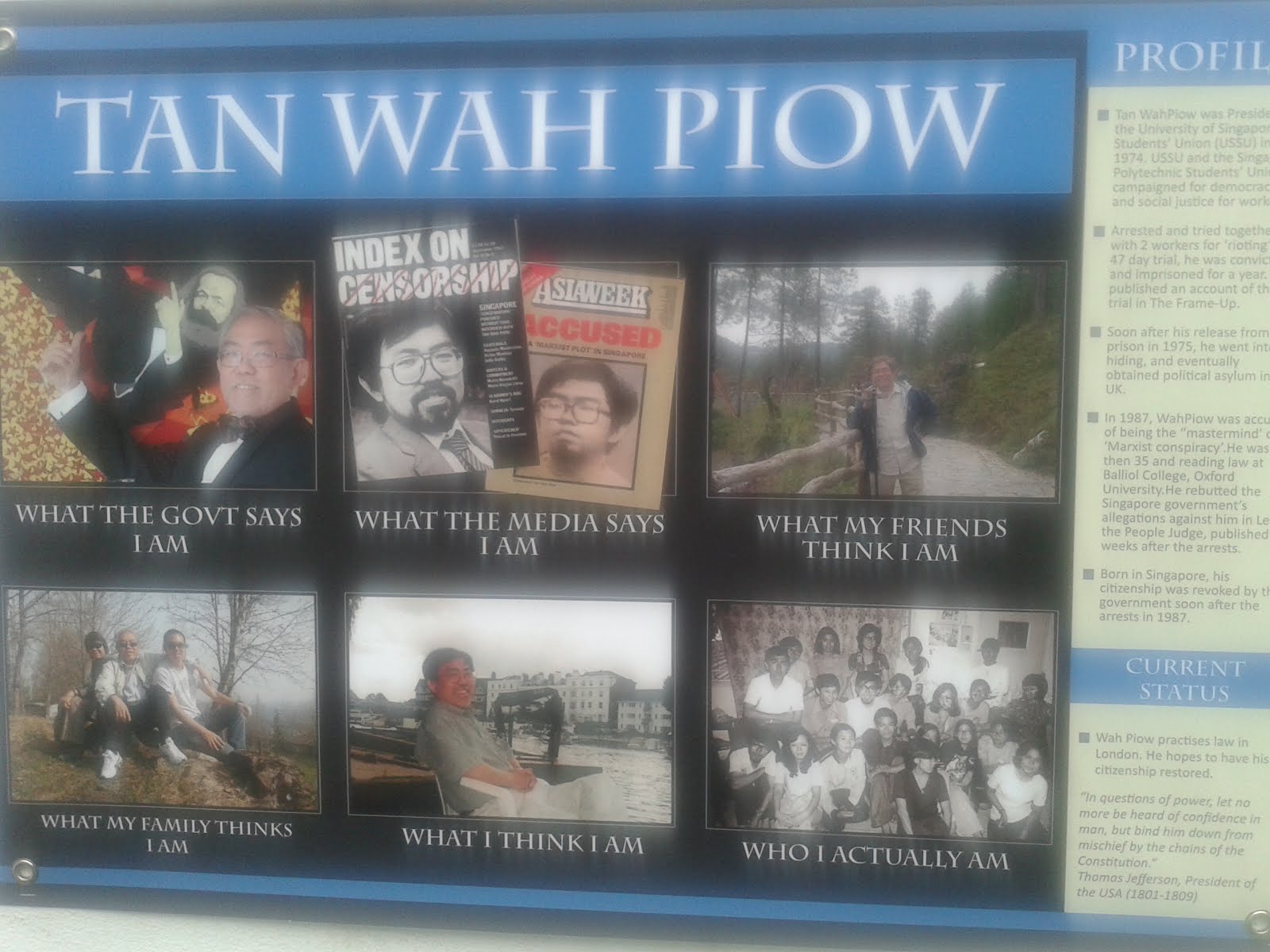
On a lighter note, I was thoroughly amused by the meme's done up to represent the different detainees. It was fun and in a certain way spoke of the lack of animosity or bitterness on the part of the detainees today. What they want today is just to set the record straight.


AS I arrived at the event rather late, I missed most of the speeches and was in time to listen to part of Vincent Wijeysinha's speech.


I support the call for the abolition of the Internal Security Act. However, I can't agree with his suggestion of replacing it with a specific act targeting terrorists and presumably therefore permitting some form of preventive detention. The issue that I have with any form of detention without trial is that it becomes a tool in the hands of politicans that tempts them to abuse power. Detention without trial would deprive the person of any opportunity to present his case to an independent judiciary. The very problem that arose with Operation Coldstore and Operation Spectrum would arise in the context of persons alleged to be terrorists.

Amongst many people that support the cause of the 1987 detainees, there are a significant proportion that are convinced of the guilt of the JI detainees and the guilt of Mas Selamat. But, how do we so confidently assert that these men are guilty? How do we presume for ourselves the right to deny these men a fair trial before an open court. Let the state produce the evidence against a person alleged to be a terrorist in a court of law and let the court find him guilty. If the state did not have such evidence in the first place, then is mere suspicion and conjecture permissible as the basis for the arrest and indefinite detention of individuals?

Anyone calling for the repeal of the ISA on a principled basis must not be calling for some sort of preventive detention law targetted at alleged terrorists. Let those terrorists be charged and convicted in a court of law for the offences that they have committed and the offences that they are conspiring to commit. We cannot, simply on the basis that we have a gut feeling that the 1987 detainees were do-gooders, engage in a form of exceptionalism for persons that we deem to be political detainees and persons that we deem to be terrorists. That's just another label. How arbitrary is that?


Friday, June 01, 2012

25th Anniversary of the Marxist Conspiracy: remembering a legal footnote

This is an old piece I did for the 22nd anniversary of the Marxist conspiracy detentions. Today, 2nd June 2012, Maruah has organised an event at Speaker's Corner, Hong Lim Park to commemorate the 25th anniversary of the detentions. So, I think it is appropriate for me to resurrect this piece....


Chng Suan Tse v Minister for Home Affairs (1998) SLR 132
The case involved Operation Spectrum and the primary issue was over the court’s ability to review the Executive’s decision to detain under the Internal Security Act. It proved to be a landmark decision as the Court of Appeal chose to apply an objective test in assessing the discretion of the Executive instead of applying a purely subjective test as the courts had done in the past. Prior to this case, the position of the courts was to adopt a subjective approach as in the case of Lee Mau Seng v Minister for Home Affairs [1971] 2 MLJ 137.

What was the implication of the Chng Suan Tse decision? The Internal Security Act demands that the as a precondition to detention, the President be ‘satisfied’ as to certain matters. If the test was purely subjective as it was in Lee Mau Seng, there was little that a detainee could do to question the exercise of discretion. If the test was objective as propounded by the Court of Appeal in Chng Suan Tse, then it was possible for the court to assess at least whether objectively the President was ‘satisfied’.

The then Chief Justice, Wee Chong Jin stated in the judgment:
“In our view, the notion of a subjective or unfettered discretion is contrary to the rule of law. All power has legal limits and the rule of law demands that the courts should be able to examine the exercise of discretionary power. If therefore the executive in exercising its discretion under an Act of Parliament has exceeded the four corners within which Parliament has decided it can exercise its discretion, such an exercise of discretion would be ultra vires the Act and a court of law must be able to hold it to be so.”

“It must be clear therefore that the boundaries of the decisionmaker’s jurisdiction as conferred by an Act of Parliament is a question solely for the courts to decide. There is also, as counsel for the appellant has pointed out, no ouster clause in respect of s 8 or 10 of the ISA. Adopting the objective test in respect of ss 8 and 10 of the ISA would also be consistent with arts 9(2) and 93 of the Constitution. Further, it is, in our view, no answer to refer to accountability to Parliament as an alternative safeguard. As Lord Diplock put it in R v IRC, ex p National Federation of Self-Employed and Small Businesses Ltd [1982] AC 617 at p 644:
It is not, in my view, a sufficient answer to say that judicial review of the actions of officers or departments of central government is unnecessary because they are accountable to Parliament for the way in which they carry out their functions. They are accountable to Parliament for what they do so far as regards efficiency and policy, and of that Parliament is the only judge; they are responsible to a court of justice for the lawfulness of what they do, and of that the court is the only judge


The Court went on to rule that:

"the President’s satisfaction under s 8 of the ISA and the minister’s satisfaction under s 10 of the ISA are both reviewable by a court of law as:
(1) the subjective test adopted in Karam Singh [1969] 2 MLJ 129 and its progeny can no longer be supported and the objective test is applicable upon a judicial review of the exercise of these discretions; and
(2) although a court will not question the executive’s decision as to what national security requires, the court can examine whether the executive’s decision was in fact based on national security considerations; similarly, although the court will not question whether detention was necessary for the purpose specified in s 8(1), the courts can examine whether the matters relied on by the executive fall within the scope of those specified purposes"


Of course, the story did not end there. Parliament duly amended the Internal Security Act in 1989 to nullify the effect of this case in relation to detentions under the ISA. By virtue of s.8B, the law on judicial review with regard to the ISA detentions was brought back to the position in 1971 and by virtue of s.8D the legislative change was to have effect in relation to any proceedings whether commenced before or after the amendment.

Law applicable to judicial review.
8B. —(1) Subject to the provisions of subsection (2), the law governing the judicial review of any decision made or act done in pursuance of any power conferred upon the President or the Minister by the provisions of this Act shall be the same as was applicable and declared in Singapore on the 13th day of July 1971; and no part of the law before, on or after that date of any other country in the Commonwealth relating to judicial review shall apply.
(2) There shall be no judicial review in any court of any act done or decision made by the President or the Minister under the provisions of this Act save in regard to any question relating to compliance with any procedural requirement of this Act governing such act or decision.
- Act 2/89 wef 30.1.89.

Commencement provision.8D. Sections 8A and 8B shall apply to any proceedings instituted by way of judicial review of any decision made or act done under the provisions of this Act, whether such proceedings have been instituted before or after the commencement of the Internal Security (Amendment) Act 1989.
- Act 2/89wef30.1.89.

Thursday, May 31, 2012

The media in Singapore: A structural problem


Many Singaporeans will readily acknowledge (however much the MSM may protest otherwise) that there is an inherent slant in the local news that favours the ruling PAP. Some techniques are pretty obvious whilst others are quite subtle. The newspapers here have for a long time been assisting the state in building a narrative about our society and its politics. Much of the slanted views have entered into the collective psyche of the nation to a point where Singaporeans would readily agree with many fundamental arguments put forward by the ruling PAP.

Looking beyond the the way the the traditional media reports news, it is worthwhile reminding ourselves of the structural aspects of the newspaper industry in Singapore. The possession of a printing press, the printing of a newspaper and its circulation and the formation and operation of newspaper companies are tightly controled by the government through the Newspaper and Printing Presses Act.


Firstly, by virtue of S.3 of the Act, the keeping and using of a printing press is subject to licensing by the Minister. If a licence is refused or withdrawn, an appeal can be made to the President. But, does the President have discretion in this matter? Well, we have to look at the Singapore Constitution:

Article 21.
—(1) Except as provided by this Constitution, the President shall, in the exercise of his functions under this Constitution or any other written law, act in accordance with the advice of the Cabinet or of a Minister acting under the general authority of the Cabinet.

Thus the President's decision making under s.3 of the Newspaper and Printing Presses Act is subject to acting in accordance with the advice of the Cabinet.

So, if I were to apply for a licence to operate a printing press and it were to be rejected by MICA, I can appeal to the President. The President will then be told by the Cabinet to reject my licence anyway. It is a mockery of common sense. But, that is the law.

Secondly, the management of newspaper companies is controlled under sections 9 and 10 of the Newspaper and Priting Presses Act. The management shareholders of a newspaper company are persons approved by the Minister. Newspaper companies are not in a position to refuse the appointment of these management shareholders. The Minister's decision can be appealed to the President. the President's powers are subject to Article 21 of the Constitution.

Additionally, the management shareholders have 200 votes for every share that they hold in relation to hiring and firing decisions. As a result of this arrangment, the government approved management shareholders have effective control over the newspaper companies.
Section 10(11)of the Newspaper and Printing Presses Act is as follows:

"The holder of management shares shall be entitled either on a poll or by a show of hands to 200 votes for each management share held by him upon any resolution relating to the appointment or dismissal of a director or any member of the staff of a newspaper company but shall in all other respects have the same voting rights as the holder of ordinary shares."

Not happy with an article written by a journalist? No problem. Government approved management shareholders are on hand to fire him.

Journalists and reporters may want to perform their job impartially. But, there are structural aspects to our print media that prevent the aspiration for media independence to be truly realised.

Wednesday, May 30, 2012

To SPP: Don't oppose the Bishan nursing home

The Ministry of Health plans to build a nursing home at Bishan Street 13. This is a good thing and it should be welcome. Too often, Singaporeans are found complaining that the current government is not doing enough for the elderly and the poor. I would, therefore, expect that a decision to build a nursing home would therefore be welcome.

However, as in the past, residents living near the affected area are unhappy with the idea of a nursing home being built in the vicinity of their homes. Whilst welcoming the idea of a nursing home, these residents are not happy that it would be in their own backyard. What's wrong with my fellow Singaporeans? Why such selfishness?

To be fair, it has been reported that some residents welcome the idea. Besides, those individuals that are opposed to the building of the nursing home might well be in the minority. But, the disconcerting fact is that this is not the first time that residents living in a particular locality have opposed the building of a facility that would have served a larger communal goal. Why is the narrow-minded asset-enhancement mentality so entrenched in us that we are so troubled by worthwhile welfare projects cropping us near our housing estates?

Whilst I was not too surprised by the fact that some residents were unhappy about the decision to build a nursing home, I was definitely surprised to read a statement from the Singapore Peoples Party about this issue:

28 May 2012

The proposed nursing home at Bishan Street 13

The SPP believes in a humane and just Singapore, where the disadvantaged such as the elderly will be looked after with dignity. The proposed nursing home in Bishan will be an essential facility towards this, but the residents most affected deserve consideration.

Alternative sites should be actively sought. The location of the nursing home in this case is still negotiable. A voting exercise similar to that for the Lift Upgrading Programmes should be conducted to determine the site for the nursing home. A more entrenched culture of greater consultative decision-making can only be good for Singapore in the long term.

From what we understand, the residents in Toh Yi Drive who faced a similar incident a few months ago were in fact more unhappy that they were not properly consulted before the plans were drawn up, rather than the plans for building the nursing home in itself.

The situation we are in is caused by the PAP Government’s policy of “asset enhancement”. It has been drummed into Singaporeans that their HDB flat is not only a home, but also an asset that they can cash-out in their old age. It is naturally a hard sell asking Singaporeans to accept anything likely to devalue their ‘retirement plan’. This situation will not be fully resolved until Singapore returns to when a HDB flat is affordable housing, when retirement savings are diversified and liquid, and when Community regains its importance in Singaporeans’ lives.

The SPP has observed the good work of the various Lions organisations among the elderly and poor in Bishan and Toa Payoh. We thank them and encourage them to persevere in their efforts. Going forward, we hope to be able to work closely with them in our service to Bishan-Toa Payoh residents.

Finally, we note that residents will need more information and will need to be consulted thoroughly throughout the planning, construction and operations for the nursing home, should it proceed. The SPP will be engaging Bishan residents for their in-depth views during our scheduled walkabout this Sunday, 3 June 2012, beginning 9am that will cover Bishan Street 13. The SPP will work constructively with the Government, residents and the Lions Home for the Elders on this issue.


CHIAM SEE TONG
Secretary-General, SPP

I believe that there was no necessity for the SPP to wade into this issue. I have to admit that statement is finely poised and nowhere in there does Mr Chiam See Tong rubbish the need for a nursing home. He takes issue with the lack of consultation. However, should any government really be held ransom to popular sentiment when making decisions about land use especially when the use of the land is for the greater good of the community? After all, we are not talking about residential property being acquired and destroyed in order to make way for a golf course or a highway. Nor are we talking about destroying a heritage site in order to construct a highway. Even in instances where people may feel justified in objecting to government decisions on land usage, I do not believe that government decision making should be tied to a issue based voting by citizens. The SPP's idea of having a voting exercise similar to the Lift Upgrading Programme is in my view undesirable.

I do not oppose the idea of consultation. In fact, I welcome the suggestion that the government should consult before making decisions on land use where there may be significant impact on the properties of citizens. But, such consultation should not result in an expectation that the government should be restrained from exercising its discretion and making a decision one way or the other. Democracy in the form of a general mandate to govern based on a package of policies is one thing. This should not be confused with an anarchic attempt to engage in popular decision making on every single administrative and policy task.

I have often taken a critical stance against the PAP on matters pertaining to the law and the Constitution and in relation to the rights of individuals. But, I welcome the building of nursing homes. They are needed. As much as we demand that our government be more compassionate, we should examine ourselves and ask whether we are even taking any effort to cast aside at least a minute amount of our money-faced selfishness.


Friday, May 25, 2012

This is Hougang

I am a Liverpool fan. There is a famous sign at Liverpool's stadium that reads: "This is Anfield". It is awe-inspiring for every football player that has worn that famous red jersey and for every fan around the world that has seen that sign. In the days when Liverpool dominated the league, piling up victory after victory, "This is Anfield" was an intimidating statement to be confronted with as opposing teams entered the couldron.

Our politicians are fond of footballing analogies. This is my footballing analogy:

THIS IS HOUGANG!


When it comes to election statistics, the national norm does not apply to Hougang. When it comes to voter behaviour, the national norm does not apply to Hougang. When it comes to standing up to intimidation, the national norm does not apply to Hougang. There is something strong, resilient and courageous about the people of Hougang. I know a few Hougang residents personally. The ones that I know have been voting for the Workers' Party repeatedly. Why did these friends vote for WP? Check and balance in Parliament! That is the answer. What is particularly sophisticated about this way of voting is that these friends did not consider their local municipal issues as the key determinant for voting during a Parliamentary election. They understand that essentially in our system of democracy, we are voting for representatives in Parliament so that if there is a sufficient majority, that party could form the government and if not, those representatives could act as an effective check and balance. These friends are fully aware that the PAP's parliamentary majority is not under any threat. These friends are also uncomfortable with the size of the PAP's Parliamentary majority where Constitutional amendments can be pushed through. For these friends of mine, a strong opposition presence in Parliament of between 20 to 30 members would serve as a way to push the PAP to implement more people friendly policies and to monitor the way that the government functions.

So, what do they think about upgrading and other bullying tactics? It doesn't figure in their voting. In fact, I suspect that it enrages them and entrenches the WP vote.

As I observed the campaign by the two sides during this by-election, I can't help but realise that the PAP has lost the plot when it comes to the 'new normal'. Here was a perfect opportunity to show everyone that they have emerged from GE 2011 wiser and are now willing to go down the road of clean politics. But, this has become an opportunity squandered with them attempting to make an issue out of Yaw Shin Leong's selection and then making an issue out of Png Eng Huat's non-selection for the NCMP position in the last GE. What we saw was the same old tactics. I doubt that the campaign approach is going to go down well with Hougang voters.

What do I think will be the outcome of this by-election? WP will win, of course. I am sure that if this was open for a bet, even the PAP leaders would bet on a WP win. What would be interesting is the % of the win. How wide a margin would the WP get? Would they lose some ground? Would they gain more?

Firstly, I always assume a core group of PAP supporters and opposition supporters exist in every constituency. These voters would not change their vote. Yaw-gate and NCMP-gate will not move the strong WP supporter in Hougang to vote for the PAP. PAP's bullying and dirty campaign tactics will not move the hardcore PAP suporter into feeling disgusted and voting for the WP.

So, it is the middle ground that we are looking at.

I also suspect that most of the middle ground had already voted for WP in GE 2011. The PAP's 35% in Hougang (during GE 2011) represents the hardcore PAP support that exists throughout the country. (I use the Dr Tony Tan voters during the PResidential election as a gauge of the 'PAP-whatever-the-situation' vote in Singapore.)

In GE 2011, WP was scraping the bottom of the barrel in terms of middle ground voters. It will be an uphill task to convert more of them, unless new voters added onto the register this year turn overwhelmingly towards the WP. Even then, it would be a small number. Maybe, we might tweak the national average a little bit since this is Hougang. So, instead of a hardcore 35% PAP supporters, we might assume that there is a 30% hardcore support for PAP in Hougang. If that is the case, there may be some votes to be scraped away from the PAP by the WP.

The probability of an increase in WP's percentage is very low. On the other hand, there is a reasonably high probability of WP's vote share going down. Any shift downwards would be by 1% to 3%. Any shift upwards would be 1% at the most. Anyone seeking to get the impact of a referrendum out of this by-election would be severely disappointed. The way that the campaign has been reported in the media and the way the online media has focused attention on 'NCMP-gate', the more important national issues have not been given any prominence and I am pretty certain that this is not going to turn out to be a referendum on the policies of the PAP over the last year.

WP was attempting to make this into an election about national issues at its rallies. Personally, I felt at the outset that in a small country like ours, the national and the local gets merged together inextricably. But, the loudest news filtering through the media is about Png Eng Huat's selection (or non-selection for the NCMP post). (And inexplicably the loudest 'political' social media shared event today is the XiaXue fight back against some pretty nasty comments by Facebookers.) The middle ground voters in Hougang may be swayed against Png Eng Huat. But, this is bound to be marginal.

Whatever the outcome, Hougang will remain with the WP. Hougang residents will continue to shout out loud and proud:
THIS IS HOUGANG!


UPDATE:
In GE 2011, the voter turnout was 23,176 out of 24,560 eligible voters. 1,384 did not turn up for voting. WP had 14850 votes (64.8% of valid votes) and PAP had 8065 votes (35.2% of valid votes). 261 spoilt votes.

Based on a Channelnewsasia report today, there are 23,368 eligible voters. Those 1,384 that did not vote would have been removed from the electoral register. New voters added onto the register would therefore be: 23,368 - 23,176 = 192 (bearing in mind that a small segment of the 192 would be those that got themselves reinstated in the register)

If everyone voted without changing their votes and if WP picked up all 192 of the new votes, the result would be 15,042 for WP and 8065 for PAP. That would be 65.1% for WP and 34.9% for PAP.
Similarly, if PAP picks up all the 192 votes, the result would be 14,850 for WP and 8,257 for PAP. That would be 64.2% for WP and 35.8% for PAP.


Monday, May 21, 2012

Any food, drinks or vouchers at the by-election rallies?


I am just wondering out aloud... Did either the WP or PAP rally involve any supply of free food, drinks, vouchers or other gifts?

Political parties should be aware that treating is an offence under the Parliamentary Elections Act.

58. —(1) A person shall be guilty of treating if he corruptly, by himself or by any other person, either before, during or after an election, directly or indirectly gives or provides, or pays wholly or in part the expense of giving, any meat, drink, refreshment, cigarette, entertainment or other provision or thing or any money or ticket or other means or device to enable the procuring of any such meat, drink, refreshment, cigarette, entertainment or other provision or thing, to or for any person —

(a) for the purpose of corruptly influencing that person or any other person to vote or refrain from voting;

(b) for the purpose of inducing that person to attend or remain at any election meeting;

(c) on account of any such person or any other person having voted or refrained from voting or being about to vote or refrain from voting at the election; or

(d) on account of any such person having attended an election meeting.

(2) A person shall also be guilty of treating if he corruptly accepts or takes any such meat, drink, refreshment, cigarette, entertainment or other provision or thing or any such money or ticket or who adopts any other means or device to enable the procuring of such meat, drink, refreshment, cigarette, entertainment or other provision or thing


It is clear that treating for the purpose inducing persons to attend a rally or to remain at the rally is an offence. So, has anyone attended these rallies? Do you have knowledge of infringement of this law?

Thursday, May 17, 2012

Why is the PAP anxious to keep national issues out of the Hougang by-election?


For starters, let us not kid ourselves. WP is going to win in Hougang. This is an opposition stronghold and I am sure the PAP leadership and their candidate for Hougang, Desmond Choo, are under no illusions as to the outcome on 26th May 2012. The Hougang constituency has gone to the Workers' Party since 1991 and the election statistics are as follows:

1991 - 52.8% for WP
1997 - 58% for WP
2001 - 55% for WP
2006 - 62.7% for WP
2011 - 64.8% for WP

The demographic change between the last General Elections and this by-election is going to be miniscule and unlikely to have any impact on the voting pattern. There is no reason to believe that voters that went for WP last year would change their minds. There is not much that has changed in the national socio-political arena to suggest that significant change could take place in the voting pattern. There is no doubt that the PAP will put up a fight. But, they would be fully prepared for defeat on 26th May.

So, why are they keen to make this out to be an election about 'local' issues and not 'national'. (Incidentally, I don't buy into that 'local' v 'national' dichotomy. This is a false dichotomy in a country like ours where the 'national' morphs into, overlaps with and is indistinguishable from the 'local' in many instances.) I suspect that the PAP is worried about the prospect of a further swing towards the WP. Even a marginal 2 to 3% increase for WP can be interpreted as growing voter disapproval of the PAP government's performance in the last year. Though it is not fair to consider the Hougang outcome (whichever way the swing of votes goes) as a referrendum on PAP's policies, it is inevitable that WP MPs will attempt to paint the by-election as a referrendum in order to push the PAP on certain policies. For instance, transportation could be made into a major issue during this by-election and if there is a vote increase in WP's favour, WP would use that a leverage in its Parliamentary arguments on that issue.

I am pretty sure that the PAP does not want to be pushed into decision making on policy matters on the basis of the outcome in a by-election. It is therefore anxious to paint this election as one that concerns itself with constituency representation and about effectively taking care of Hougang residents. A by-election as a referrendum is clearly not in the PAP's best interest.

Monday, May 14, 2012

Did Subhas Anandan really say that?

It was reported in Temasek Times that Subhas Anandan has made an offer of setting up a Legal Bureau at the Hougang Community Club if the PAP candidate wins the Hougang by-election. ( http://temasektimes.wordpress.com/2012/05/11/subhas-anandan-to-offer-free-legal-aid-to-hougang-residents-if-desmond-choo-is-elected/ )

It appears that this information has been taken from a Chinese newspaper. I do not know Mandarin. But, I am given to understand that the article does not actually say that Subhas Anandan will set up a Legal Bureau at Hougang if Desmond Choo wins the by-election.


In fact, I should add that it would be shocking if Subhas Anandan actually made such an assertion as it could run counter to the Parliamentary Elections Act (Cap 218):

60. The following persons shall be deemed guilty of the offence of bribery:

(a) every person who, directly or indirectly, by himself or by any other person on his behalf, gives, lends, or agrees to give or lend, or offers, promises, or promises to procure or to endeavour to procure, any money or valuable consideration to or for any elector or voter, or to or for any person on behalf of any elector or voter or to or for any other person, in order to induce any elector or voter to vote or refrain from voting, or corruptly does any such act on account of that elector or voter having voted or refrained from voting at any election under this Act;

(b) every person who, directly or indirectly, by himself or by any other person on his behalf, gives or procures, or agrees to give or procure, or offers, promises, or promises to procure or to endeavour to procure, any office, place or employment to or for any elector or voter or to or for any person on behalf of any elector or voter, or to or for any other person, in order to induce that elector or voter to vote or refrain from voting, or corruptly does any such act on account of that elector or voter having voted or refrained from voting at any election under this Act;

(c) every person who, directly or indirectly, by himself or by any other person on his behalf, makes any such gift, loan, offer, promise, procurement or agreement referred to in paragraph ( a) or (b) to or for any person in order to induce that person to procure or endeavour to procure the return of any person as a Member of Parliament, or the vote of any elector or voter at any election under this Act;

Temasek Times ought to have been more careful in reporting the statement considering that it translates into a potential election offence. As we hurtle towards the new reality that more and more people are relying on online news, 'new media' must exercise some degree of responsibility in reporting information this like. True. We may put up such info hurriedly. But, if there are errors, we must be willing to acknowledge them. I am given to understand from a friend that the mistake could have been a result of poor translation. Does anyone with a good command of Mandarin care to comment?

Friday, May 11, 2012

Hougang by-election case may be withdrawn from the Court


It appears that Mdm Vellama Marie Muthu is seeking to withdraw her case if the AG were to drop the appeal. A proposal has been forwarded to the Attorney General's office by Mdm Vellama's lawyer that upon withdrawal of her application and the AG's appeal, a consent order be drafted and recorded in Court.

Firstly, I believe that the application for the mandatory order has become unsustainable by virtue of the PM's decision to call for the by-election. If at all there is a live issue for the Court to determine, it is in relation to the declaratory orders sought by Mdm Vellama.

Mdm Vellama's application involved the following:

(a) Declaratory orders:

(i) That the Prime Minister does not have unfettered discretion in deciding whether to announce by-elections in Hougang SMC; and

(ii) That the Prime Minister does not have unfettered discretion to decide when to announce by-elections in Hougang SMC and must do so within three months or within such reasonable time as this Honourable Court deems fit; and

(b) A Mandatory Order
- enjoining the Prime Minister to advise the President to issue a Writ of Election mandating by-elections in Hougang SMC pursuant to Article 49(1) of the Constitution of the Republic of Singapore (1985 Rev Ed, 1999 Reprint) and Section 24(1) of the Parliamentary Elections Act (Cap 218, 2011 Rev Ed) and to tender such advice within three months or within such reasonable time as the Honourable Court deems fit.


As the PM has already advised the President to issue the Writ of Election, (b) above is rendered nugatory.

The question of whether the PM has unfettered discretion in deciding whether to announce by-election or in deciding when to announce such by-elections still remains an important Constitutional issue that is undefined and speculative given the gap in our Constitutional and statutory provisions on by-elections. This being the case, I do not think that the declaratory orders are less significant now that the PM has called for the by-election. (Of course, the wording of the declaratory order should be amended in the application to remove the reference to Hougang SMC. There is a generic question as to whether the PM has unfettered discretion in relation to whether and when to announce by-elections in any single member constituency.)

What would happen if the matter proceeds? The application for leave is in the first place being made on account of the mandatory order sought and by virtue of Order 53 of the Rules of Court. The declaratory orders are also being sought under Order 53 and they ride on the mandatory order. If the Court of Appeal rules that leave to appeal would not be granted on the mndatory order, then the application would fail and Mdm Vellama's Counsel has the option of filing a fresh application for the declaratory orders under Order 15 Rule 16 of the Rules of Court. This application, being solely for declaratory orders, would not require the leave of court.

This could be one way to proceed. However, I understand that the letter sent by Mdm Vellama's lawyer alludes to the fact that the Constitutional clarification must await some future date when such matter may arise. That is as good an indication as one may get on whether a fresh application would be made for the declaratory orders. It is plain that Mdm Vellama would not be pursuing any clarification via a fresh set of proceedings.

Since Mdm Vellama has proposed withdrawal, I would expect that the AG (and presumably the PM) would decide to take up the offer and drop the appeal. That would be the politically prudent step to take to avoid any possible fallout.

In any event, I think that Mdm Vellama deserves the respect of every citizen in Singapore. There are some people commenting online about her wasting time in making the Court application in the first place. This is what I have to say: Even if she has been put up to it by some others with a political interest in this situation, it takes a lot of guts to stick one's neck out like this. For that alone she deserves respect. She is a Singaporean that has shown that she meant every word of the pledge that we unashamedly take... "to build a democratic society based on justice and equality". In fact, those people that choose to take our national pledge and still deride the efforts of Mdm Vellama are hypocrites of the highest order. The rest of us, proud citizens, salute her!

In a way, this is our own little Bersih... A cleaner takes the PM to court to clean up our electoral law.