We are creatures of PAP's social engineering.
I used to think that we have become cowards in being afraid to question authority. The last general elections in 2011 successfully lifted the fear out of the hearts of many Singaporeans. It has been gratifying to witness the transformation of Singaporeans from a once fearful population into a group of people that question the rationale of government policies. But, I have to admit I was stumped when I read the reaction of many Singaporeans (online and offline) to the strike by the SMRT bus drivers.
Many Singaporeans were calling for tough action. Some were ridiculing the media (and the mainstream media deserves the ridicule) for failing to identify the action of the bus drivers as a strike. Much of this ridicule of the failure to use the word 'strike' was with the subtext of how foreigners were getting away with the breaking of our laws. Many were calling for these foreigners to be punished. Perhaps, it was just the hatred of persons from China. Perhaps, it was just the need to use any negative news against the ruling party (and thereby questioning the failure to act in a strict fashion against foreigners when locals are handled harshly).
Or perhaps, we have just become so accustomed to the PAP constructed reality that we think that a strike is necessarily a bad thing. Some of the posts seem to indicate as such (referring to the social harmony that we have worked hard to build). Well, a couple of hundred transport workers going on strike would not bring our nation to its knees or result in widespread chaos and disarray. But, judging from the reaction of some Singaporeans, one would get the impression that a 'strike' is, in its very nature, destablising.
I remember thumbing through my niece's primary school textbook where references to the Hock Lee Bus riots are made. At the end of that chapter, there is a kind of self-assessment question about what the student understands a strike to be. I asked my niece what she thinks is a strike. Her reply was that it would involve breaking shop windows and burning things. It is entirely possible that this is the general impression that runs through the minds of many people. Of course, there are many that do understand that a strike is just stoppage of work.
There also appears to be another variant whereby strikes are recognised for what they are. But, it is viewed that the consequences of a strike must necessarily be economically debilitating. It is true that strikes worldwide have had a crippling effect for a short period of time and as a result inconvenienced many people. However, these instances have been sufficiently spread out and prudently and responsibly managed by trade unions to avoid long-term destabilisation of the economy. (Singapore's own zero strike approach ends up on the other end of the spectrum where workers' rights can be effectively trampled upon as these are sacrificed and offered up on the altar of corporate profits.)
I wonder if the hesitation of the journalists from mainstream media to label the actions of the bus drivers as a strike had anything to do with this extreme conditioning of our society whereby a strike is always associated with something that is chaotic and destabilising. All the other words that they used in substitution of the word 'strike' still described what would constitute a strike. So, why did they avoid the word in the first place? Maybe it was just plain ignorance of the meaning of that word. Maybe it was a hesitation that was born out of knowing that 'strike' came within the ambit of things that were beyond the OB markers. Maybe, being a mouthpiece for the government, they were waiting for the 'green light' from the authorities before using this 'sensitive' word. (Rather comically, an article by Teo Xuan Wei in Todayonline explained the reason for the media's avoidance of the word 'strike' by referring to the explanation given by the Minister for Manpower http://www.todayonline.com/Hotnews/EDC121128-0000063/Why-the-word-strike-was-not-used-initially )
In the end, we must not forget that a strike is essentially an 'economic' offence.
Thursday, November 29, 2012


Monday, November 05, 2012
The end of another judicial era
With the retirement of Chief Justice Chan Sek Keong, another era in Singapore's judicial history ends. Every CJ has left some indelible mark in our legal history and it has to be acknowledged that the outgoing CJ definitely left his.

The accolade from the new Chief Justice Sundaresh Menon is as follows:
CJ Chan was reportedly described (by CJ Sundaresh Menon) as "a world-class jurist, with a clear and principled judicial philosophy and an unmatched grasp of the foundational principles that underlie the law." The Channelnewsasia article reporting his retirement and book launch is here: http://www.channelnewsasia.com/stories/singaporelocalnews/view/1235377/1/.html
I definitely appreciate the clarity and consistency found in the judgments of CJ Chan in comparison with his immediate predecessor. In fact, a classic moment in our legal history was when CJ Yong (sitting as a single judge in the High Court) made a clear error of law in increasing a defendant's sentence beyond the maximum permitted under the law (PP v Gilbert Louis) and it was the then AG Chan Sek Keong that had to bring a Criminal Reference to the Court of Appeal against CJ Yong's decision in order to get the defendant's sentence reduced and to set the law right. In my recollection, that stands out as CJ Chan's finest moment. http://lwb.lawnet.com.sg/legal/lgl/rss/landmark/[2003]_SGCA_33.html
And, it is interesting that the other event that immediately crops up in my mind as his least noble moment was also when he was the AG. In 1997, Goh Chok Tong, Dr Tony Tan and Lee Hsien Loong were within a polling station. The Workers' Party had lodged a complaint against them for violations of the Parliamentary Elections Act. No action was taken. The following opinion of the Attorney General (Chan Sek Keong) was made available to the public by the then Law Minister:
I still remember reading this a long time ago in 1997. I could imagine the PAP candidates dropping into the polling station using parachutes. :-)
Anyway, when all in said and done, he has definitely had an impact on the bench. Under the previous CJ, the concentration was on administrative efficiency. It used to be next to impossible to get an acquittal. With CJ Chan, there was a discernible difference. Many criminal lawyers will vouch for the fact that CJ Chan brought about a significant attitudinal change in the criminal justice system. At least, CJ Chan will be remembered as a legal technician and not a 'banker'.
In his first speech as the Chief Justice he said this:
Many practising lawyers saw in that speech the indication of a shift away from what used to be perceived as 'efficiency at the expense of justice' under the tenure of the previous CJ.

The accolade from the new Chief Justice Sundaresh Menon is as follows:
"We know him as a lawyer with a peerless love and devotion to the law. If law is the foundation of society and judges are its servants, then we know that the Chief is among its most ardent and loyal servants, passionately committed to doing justice in accordance with the law and seeking, like Dworkin's Hercules, to always get it right. I know that history will vindicate these assessments; but more than that, with the benefit of time, I believe history will judge the Chief as the greatest jurist this country has ever produced. And in time, we will each fully realise just how privileged we have been to have shared at least some part of that ride with him."
CJ Chan was reportedly described (by CJ Sundaresh Menon) as "a world-class jurist, with a clear and principled judicial philosophy and an unmatched grasp of the foundational principles that underlie the law." The Channelnewsasia article reporting his retirement and book launch is here: http://www.channelnewsasia.com/stories/singaporelocalnews/view/1235377/1/.html
I definitely appreciate the clarity and consistency found in the judgments of CJ Chan in comparison with his immediate predecessor. In fact, a classic moment in our legal history was when CJ Yong (sitting as a single judge in the High Court) made a clear error of law in increasing a defendant's sentence beyond the maximum permitted under the law (PP v Gilbert Louis) and it was the then AG Chan Sek Keong that had to bring a Criminal Reference to the Court of Appeal against CJ Yong's decision in order to get the defendant's sentence reduced and to set the law right. In my recollection, that stands out as CJ Chan's finest moment. http://lwb.lawnet.com.sg/legal/lgl/rss/landmark/[2003]_SGCA_33.html
And, it is interesting that the other event that immediately crops up in my mind as his least noble moment was also when he was the AG. In 1997, Goh Chok Tong, Dr Tony Tan and Lee Hsien Loong were within a polling station. The Workers' Party had lodged a complaint against them for violations of the Parliamentary Elections Act. No action was taken. The following opinion of the Attorney General (Chan Sek Keong) was made available to the public by the then Law Minister:
PRESENCE OF UNAUTHORISED PERSONS INSIDE POLLING STATIONS
1. On 14 July l997, THE Workers' Party issued a press release expressing "amazement" that the public prosecutor had advised police that no offence was disclosed in the reports made by it leaders against the prime minister, the two deputy prime ministers and Dr S Vasoo that they had been present inside polling stations when they were not candidates for the relevant constituencies. The Workers' Party queried why such conduct was not an offence under paragraph (d) or (e) of section 82(1) of the Parliamentary Elections Act.
2. On 15 July 1997, the Singapore Democratic Party also called on the attorney general to explain his "truly befuddling" decision and to state clearly if it was an offence for unauthorised persons to enter polling stations.
3. You have asked me for my formal opinion on the question raised in these two statements. My opinion is set out below.
Opinion
4. The question is whether it is an offence under the Parliamentary Elections Act for an unauthorised person to enter and be present in a polling station.
5. For this purpose, the authorised persons are the candidates, the polling agent or agents of each candidate, the Returning Officer, and persons authorised in writing by the returning officer, the police officers on duty and other persons officially employed at the polling station; see section 39 (4) of the Act (quoted below)
Activities Outside Polling Stations
6. The relevant sections of the Parliamentary Elections Act to be considered are sections 82 (1)(d) and 82 (1)(e). These provisions were enacted m 1959 pursuant to the Report of the Commission of Inquiry into Corrupt, Illegal or Undesirable Practices at Elections, Cmd 7 of 1968 (hereinafter called "the Elias Report)"
7. Section 82 (1)(d) provides that - "No person shall wait outside any polling station on polling day, except for the purpose of gaining entry to the polling station to cast his vote".
8. Plainly, persons found waiting inside the polling stations do not come within the ambit of this section. Similarly, those who enter or have entered the polling station cannot be said to be waiting outside it. Only those who wait outside the polling station commit an offence under this section unless they are waiting to enter the polling station to cast their votes.
9. Section 82 (1)(e) provides that -
"No person shall loiter in any street or public place within a radius of 200 metres of any polling station on polling day."
10. The relevant question is whether any person who is inside a polling station can be sad to be "within a radius of 200 metres of any polling station". The answer to this question will also answer any question on loitering inside a polling station.
11. Plainly, a person inside a polling station cannot be said to be within a radius of 200 metres of a polling station. A polling station must have adequate space for the voting to be carried out. Any space has a perimeter. The words "within a radius of 200 metres" ' therefore mean "200 metres from the perimeter of" any polling station. This point is illustrated in the diagrams in the Appendix. (Editor's note: Diagrams not available).
12. The above interpretation is fortified by the context of the provision. The polling station, as a place, is distinguished from a street or public place. It is not a street or a public place. Hence, being inside a polling station cannot amount to being in a street or in a public place. By parity of reasoning, loitering in a street or public place cannot possibly include loitering in the polling station itself and vice versa.
13. There is no ambiguity in section 82 (1)(e). If the legislature had intended to make it an offence for unauthorised persons to wait or loiter inside a polling station, it could have easily provided for it. It did not. The mischief that section 82 (1)(e) is intended to address is found in paragraph 99 of the Elias Report. It reads:
"In order to prevent voters being made subject to my form of undue influence or harassment at the approaches to polling stations, we recommend that it should be made an offence for any person to establish any desk or table near the entrance to any polling station, or to wait outside any polling station on polling day except for the purpose of gaining entry into the polling station to cast his vote; and that it should be an offence for any person to loiter in any street or public place within a radius of 200 yards of any polling station on polling day ."
14 . Paragraph 99 of the Elias Report appears under the heading "Activity OUTSIDE POLLING STATIONS". The Commission of Inquiry was addressing the possibility of voters being subject to undue influence and harassment as they approach the polling stations. There is therefore no doubt whatever that this provision was never intended to cover any activity inside the polling station as there would be officials and election agents in attendance.
15. The legislative history makes the provision so clear that it is not even necessary to consider the application of an established principle of interpretation that any ambiguity in a penal provision should, whenever possible, be resolved favour of the accused.
Activities Inside Polling Stations
16 Activities inside polling stations were made subject to a different regime under the Act. Section 39(4) provides that -
"the presiding officer shall keep order in his station and shall regulate the number of voters to be admitted a time, and shall exclude all other persons except the polling agent or agents of each candidate, the Returning Officer and persons authorised in writing by the Returning Officer, the police officers on duty and other persons officially employed at the polling station."
17. Under section 39(7), any person who misconducts himself in the polling station, or fails to obey the lawful orders of the presiding officer may be removed from the polling station by a police officer acting under the orders of the presiding officer. If an unauthorised person refuses to leave the polling station when told to do so by the public officer, he commits an offence under section 186 of the Penal Code for obstructing a public servant in the discharge of his duty.
18. There is a consistency in the rationales of the regulatory schemes governing activities inside and those outside polling stations on election day. Waiting outside a polling station is made an offence because it gives rise to opportunities to influence or intimidate voters: see paragraph 99 of the Elias Report. Hence, the Act has provided a safety zone which stretches outwards for 200 metres from the polling station. In contrast, the possibility of a person inside a polling station influencing or intimidating voters in the presence of the presiding officer and his officials, the polling agents etc was considered so remote that it was discounted by the Act.
19. I therefore confirm my opinion that the Parliamentary Elections Act does not provide for any offence of unauthorised entry into or presence within a polling station. Accordingly, those unauthorised persons who only wait or loiter inside a polling station on polling day do not commit any offence under the Act.
20. You are at liberty to publish this opinion
I still remember reading this a long time ago in 1997. I could imagine the PAP candidates dropping into the polling station using parachutes. :-)
Anyway, when all in said and done, he has definitely had an impact on the bench. Under the previous CJ, the concentration was on administrative efficiency. It used to be next to impossible to get an acquittal. With CJ Chan, there was a discernible difference. Many criminal lawyers will vouch for the fact that CJ Chan brought about a significant attitudinal change in the criminal justice system. At least, CJ Chan will be remembered as a legal technician and not a 'banker'.
In his first speech as the Chief Justice he said this:
It is therefore not surprising that Professor Michael Hor, who teaches criminal law and justice in the Law Faculty of the National University of Singapore, expects me “to re-focus on the law and its internal values – rather than on its management and measurement by external criteria – with an increased attention to the quality of decisions, a fine tuning of the balance between fairness and efficiency.”
My response to this expectation is: “Yes, the fearsome backlog of cases which was the driving force behind the relentless waves of court reforms has been eliminated more than 10 years ago. Efficiency is vital in court administration but it should not be pursued to the point when it starts to yield diminishing returns in the dispensation of justice. The Judiciary must always give priority to upholding the fundamental values of the legal system, such as due process or procedural fairness, equal protection of the law, consistency and proportionality in sentencing, and rationality in decision-making. We should now be confident enough to give greater emphasis to the basics of judicial decision-making without the recurrent fear of a resurgent backlog.”
Many practising lawyers saw in that speech the indication of a shift away from what used to be perceived as 'efficiency at the expense of justice' under the tenure of the previous CJ.
Tuesday, October 23, 2012
The day the Constitution died (again)

But, whatever we might say about our (amendment-ravaged) Constitution, the fact remains that it is a document that is a starting point for any discussion in law about the extent of the state's power and the extent of the citizen's rights. There are 'silences' in many provisions that enable legroom for a pro-citizen instead of a pro-state interpretation. (Just realised that 'pro-state' unhyphenated is prostate. There is an accidental link between intellectual alignment with the powers that be and a part of the anatomy near the testicular region. Sorry about this unnecessary and irrelevant digression. :-) )
That brings me to the IMF loan case. Kenneth Jeyaretnam, the leader of the Reform Party, brought an application to the High Court for the Court to rule on the legality of the Singapore government's decision to pledge a loan to the IMF. I wasn't surprised by the decision of the Court. The Court has ruled as follows:
At issue in the case was the question of whether the government required Presidential/Parliamentary approval for the raising and giving of loans. Kenneth contended that approval is needed for both. The government contended that approval is only needed for the raising of a loan and not the giving of a loan. The reason for the contention is the mode of interpretation to be employed. Kenneth's Counsel argued for a literal interpretation of the Constitution relying on the ordinary dictionary meaning of the words employed. The government relied on a purposive interpretation. (This is a technique of statutory interpretation where a law is interpreted on the basis of the objectives of Parliament in enacting the provision; i.e. looking at the 'purpose' behind the provision.)
The Court has obviously accepted the purposive interpretation. The actual provision in question is:
"Article 144.
—(1) No guarantee or loan shall be given or raised by the Government —
(a)except under the authority of any resolution of Parliament with which the President concurs"
The Court is of the view that Article 144 prohibits the giving of a guarantee and the raising of a loan and not the other way around. I have blogged about this earlier and have mentioned that this is a technical legal possibility. http://www.article14.blogspot.sg/2012/06/singapores-pledge-of-us-4-billion-to.html
So, no surprises as to the result. If so, why do I say that the Constitution has died. Well, there is another concern that I have about the High Court decision. This is a far more serious matter with far-reaching consequences. The Court has decided that Kenneth Jeyaretnam does not have the locus standi to make a claim. (locus standi - the standing of the party. the question as to whether the person has the right to make a particular claim in court.)
Ordinarily, if the case is one involving a private interest, there is little difficulty in establishing locus standi. But, if the issue is one of public interest, the law hasn't been clear in Singapore. The English Courts (from whom we adopt this concept) have moved ahead to give a broad application for locus standi in public interest cases. Tan Lee Meng J stated the following at paragraph 42 of the judgment:
It is not, in my view, a sufficient answer to say that judicial review of the actions of officers or departments of central government is unnecessary because they are accountable to Parliament for the way in which they carry out their functions. They are accountable to Parliament for what they do so far as regards efficiency and policy, and of that Parliament is the only judge; they are responsible to a court of justice for the lawfulness of what they do, and of that the court is the only judge. "
The judge went on to look at the Malaysian position in Government of Malaysia v Lim Kit Siang. In the end, the decision of the Court was to decide along the lines of the Malaysian case. (In any event, the Malaysian case appears to have been given a nod to by our Court of Appeal in PP v Tan Eng Hong recently.)
On that basis, the High Court has now decided that Kenneth does not have the locus standi to pursue this case:
The impact of this decision is that in future, any judicial review case involving a public interest will require special damage to be suffered by a citizen before it can be brought before the Court. And so, one possible avenue of ensuring Constitutional governance is closed. And so too, our Constitution has died.
Of course, one might just as well cynically conclude that it was not a living document to begin with. To be alive, the Constitution must not merely be a bunch of words on a piece of paper. To be alive, the Constitution must be imbued with the spirit of a people and the values of a nation. With so much to question about whether we have a coherent set of values or that there is a certain Singapore spirit and in fact, with so much to question as to whether we are even a coherent collection of individuals capable of being collectively referred to as a 'people' and even so much to question whether we are a 'nation', the question of a living Constitution probably doesn't arise. If something is not alive, it can't die, can it?
Tuesday, October 16, 2012
Minister spoke to Archbishop

I have blogged on this issue before and the brief background can be found here:
http://article14.blogspot.sg/2012/09/mha-walks-into-minefield-when-didnt.html
http://article14.blogspot.sg/2012/09/and-mine-explodes.html
We now know for a fact that after the Archbishop's first letter to Function 8 (presumably with sympathetic words for the Speakers' Corner event on the call for the abolition of the ISA), there was a meeting between the Archbishop and the DPM. On the same day as the meeting, the Archbishop changed his mind and sent a letter to Function 8 retracting his earlier letter.
I have reproduced the Minister's answer to the Supplementary question in Parliament:
Response to Supplementary Question on Keeping Politics and Religion Separate
Response by Mr Teo Chee Hean, Deputy Prime Minister, Coordinating Minister for National Security & Minister for Home Affairs to Mr Hri Kumar’s supplementary question in Parliament (15 October 2012) on whether there a meeting between the DPM and the Archbishop of the Catholic Church Nicholas Chia regarding a letter that the Archbishop had written to the organisers of the F8 function at Speakers’ Corner on 2 Jun 2012.
Mr Speaker, Sir, I’ll be happy to do so. As I have explained in my earlier reply to Mr Laurence Lien, Government leaders meet religious leaders regularly to build mutual understanding and trust. I have met Archbishop Nicholas Chia from time to time over the years, and several times since I was appointed as the Minister for Home Affairs last May.
2. Last year, I hosted him and a small group of Catholic leaders to lunch, so that I could understand better the issues that concern the Catholic community in Singapore. I also visited the Archbishop in hospital when he unfortunately fractured his leg last August. There was no publicity or fanfare for these meetings. The Archbishop knows that any time he needs to discuss any sensitive issue with me, he can see me in private. Likewise, I would have no hesitation to share my concerns honestly and openly with him if I felt the need to do so.
3. Sir, it was in this spirit that I asked to meet Archbishop Nicholas Chia on 30 May 2012 together with the Chairman of the Presidential Council for Religious Harmony (PCRH), Mr Goh Joon Seng. I wanted to understand better the context to the Archbishop’s letter to the organisers of an organisation which calls itself F8, which was going to stage a political event scheduled for 2 Jun at Speakers’ Corner. I was anxious to avoid any misunderstanding between the Government and the Catholic Church. When we met, I explained my concerns to Archbishop Chia. The Archbishop stated very clearly that the Catholic Church has always maintained the position that it does not wish to be involved in political activities, and that the Church wants to work closely with the Government and does not wish to set itself on a collision path with the Government.
4. I was greatly reassured by the Archbishop’s comments, as they were consistent with his record of service throughout his 11-year tenure as leader of the Catholic Church in Singapore. He has consistently shown that he values religious harmony and appreciates the importance of separating religion from politics in our local context.
He has also worked hard to forge inter-religious understanding and harmony, reflecting his strong belief in this fundamental basis of our social harmony.
5. It also became clear from the discussion that firstly, the Archbishop had intended the letter as a private communication to the F8 organisers; and secondly, on reflection, the Archbishop felt that the letter did not accurately reflect his views on the subject, and if used in a manner he did not intend, might inadvertently harm our social harmony. Archbishop Chia then decided on the same day to send a second letter to the F8 organisers to withdraw his earlier letter. The F8 organisers acknowledged the Archbishop’s request and according to the Archbishop, returned him his original letter.
6. Sir, those who know well Archbishop Chia, the type of person he is, and his contributions to Singapore over the decades, will certainly know that he is not one who would endanger social harmony in Singapore. The position he took, in withdrawing the letter, was consistent with his words and deeds throughout his leadership of the Catholic Church and as a respected religious leader in Singapore.
7. Mr Goh Joon Seng, who was at the meeting in his capacity as Chairman of the Presidential Council for Religious Harmony, is a retired Supreme Court judge who knows the Archbishop professionally and personally. They have served together on the Presidential Council for Religious Harmony for the 10 years, and have been friends, I’m told, for some 50 years. Mr Goh is a Catholic himself, and he knew that it was not in character for Archbishop Chia to do anything that would entangle the Church in politics.
8. Although I may not know the Archbishop as well as Mr Goh, I have had interactions with him on several occasions. Through my conversations with the Archbishop, we have established mutual understanding and share the desire to respect the religious beliefs of the various communities in Singapore while upholding the wider interest of all Singaporeans and of Singapore.
The Minister states that the purpose of the meeting was for him to understand the context of the Archbishop's letter to Function 8. So, the Minister had known about this private letter sent by the Archbishop to Function 8 before he arranged for the meeting. If he had known about it, was his Ministry or the ISD in the first place conducting surveillance on Function 8? If there was surveillance conducted on the activities of a civil society group, on what basis was such surveillance conducted? What national security threat did Function 8 pose? If the threat was merely one of political embarrassment for the ruling party, on what basis is the resources of the security services deployed for such purposes?
Of course, that is a lot of 'If's. :-)
Friday, October 12, 2012
Race: In the words of Harry
In the wake of extensive online discussion of racist remarks, racial stereotypes and racial intolerance, I thought that it would be useful to highlight the perspective of our first Prime Minister on the issue of race.


All of the above quotes are taken from the following article entitled: "Lee Kuan Yew: Race, Culture and Genes" by Michael Barr of the University of Queensland.
http://unpan1.un.org/intradoc/groups/public/documents/APCITY/UNPAN004070.pdf
The perspectives present themselves as not merely prejudices born out of ignorance. They are couched as anthropologically sound and logically provable. If these views were expressed by you and I (or Amy Cheong), what would have happened to us?
And on a separate note, to what extent has the metanarrative of our society been influenced by these views?
"It is in part the difference between the more intense and exacting Sinic cultures of East Asia and the less demanding values of Hindu culture of South and South-east Asia, that accounts for the difference in industrial progress between Eastern and Southern Asia. The softer and more benign Hindu civilisation spread through Burma, Thailand, Laos and Cambodia, meeting the Sinic civilisation on the borders of Vietnam.... Gunnar Myrdal, in his "Asian Drama" voluminously sets out the reasons for lower achievements amongst these peoples [of South and South-cast Asia]. He terms them "soft societies." Their expectations and desire for achievement are lower. Had he studied the Sinic civilisations of East Asia - Korea, Japan, China and Vietnam - he would have come to the opposite conclusions, that these were hard societies."
on the differences between the Malays and the Chinese in Malaysia: "One is the product of a civilisation which has gone through all its ups and downs, of floods and famine and pestilence, breeding a people with very intense culture, with a belief in high performance in sustained effort, in thrift and industry. And the other people. more fortunately endowed by nature, with warm sunshine and bananas and coconuts, and therefore not with the same need to strive so hard. Now, these two societies really move at two different speeds. It's like the difference between a high- revolution engine and a low-revolution engine. I'm not saying that one is better or less good than the other.
But I'm just stating a fact that one was the product of another environment another history, another civilisation, and the other is a product of another different climate, different history."
But I'm just stating a fact that one was the product of another environment another history, another civilisation, and the other is a product of another different climate, different history."

"Three women were brought to the Singapore General Hospital, each in the same condition and needing a blood transfusion. The first, a Southeast Asian was given the transfusion but died a few hours later. The second, a South Asian was also given a transfusion but died a few days later. The third, an East Asian, was given a transfusion and survived. That is the X factor in development."
"...these were not cultures which created societies capable of intense discipline, concentrated effort over sustained periods. Climate, the effects of relatively abundant society and the tropical conditions produced a people largely extrovert, easy-going and leisurely. They've got their wars, they have their periods of greatness when the Hindus came in the 7th and again in the l2th centuries in the Majapahit and the Srivijaya empires. But in between the ruins of Borobudur and what you have of Indonesia today, you see a people primarily self-indulgent."
"There is only one other civilization near the Equator that ever produced anything worthy of its name. That was the Yucatan peninsular of South America - the Mayan Civilization. There is no other place where human beings were able to surmount the problems of a soporific equatorial climate. You can go along the Equator or 2 degrees north of it, and they all sleep after half past two if they have had a good meal. They do! Otherwise they must die earlier. It is only in Singapore that they don't. And there were good reasons for this. First, good glands, and second, good purpose."
"In the older generations, economies and culture settled it. The pattern of procreation was settled by economics and culture. The richer you are, the more successful you are, the more wives you have, the more children you have. That's the way it was settled. I am the son of a successful chap. I myself am successful, so I marry young and I marry more wives and I have more children. You read Hong Lou Meng, A Dream of the Red Chamber, or you read Jin Ping Mei, and you'll find Chinese society in the 16th, 17th century described. So the successful merchant or the mandarin, he gets the pick of all the rich men's daughters and the prettiest village girls and has probably five, six, seven, eight, nine, ten different wives and concubines and many children. And the poor labourer who's dumb and slow, he's neutered. It's like the lion or the stag that's outside the flock. He has no harems, so he does not pass his genes down. So, in that way, a smarter population emerges."

All of the above quotes are taken from the following article entitled: "Lee Kuan Yew: Race, Culture and Genes" by Michael Barr of the University of Queensland.
http://unpan1.un.org/intradoc/groups/public/documents/APCITY/UNPAN004070.pdf
The perspectives present themselves as not merely prejudices born out of ignorance. They are couched as anthropologically sound and logically provable. If these views were expressed by you and I (or Amy Cheong), what would have happened to us?
And on a separate note, to what extent has the metanarrative of our society been influenced by these views?
Tuesday, October 09, 2012
Race, Responsible Speech and a Hasty Response
If we desire freedom, we must take the verbal 'shit' that comes with it and be able to walk on unfazed, unbothered and unconcerned. Remember this: Sticks and stones may break my bones. Words can never hurt me.
Let me start this out with the following images. I am a Hindu. There'd be some expectation that I should be offended by the following images:
 The image of a Hindu deity on a pair of shoes can be quite insulting. Shoes are often accorded a 'lowly' status and taking out one's shoes and waving it at another is considered both an insult as well as a threat. So, an image of Lord Vishnu on a pair of shoes would ordinarily (and should, objectively speaking) offend a Hindu.


Let me start this out with the following images. I am a Hindu. There'd be some expectation that I should be offended by the following images:
If having an image of a deity on shoes is bad, this image of Lord Ganesha on slippers takes the cake. Most Hindus are brought up to avoid stepping on any holy symbol or image. In fact, most would scrupulously avoid stepping on books, newspapers and any other written material as well (as embodiments of the Goddess Saraswati). If one accidentally steps on any of these, it is customary to touch the article with one's hand and to place the hand on one's closed eyes (as a mark of apologetic respect). You can imagine how the slippers above would offend a Hindu.
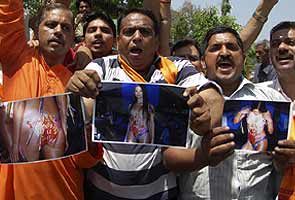
This image shows some Hindus in India protesting against a swimsuit (or rather protesting against the designer of the swimsuit) containing the image of Goddess Lakshmi. Hindus were clearly offended by the swimsuit. No necessity here to explain why they would be. 

Where am I heading with this? Well, there are 2 aspects to the issue of offensive acts or remarks. There is the perpetrator and his/her act/remark. There is then, the reaction of the group of persons maligned by the act/remark.
The Perpetrator
The person that made the offensive remark or gesture could have done so privately with no intention for the remark or gesture to be communicated in public. That person could have done so publicly with the intention to shock or offend. Alternatively, although the person made the remark or gesture in public, he/she did so without realising that it is capable of offending/hurting someone.
Whilst the perpetrator enjoys the freedom (or ought to be permitted to enjoy the freedom) to say what he wants, we do recognise that some types of speech can cause harm to society (not merely causing offense). Incitement to commit acts of violence, incitement to commit murder and generally any form of incitement to commit criminal offences should rightly be prohibited. The person making remarks or gestures must be prohibited by law from inciting crimes. But, I believe that speech that is capable of offending groups or communities should not be banned.
Whilst advocating freedom, I do not advocate irresponsibility. It is axiomatic that the freedom enjoyed by a person must be used responsibly. Whilst I might advocate the freedom of speech as a matter of law, I strongly believe that this freedom is one that comes with great responsibility. My blog itself gets its name from Article 14 of Singapore's Constitution (Freedom of Speech and Expression). I have repeatedly maintained the need for liberalisation of our laws insofar as freedom of speech is concerned.
If the law permits me to speak freely, I would still not feel that I have a right to say anything I want. If I may be permitted to do so, there is an ancient Tamil saying from Thirukkural:
இனிய உளவாக இன்னாத கூறல்
கனிஇருப்பக் காய்கவர்ந் தற்று
Uttering insults whilst there are constructive words is
equivalent to eating unripe fruits when ripe ones are available.
With a soft word, a kind utterance and a gentle smile, we generate goodwill and harmony around us. With harsh words, insults and derogatory comments we manifest sourness and spread hate and misunderstanding. It is important to remember that the freedom to say what we want should be used responsibly to ideally create a positive environment around us all the time or at least to avoid creating sourness.
Of course, sometimes when we state the truth, it can hurt. I am not exhorting the idea of being untruthful. But, even truth can be presented in a way that is less harsh. One can be critical without being hurtful. Sometimes, we have to state the truth forcefully in the face of state power or in the face of social injustice. But, stating the truth forcefully can be done with compassion and understanding. Even in the political context, leaders such as Mohandas K. Gandhi, Martin Luther King and Bishop Desmond Tutu were capable of rendering forceful anti-establishment rhetoric without violence of thought, speech or action.
The responsible use of free speech is an ideal. However, irresponsible use of free speech is not uncommon in those societies that provide for legal protection of speech. That a person says something irresponsible, however, should not be the basis of legally censoring him.
That brings me to Amy Cheong. She has made some facebook remarks that have been objectively acknowledged by many individuals (politicians, public figures and citizens) as being offensive. In Singapore, her comments could be construed as falling within the definition of Sedition under the Sedition Act. A seditious tendency is defined in s.3(1) of the Act as including a tendency to promote feelings of ill-will and hostility between different races or classes of the population of Singapore.
I am not a big fan of this provision in the Sedition Act although I understand the historical context of its origin. In many Western democracies hurling racial and religious insults is not considered an offence even though it might be offensive to those that are the targets of those insults. Having said that, one should not condone such behaviour. The state has no business in proscribing such conduct. But, the individuals in such a society must aspire to moderate their speech in way that would not be hurtful. It is for this reason that I do not consider it proper for Amy Cheong to say the things that she said (though she should not be legally prevented from doing so).
The perpetrators should examine themselves. The ones that use hate speech and peddle hateful perspectives should question themselves and see where these views are coming from. They should see for themselves the hurt that they cause to others. Freedom of speech brings with it the need to express responsible views. Those that put out their views for public consumption must consider how those views would impact the rest of the community.
Whether it is Amy Cheong, Shimun Lai, the director of "Innocence of Muslims", Lisa Burke, Sun Xu or any other person engaging in objectively offensive activity, they have to reassess themselves and the hatred that they peddle. Racist viewpoints and racial stereotypes are often a product of ignorance, limited exposure and re-inforcement of prejudiced perspectives through anecdotal evidence.
The victims of the insult
Those that end up at the receiving at of the stick when it comes to offensive words/actions have to ask themselves how they want to react. To begin with, some of us are easily offended as opposed to others. Some of my fellow Hindus would be really riled up by the images above. The bikini design would have been particularly offensive. As the protest image indicates, enough people were upset in India to engage in demonstrations and even Court actions. Some would react with anger and would then let it pass as not being uppermost on their agenda. Some would feel offended and yet decide that there is no point in pursuing the perpetrators legally or otherwise. Yet others like me would brush it aside as inconsequential and not really take offense.
My own perspective is that the insults, malicious comments, racist views, sacreligious actions and other negative acts are incapable of defining the person that I am. I don't construct my identity through the perception of others and I don't draw comfort from the high regard that others have of me. I am comfortable with my own identity on the basis of who I am. Objectively insulting words/actions have little impact on me. Something offensive comes my way. I read, I hear, I observe, I ponder upon it and then I release it. I do not see the need to react to it. I wasn't always like this and when I was younger i used to get riled up over quite a number of racist remarks and actions. Perhaps, age has caused me to mellow down. Perhaps, I have simply come to recognise that no amount of external attempts by others at constructing an image of me is going to change who I am.
I believe that those of us that advocate the freedom to criticise the state and its policies should acknowledge the freedom of others to make comments, however negative. We will not accept incitement to crime. But surely we can live with the messiness of the rude and crude persons amongst us. If a person is racist and denies us a job or school or university admission on account of our race, we should rightly make that an issue to be remedied even through the use of the law. If it just a racist comment or insult, I am sure we can grow a layer of thick skin and not acknowledge or give credence to the racist's comments.
In response to some of the hateful stuff that has been posted, some people have thrown insults and strongly worded condemnations at the perpetrators. The perpetrators should have expected it. There is nothing to be shocked about the reaction of anger. It doesn't lie in the mouth of the perpetrators to suggest that victims of the insult are overly sensitive. After all, you are being spared the long arm of the law and you merely need to contend with vitriol.
As for the victims of the insult, I would hope that everyone would exercise restraint. Whilst anger is understandable, violence is not justifiable. (Earlier this year I had blogged about my views on the Shimun Lai incident when she made remarks about Indians http://article14.blogspot.sg/2012/03/shimun-lai-whats-her-crime.html)
The Amy Cheong Affair

In Singapore, in relation to the Amy Cheong affair, the online response has been to turn on Amy Cheong like a lynch mob. I understand the angry reaction. But, I fail to see the need for raising the matter up to Amy Cheong's employer (NTUC). Someone has also filed a police report. Did we really need to resort to such measures. Amy Cheong might have made racist remarks (some would say classist as well) but should that be the reason for having her sacked? Just imagine if every person that makes a racist remark were to be dismissed by the employer. Where would that leave us as a country.
I am sure that many of us will realistically acknowledge that racist views are pretty common in Singapore and it is merely a case that much of these views have not been publicly articulated (except when those views are peddled as 'hard truths' by a certain elderly gentleman) or there have been no real avenues for the articulation of these views till now. Today, with the availability of social media, it is possible for one's narrow-minded views to go viral. Should every company in Singapore sack its publicly racist employee?
From what I have seen online, some individuals that have in the past written pretty nasty stuff about 'PRC' individuals and FTs, have now turned holier-than-thou and are hurling brikbats at Amy Cheong.
Some of our Ministers that had advised Singaporeans to be accomodating towards Sun Xu have now condemned Amy Cheong's FB post and even applauded NTUC's decision to fire her.
Firstly, we have to recognise that no human being is perfect. Everyone has some level of stereotypical views about other races, religions, communities, nationalities, etc. Even the best amongst us would have at some point in time expressed racial/racist comments. We have to have the wisdom to understand that the real racism that we want to fight is the kind that deprives communities of opportunities. Insults cannot break our bones.
Secondly, if we must respond to insults, it would be best to do so by pointing out to the person the error of his/her ways. There is no necessity to descend into the gutter with that person.
Thirdly, (and this is why I decided to blog on this matter) we have to ask ourselves whether an employee should be sacked on account of his/her facebook comments (however racist they may be)?
Was NTUC right in sacking Amy Cheong?
On Sunday night when I saw Amy Cheong's FB post going viral, I thought to myself how sad it is that this nation is still finding it difficult to rise above race. I then came across Amy Cheong's apology (which curiously was a PAP style apology that says, "I am sorry that my actions hurt you" as opposed to "I am sorry about what I did."). I noticed that there were those calling on NTUC to take some action against her. I expected NTUC to state that they do not approve of what Amy Cheong said and that they have asked her to deliver a public apology. I was honestly caught off-guard on Monday when I saw the breaking news online that NTUC had fired Amy Cheong.
There must be an unfair dismissal somewhere in there. How did a comment on FB spiral out of control to a point where the very next day (being the 1st working day of the week), the employers sacked the writer on the spot. Whatever happened to giving notice of termination? Fine. It is possible that the contract would have provided for some eventuality that would entitle the Employers' to terminate forthwith. Assuming that the condition for immediate termination was pertaining to discipline or for bringing NTUC into disrepute, it is still shocking that within a period of less than 24 hours NTUC was able to arrive at a decision that the relevant contractual provision had been infringed. No due process. No attempt to notify the employee of the intention of NTUC to fire her on account of the allegation. No attempt to afford the employee an opportunity to explain herself or to make amends.
In its swiftness, NTUC probably estimated that it would seize this opportunity to perform a public relations coup. I can imagine that the close association between the PAP leadership and the NTUC would have meant that criticism of Amy Cheong would have tainted the NTUC and that tainting would then have tainted the PAP as well. There must have been a flurry of activity within the Cabinet and the decision must have been taken to sack Amy Cheong. A calculation could have been made that this would portray Lim Swee Say (PAP Minister and Labour Chief) in a good light as a decisive individual willing to make the right decision. It would have been calculated that this would add to PAP's reputation for a no-nonsense approach to race related issues.
Of course, I could be wrong. Lim Swee Say could have acted on his own and felt that this was the right thing to do.
Whatever the reason for the sacking, it is truly a step in the wrong direction and a very bad precedent to be set for all employers. The National Trade Unions Congress, more than any other company, institution or organization should be intimately aware of and highly protective of the rights of employees. Instead, NTUC (or Lim Swee Say) has acted in a high handed fashion in the manner of a large corporation willing to run roughshod over its employees.
Apart from the question of whether NTUC conducted a proper investigation of the issues at hand before sacking Amy Cheong, there is the issue of whether a person's personal Facebook posting should be the basis of an employer's decision to sack that person. It would have been a different matter if Amy Cheong had in the course of her employment insulted a customer by using a racist statement. (Recently, a SMRT bus driver was disciplined (not sacked) for referring to a passenger as Ah Kua.) Clearly, Amy Cheong's comment was not made in the course of employment.
What could NTUC have done? Since a police report had been made and assuming Amy Cheong was being investigated for sedition, NTUC could have suspended her pending the criminal proceedings. If she was eventually convicted, NTUC could then have relied on an appropriate contractual clause to terminate her.
Now that NTUC has decided to behave like a high handed employer, what kind of example does that set? Well, I guess some of the more cynical amongst us would say that NTUC was never really a worker's union. It was a body set up to manage workers' expectations whilst bending over backwards for business/corporate interests. I am, therefore, not surprised, after some reflection, that NTUC sought to 'save face' and to avoid the ire of the lynch mob.
The reaction against Amy Cheong was speedily and irrationally turning against NTUC and had the potential to turn against the PAP. Perhaps, Amy Cheong was the sacrifical lamb.
Thursday, September 27, 2012
The debts of Chee Soon Juan that were not provable in his bankruptcy
It is good to hear that Dr Chee Soon Juan has managed to raise the $30,000 that he had offered by way of settlement to his creditors (which offer had been acknowledged by the OA as has having been accepted by LKY and GCT).
Perhaps, it is prudent at this stage to be somewhat cautious. As far the law is concerned, when a person is discharged from bankruptcy, all the debts that are provable in bankruptcy get wiped out. Creditors will not be able to go after the bankrupt person after his discharge. However, this does not apply to debts that were not provable in the bankruptcy in the first place. When a person is made bankrupt, apart from the creditors that made him bankrupt, other creditors will come forward to file their proof of debts. The OA will not accept all of these claims as debts provable (claimable) in the bankruptcy. Such creditors may be genuine creditors with genuine cases. But, they will have to wait. They can, however, make a claim against the discharged person soon after the bankruptcy is lifted.
In the email addressed to CSJ, the OA indicates the existence of a claim by DBS bank that the OA had rejected as a debt not provable in bankruptcy. Such a debt can still be the basis of a fresh claim against CSJ once he is discharged. I hope that this is a small amount and CSJ has no difficulty in paying off. If the sum is substantial, we might be dealing with another attempt at applying for bankruptcy by DBS bank this time. CSJ may not be out of the woods yest.
OA's email:
Perhaps, it is prudent at this stage to be somewhat cautious. As far the law is concerned, when a person is discharged from bankruptcy, all the debts that are provable in bankruptcy get wiped out. Creditors will not be able to go after the bankrupt person after his discharge. However, this does not apply to debts that were not provable in the bankruptcy in the first place. When a person is made bankrupt, apart from the creditors that made him bankrupt, other creditors will come forward to file their proof of debts. The OA will not accept all of these claims as debts provable (claimable) in the bankruptcy. Such creditors may be genuine creditors with genuine cases. But, they will have to wait. They can, however, make a claim against the discharged person soon after the bankruptcy is lifted.
In the email addressed to CSJ, the OA indicates the existence of a claim by DBS bank that the OA had rejected as a debt not provable in bankruptcy. Such a debt can still be the basis of a fresh claim against CSJ once he is discharged. I hope that this is a small amount and CSJ has no difficulty in paying off. If the sum is substantial, we might be dealing with another attempt at applying for bankruptcy by DBS bank this time. CSJ may not be out of the woods yest.
OA's email:
7 September 2012
Dear Dr Chee
We refer to your email of 5 September 2012.
2. Please be informed that the Official Assignee ("OA”) conveyedyour offer of composition of $30,000, on 17 August 2012 (the same daywe replied to your email of 8 August 2012) to all your creditors,namely, Mr Lee Kuan Yew, Mr Goh Chok Tong and the Attorney-General’s Chambers. We invited them to respond with their views on your offerand their counter-proposals (if any) by 7 September 2012.
3. You may wish to note that the OA has rejected DBS Bank Ltd’s claimfiled against your estate in bankruptcy, as the debt claimed wasincurred after the making of the Bankruptcy Order against you and istherefore not provable in your current bankruptcy.
4. Your three creditors have since replied on 30 August 2012 and 3 September 2012, informing us that they have no objection to youroffer of composition of $30,000. Please let us know when you will beremitting the sum of $30,000 to our office. Upon receipt of the sum,we will need to ask your creditors to formally vote on the offer. Once they have voted their acceptance of your offer, the OA willprocess the necessary paperwork to effect the annulment of yourbankruptcy.
5. Please note that a certificate of annulment issued under section 95A(1) of the Bankruptcy Act will be binding on your creditorsinsofar as it relates to any debts due to them which are provable inthis bankruptcy.
Yours faithfully
Lydia Loh
For OFFICIAL ASSIGNEE
Friday, September 21, 2012
And the mine explodes!
In my previous post, (http://article14.blogspot.hk/2012/09/mha-walks-into-minefield-when-didnt.html) I was questioning the wisdom of MHA wading into the saga of the Archbishop's letter. They could have stayed away and avoided embarrassment. They didn't. And now they have stepped on a mine.
Function 8 (evidently riled up by MHA's press statement) has released a letter written by them to the Archbishop after the latter's withdrawal of his first letter. This is Function8's letter:
The first paragraph is sufficient (despite the blanked out portions) to indicate that the Archbishop had expressed support for the event.
Someone has been copied into the letter of retraction. One wonders who that might be. Someone from the Church? Someone from the government? Why would that person be copied into the letter? More questions.
Let us not get sidetracked from the key issue. Whatever might have transpired between Function 8 and the Archbishop and however any party may be alleged to have acted irresponsibly, is irrelevant for the rest of us. What is relevant is whether government officials had brought pressure upon the Archbishop to retract his letter of support.
If such pressure was placed on the Archbishop, how did the officials come to know of the letter? Were the members of Function 8 and their meetings subject to surveillance by the ISD? If as is repeatedly alleged, the ISD's function is to prevent terror attacks, why would their efforts be directed at the activities of a civil society group? (Although many of us in my generation and those older than me have taken it for granted that the ISD may have done routine surveillance on citizens for political purposes, I have increasingly heard from a younger generation of PAP apologists that the ISD and the ISA is necessary for the prevention of terrorist activity. These persons ought to consider whether the surveillance activities of our state is limited to crime prevention and prevention of terror or such surveillance activities are extended to political activities of persons seen as being unfriendly towards the ruling party.)
Of course, I am speculating a fair bit here.
The following scenario is also entirely probable:
Archbishop writes a letter to Function 8. A few days later, Minister has a routine meeting with the Archbishop where the latter frankly reveals the fact of the letter written to Function 8. Minister suggests that it is not advisable to have the letter released to the public and persuades the Achbishop to withdraw the letter. On day 5, Archbishop writes to Function 8 to withdraw the letter.
We will never know the truth.
---------------------------------------------------------------------------------------------------------------------
A short aside... I just saw the scanned image of Function 8's letter.

Function 8 (evidently riled up by MHA's press statement) has released a letter written by them to the Archbishop after the latter's withdrawal of his first letter. This is Function8's letter:
1 June 2012
Dear Monsignor Nicholas Chia
May we first say that we were very happy to receive your lett er of 25th May 2012 in support of the commemorati on event of Operation Spectrum to be held on 2 June 2012 and your wish (parts blacked out by F8 to protect the direct contents of the Archbishop's original letter). We received and appreciated it as a gesture on the part of the Catholic Church in Singapore to recognize truth and acknowledge the injustice suffered by the former detainees of Operation Spectrum and their families.
Needless to say, we are deeply disappointed and puzzled to receive your letter of withdrawal, just five days later.
Whatever might have transpired to pressurize the head of the Catholic Church in Singapore to withdraw the letter, we would like to think that you can now understand why the detainees had to make their "confessions" under the duress of torture and the threat of indefinite detention without trial.
We do not regard the event we are organizing as "political activities", but as an effort to achieve restorative justice. This is a human and necessary stage in the healing process for the former detainees of Operation Spectrum, their families and friends. We are somewhat amazed and dismayed that you seem to suspect - without giving any reason (and indeed there is none) - that there is any ulterior motive to use your letter outside of the event, in any way at all.
How did you come to this conclusion? We had not even solicited the letter from you in the first place.
We note that you have copied a Mr (parts blacked out by F8 to protect the identity of the person) in your letter of withdrawal and are puzzled as to his role in this matter when he was not copied in the fi rst letter. Should we also copy this response to Mr (parts blacked out by F8 to protect the identity of the person)? Out of courtesy, we will await your response.
Lastly, while we can understand that Christians are obliged to "render to Caesar what is Caesar's", in the context of Singapore, we are curious to know what you think they should "render to God" in this same context.
Yours sincerely,
The Organisers
The first paragraph is sufficient (despite the blanked out portions) to indicate that the Archbishop had expressed support for the event.
Someone has been copied into the letter of retraction. One wonders who that might be. Someone from the Church? Someone from the government? Why would that person be copied into the letter? More questions.
Let us not get sidetracked from the key issue. Whatever might have transpired between Function 8 and the Archbishop and however any party may be alleged to have acted irresponsibly, is irrelevant for the rest of us. What is relevant is whether government officials had brought pressure upon the Archbishop to retract his letter of support.
If such pressure was placed on the Archbishop, how did the officials come to know of the letter? Were the members of Function 8 and their meetings subject to surveillance by the ISD? If as is repeatedly alleged, the ISD's function is to prevent terror attacks, why would their efforts be directed at the activities of a civil society group? (Although many of us in my generation and those older than me have taken it for granted that the ISD may have done routine surveillance on citizens for political purposes, I have increasingly heard from a younger generation of PAP apologists that the ISD and the ISA is necessary for the prevention of terrorist activity. These persons ought to consider whether the surveillance activities of our state is limited to crime prevention and prevention of terror or such surveillance activities are extended to political activities of persons seen as being unfriendly towards the ruling party.)
Of course, I am speculating a fair bit here.
The following scenario is also entirely probable:
Archbishop writes a letter to Function 8. A few days later, Minister has a routine meeting with the Archbishop where the latter frankly reveals the fact of the letter written to Function 8. Minister suggests that it is not advisable to have the letter released to the public and persuades the Achbishop to withdraw the letter. On day 5, Archbishop writes to Function 8 to withdraw the letter.
We will never know the truth.
---------------------------------------------------------------------------------------------------------------------
A short aside... I just saw the scanned image of Function 8's letter.

Let me make a guess as to the missing bit. I typed out the text on a Word document and the following words fit in perfectly into the blacked out portion.... "truth to be established and justice to
prevail." So, that first sentence might have read as follows: "May we first say that we were very happy to
receive your letter of 25th May 2012 in support of the commemoration
event of Operation Spectrum to be held on 2 June 2012 and your wish for truth
to be established and justice to prevail."
Thursday, September 20, 2012
MHA walks into a minefield
When I read Alex Au’s blog post on the letters written by Archbishop
Nicholas Chia to Function 8 (one of the organisers of the Speakers’ Corner
event to commemorate the 25th anniversary of the detention of the
so-called Marxist conspirators), my eyebrows were raised a little. But, I wasn’t too surprised at the
possibility raised by Alex that some ‘friendly’ visit from the state might have
persuaded the Archbishop to reconsider the wisdom of his original letter. http://yawningbread.wordpress.com/2012/09/18/lunch-menu-a-4-point-letter/
All the usual suspects (including myself) that would
normally read Alex’s blog would have gotten wind of this information. Very few would have bothered to discuss this
beyond a few casual conversations.
Perhaps, one or two blogs might have picked up on it and repeated
it. After a short while (perhaps a
couple of days), any interest in the subject would have died out.
But, to my surprise, first the Archbishop comes forward to
explain the reason behind his retraction and then Function 8 and MARUAH get
upset and set down their position and guess who wades into the battlefield….. the Ministry of Home Affairs. Honestly, I didn’t expect MHA to come forward
to release a statement on this one. The
best part is that they pretty much admitted that somebody from the government
had met up with the Archbishop. Of
course, this is presented as a routine meeting.
The MHA’s full press statement is as follows:
MHA’s Statement on
Archbishop Nicholas Chia’s Comments
The Government values its long-standing relationship with
the Catholic Church and the Catholic community in Singapore, and deeply
appreciates Archbishop Nicholas Chia’s many contributions to religious harmony
in Singapore.
2 As part of building trust and understanding and to
maintain religious harmony in Singapore, government ministers meet regularly
with various religious leaders in Singapore. Such closed-door meetings allow a
frank exchange of views specially on sensitive subjects. This is a well-established
process that is appreciated by both ministers and religious leaders.
3 We note Archbishop Chia’s statement yesterday that he
had withdrawn his earlier letter as its contents did not accurately reflect his
views on the subject. He also expressed concern that if the letter was used in
a manner that he did not intend, it may inadvertently harm the social harmony
in Singapore. His decision to withdraw his letter ahead of a political event in
June 2012, shows his appreciation of the complexity of our multi-racial,
multireligious society, and the need to keep religion and politics separate.
4 The actions by this group to publicise the matter
through Mr Au is disrespectful of the Archbishop, and contrary to his views and
intentions as conveyed to the group after he had decided to retract his letter.
This deliberate breach of the Archbishop’s trust confirms the objective of this
group to publicly involve the Catholic Church and the Archbishop in their
political agenda.
Issued by
Ministry Of Home Affairs
Ministry Of Home Affairs
The channelnewsasia story on this is here.. http://www.channelnewsasia.com/stories/singaporelocalnews/view/1227148/1/.html
This seems to be a very ill-advised move on the part of the
MHA. This issue can now be amplified
thanks to the fact that MHA came forward to issue a statement. Now, the online community would have a field
day raising question after question. I
did not, initially, have any intention to blog on this matter. But, given the MHA response, there are more
questions raised.
In its statement, the MHA states: . “He also expressed concern that if the
letter was used in a manner that he did not intend, it may inadvertently harm
the social harmony in Singapore. His decision to withdraw his letter ahead of a
political event in June 2012, shows his appreciation of the complexity of our
multi-racial, multireligious society, and the need to keep religion and
politics separate.”
If I take the statement at face value and do not construe
any attempt by the government to put a spin on the Archbishop’s letter, then
the following is clear:
a)
Something
in the letter was capable of harming social harmony (although the Archbishop
did not intend it).
b)
That ‘something’ relates to the ‘complexity of
our multi-racial, multireligious society’
c)
That ‘something’ might involve the mixing of
religion and politics
What kind of statement made by the Archbishop could be characterized
as being capable of doing the above?
i)
A statement referring negatively to a particular
race
ii)
A statement referring negatively to a particular
religion or religious denomination
What is the likelihood of the Archbishop’s original letter
making even an inadvertent statement to that effect? He wrote an unsolicited letter to the
organizers of the “That we may Dream again” event. Any rational Singaporean reading about the
sequence of events would come to the conclusion that the Archbishop’s letter
would, at most, have contained one or all of the following assertions:
i)
That his prayers are with the ex-detainees
ii)
That he hopes that truth about the ‘Marxist
conspiracy’ would be established one day
iii)
That he does not support detention without trial
iv)
That he supports the organisers’ call for the
abolition of the ISA
v)
That he supports the development of civil society
in Singapore and the consequent call for greater human rights protections
None of the above assertions (whilst sensitive from the
perspective of the PAP government) could be construed as being capable of
disrupting social harmony. (Of course, I
am fully aware that the phrases ‘social harmony’, ‘multi-racial &
multi-religious’ and ‘mixing religion with politics’ are part of the tiresome, clichéd
routine employed by the government to keep reason at bay and they were probably
deployed here unthinkingly and without realizing the illogicality in the
present context.)
It would have been logically incongruous for a letter
written to the organizers of an anti-ISA event, to include a statement making a
negative reference to a race or religion.
The only possibility is a reference to Mas Selamat (being an ISA
detainee) as an exception to the norm of political detention under the
ISA. Such reference may arguably be ‘sensitive’
if it is couched as an argument that it is ok to detain an alleged Islamic terrorist
without trial, but not ok to detain any others without trial. It is highly unlikely that the Archbishop
would have said anything to that effect in his letter. But, only such a statement could be even
remotely be construed as affecting social harmony and having something to do
with the complexity of our multi-blahblahbah society.
So, taking the MHA statement at face value, I should arrive
at the conclusion that there was some kind of racially or religiously sensitive
statement. But, that conclusion would be
incongruous with the context of the letter.
In all likelihood, the content of the original letter was politically embarrassing
for the government. The Archbishop coming
in support of a political event that was intended to commemorate the 1987 ISA
detentions was capable of undermining the credibility of the PAP
government. Even a simple statement such
as “I pray for you” or “I support your cause” would have been politically
sensitive. It would not have affected
social harmony. But, it would have cast
the government in a bad light.
So, it would appear that the real issue was not about social
harmony or the multi-racial, multi-religious nature of our society. The real issue was related to the mixing of
religion and politics:- The commentary
by the head of a Church on a political matter where the negative publicity
would damage the ruling party’s image.
It would not cause social disharmony.
Our society would not descend into a state of violence or chaos. But, more people may be persuaded to see the
PAP in a negative light.
The following is the Archbishop’s statement to the press
after Alex Au’s article.
Chronologically, this preceded the MHA’s statement.
Archbishop’s Press Statement
"I refer to the article by Mr Alex Au which he says is based on second
hand information. Mr Au could only have obtained such an ccount from the group
he referred to, with which I had communicated in private. I had earlier decided
to withdraw my letter to this group as, on reflection, its contents did not
accurately reflect my views on the subject, and if used in a manner that I did
not intend, may inadvertently harm the social harmony in Singapore. The group
had acknowledged my decision and returned the letter to me.
The article by Au, which has appeared now, months later, confirms the
correctness of my earlier decision to withdraw the letter so as not to
inadvertently embroil the Catholic Church and the office of the Archbishop in a
political event which was being staged by the group.
The Catholic Church has always maintained the position that it will not
involve itself in political activities. We have always worked in harmony with
the Government to contribute positively to society, rather than set ourselves
on a collision path with the Government.
Au's article confirmed my fear that the group would use my letter in a
manner that I did not agree with, and make use of the Office of the Archbishop
and the Catholic Church for their own ends.
These irresponsible actions can easily cause serious misunderstanding
between the Catholic Church and the Government, and damage the longstanding
trust and cooperation between the two. It is most regrettable that Au and the
group have acted in this manner."
Whilst Function8 and MARUAH have taken issue with the Archbishop’s
press statement, I want to highlight the last three sentences. Operating on the mind of the Archbishop is
the relationship between the Catholic Church and the government. A reasonable inference to be drawn from this
press release is that whilst the original letter from him would not have
directly blamed the government, his solidarity with the organisers, detainees
or their families by writing a letter relating to an anti-ISA event could be
used by event organisers to suggest an anti-government stance on the part of
the Archbishop. This would have harmed
the relationship between the Church and the government.
This then, is the real issue of ‘harmony’ being referred to: A cordial relationship between the government
and the religious leaders in Singapore. What
the Archbishop must have feared is unnecessary bullying from the
government. What the government must
have feared is the unraveling of the government’s image in the eyes of, if not a
majority of the citizens, then at least a sizeable segment of the Catholic
community.
At this stage in this saga, what are the established facts?
a)
The Archbishop wrote a letter to Function 8
(presumably supportive of the anti-ISA event)
b)
The Archbishop retracted the letter (allegedly
because the contents did not accurately reflect his views & they could
inadvertently cause disharmony)
c)
Some meetings have taken place between
government officials/ministers and the Archbishop (the purpose of the those
meetings may or may not be related to the letter sent to Function 8)
What is the issue at stake here? The possible behind-the-scenes government
intervention in relation to the Archbishop’s letter. If there was such involvement, then it would
be confirmation that this government isn’t about to fundamentally alter the way it does things.
For reference, the following are statements from Function 8
and MARUAH
Function8’s press statement:
We are deeply saddened by the comments of Archbishop
Nicholas Chia reported in The Straits Times of 20th September 2012. He made three
unsubstantiated remarks:
1.
That Mr Au’s account (in Yawningbread) could only have
come from Function 8, with whom he had communicated in private.
2.
That he decided to withdraw his letter of support
“because if the letter were to be used in a manner that I (Archbishop) did not
intend, it may inadvertently harm the social harmony in Singapore.”
3.
That Mr Au’s article appearing now, months later,
“confirms the correctness of my (Archbishop’s) earlier decision to withdraw the
letter so as not to inadvertently embroil the Catholic Church and the office of
the Archbishop in a political event which was being staged by the group.”
Our response is as follows:
1.
Archbishop Nicholas Chia’s initial letter to us, and the
subsequent one withdrawing the first letter, were not marked “private and/or
confidential”. Indeed, in discussing his first letter, members of Function 8
concluded that it was intended to be made public on 2 June 2012, the 25th anniversary of Operation Spectrum.
The retraction of the first letter made us cancel the plan. The organisers of
the 2 June event subsequently decided that we would try to have a private
dialogue with the Ministry of Home Affairs.
2.
Archbishop Nicholas Chia assumed that Mr Au could only
have obtained an account of what he wrote in his article from Function 8. Has
His Grace forgotten that his second letter was cc to a third party and that his
staff and others within the Church may also have sight of the letters?
3.
What was his initial letter intended for and what are the
unintended manners in which it could possibly be used to ‘harm the social
harmony in Singapore’?
4.
Finally, we do not understand how His Grace can draw the
conclusion that the disclosure of his own letter can “inadvertently harm the
social harmony in Singapore” and that the fact that Mr Au has now written an
article confirms the correctness of his earlier decision to withdraw the
letter.
In the midst of a national conversation called by the
prime minister, we believe there is no room for whispered meetings on the
issues above. We request Archbishop Nicholas Chia to publish his first and
second letters and advise on what transpired between the time his first letter
was written and his second letter so that the public can judge for themselves
whether the actions or inaction of Function 8 and Mr Au were “irresponsible and
regrettable”. For clarity, His Grace should also make known to members of the
public if his first letter to the organisers of the 2 June event was solicited
or unsolicited.
Function 8 Ltd
20/9/2012
20/9/2012
Here is MARUAH's press statement in full:
"MARUAH, a human rights NGO, is a partner with Function 8, in particular for the June 2nd 2012 event to mark the 25th Anniversary of the alleged Marxist Conspiracy. MARUAH's position is that it is timely for a Commission of Inquiry to be set up to review the detentions under Operation Spectrum.
As part of this collaborative effort MARUAH was informed of the letters that the Archbishop had sent to Function 8 and we are aware of the contents. The letters reflect diverse views on key content areas in relation to preventive detention without trial. Both organisations made a decision not to publicise the letter(s) till we sought clarifications from Ministry of Home Affairs and other relevant parties. This decision was taken as we feel it is a better way forward as both organisations are mindful of the previous pain within the Catholic community over what happened in 1987 where the Church, the government, the detainees and the community were involved. We agreed that after these approaches to reach out for dialogues had been tried and tested we would review this incident of the letters. It is unfortunate that the matter of the letters was leaked to the media before we could receive clarifications from the relevant bodies. Both organisations had wanted to focuson seeking a dialogue rather than dealing with the Archbishop's letters a public manner through the media.
Having said that, MARUAH has to state that we are deeply disappointed with the remarks of the Archbishop in his response to the media queries. An opportunity to understand the change in the position of the Archbishop vis-a-vis preventive detention without trial was missed. We are still clueless as to whether there was intervention by the State in this matter and if so, on what grounds and to what extent. Instead civil society has been vilified in the Archbishop's remarks which are the opposite of our intentions to preserve harmony by seeking clarifications.
Nevertheless, it is more important to move forward. We are keen to have dialogue with the Ministry of Home Affairs on our ongoing efforts at public education and advocacy on preventive detentions without trial. We will also be very happy to meet the Archbishop in relation to this matter.
More importantly, it is very important to us, and to many other Singaporeans that an independent Commission of Inquiry be set up as we are perturbed by the many contradictions in this case. This was the work that began on June 2nd between MARUAH and Function 8, to ensure that the rights of those detained are protected and fulfilled through an inquiry.
Braema Mathi
President
MARUAH Singapore"
"MARUAH, a human rights NGO, is a partner with Function 8, in particular for the June 2nd 2012 event to mark the 25th Anniversary of the alleged Marxist Conspiracy. MARUAH's position is that it is timely for a Commission of Inquiry to be set up to review the detentions under Operation Spectrum.
As part of this collaborative effort MARUAH was informed of the letters that the Archbishop had sent to Function 8 and we are aware of the contents. The letters reflect diverse views on key content areas in relation to preventive detention without trial. Both organisations made a decision not to publicise the letter(s) till we sought clarifications from Ministry of Home Affairs and other relevant parties. This decision was taken as we feel it is a better way forward as both organisations are mindful of the previous pain within the Catholic community over what happened in 1987 where the Church, the government, the detainees and the community were involved. We agreed that after these approaches to reach out for dialogues had been tried and tested we would review this incident of the letters. It is unfortunate that the matter of the letters was leaked to the media before we could receive clarifications from the relevant bodies. Both organisations had wanted to focuson seeking a dialogue rather than dealing with the Archbishop's letters a public manner through the media.
Having said that, MARUAH has to state that we are deeply disappointed with the remarks of the Archbishop in his response to the media queries. An opportunity to understand the change in the position of the Archbishop vis-a-vis preventive detention without trial was missed. We are still clueless as to whether there was intervention by the State in this matter and if so, on what grounds and to what extent. Instead civil society has been vilified in the Archbishop's remarks which are the opposite of our intentions to preserve harmony by seeking clarifications.
Nevertheless, it is more important to move forward. We are keen to have dialogue with the Ministry of Home Affairs on our ongoing efforts at public education and advocacy on preventive detentions without trial. We will also be very happy to meet the Archbishop in relation to this matter.
More importantly, it is very important to us, and to many other Singaporeans that an independent Commission of Inquiry be set up as we are perturbed by the many contradictions in this case. This was the work that began on June 2nd between MARUAH and Function 8, to ensure that the rights of those detained are protected and fulfilled through an inquiry.
Braema Mathi
President
MARUAH Singapore"
Subscribe to:
Posts (Atom)