Pages

Showing posts with label article 14. Show all posts

Tuesday, June 11, 2013

The Broadcasting Act is fundamentally flawed

We've had our blackout online protest.  We have done our offline protest at Hong Lim Park.  The blogging community has made a loud enough statement to be heard.  But, as with many things in Singapore, though we might shout out loud, we may still not be heard. 

I was at Speakers' Corner on Saturday, 8 June 2013.  It was a remarkable job by the #FreeMyInternet chaps.  They managed to get themselves organized within a short time frame and got the message out to enough people to gather a decent crowd on Saturday. 

I know that the #FreeMyInternet movement made it very clear that their primary goal for the time being is the revocation of the MDA's latest licensing rules.  But, I am sure their ultimate desire is also to see greater freedom in terms of the traditional media as well. 

There is one thing that we need to be very clear about.  The current licensing rules are set out in the Broadcasting (Class Licence) (Amendment) Notification 2013.  By virtue of this notification, MDA can, at its discretion, remove any website from the Class Licence and require it to obtain a specific licence.  The problem is not really a result of this subsidiary legislation.  The problem is in the parent Act of Parliament itself.  Parliament has drawn up a provision that is so broad that it has authorised lawlessness. 

Under Section 8(2) of the Broadcasting Act,
"Every broadcasting licence, other than a class licence, granted by the Authority shall be in such form and for such period and may contain such terms and conditions as the Authority may determine"

This is equivalent to saying that the licence will be in 'x' form, for 'y' period and contain 'w' terms, where x, y and w will be determined by MDA. 

As for Class licenses, section 9 deals states the following:

9(1) The Authority may, by notification published in the Gazette, determine a class licence, being a broadcasting licence, for the provision of such subscription broadcasting services and other licensable broadcasting services as the Authority may specify.
(2) The Authority may include in a class licence such conditions as it thinks fit.
 
 
MDA may issue any form of class licence and impose any conditions. 
 
Sometimes when a legislative provision is vague and open to interpretation and there exists a danger that it could be interpreted too broadly, we might caricature that legislation by stating that Parliament could have simply given unfettered discretion to a public body to do as it pleases.  The Broadcasting Act has been drafted in such a manner that it literally gives that unfettered power to the MDA. 
 
In Chng Suan Tze v Minister of Home Affairs (1988), Wee CJ stated:
 
"All power has legal limits and the rule of law demands that the courts should be able to examine the exercise of discretionary power. If therefore the executive in exercising its discretion under an Act of Parliament has exceeded the four corners within which Parliament has decided it can exercise its discretion, such an exercise of discretion would be ultra vires the Act and a court of law must be able to hold it to be so."


Ordinarily, the kind of case that the Courts would face involves a government body that exceeds the discretionary power that has been given to it by an Act of Parliament.  Clearly, the Courts would restrain any government body that attempts to do so.  But, the relationship between the Broadcasting Act and the MDA is such that the "four corners" that the Chief Justice referred to in the quotation above is missing from the legislation.  The legislation literally states that the MDA can do whatever it wants.  How did Parliament enact such a law in the first place? 

For Parliament to make a law stating that the Executive arm of government may do as it pleases is as good as signing off on a blank cheque.  The Broadcasting Act is MDA's blank cheque.  It is the hallmark of the rule of law that a government must be subject to and act in accordance with the law.  But, the Broadcasting Act makes a mockery of this principle.  MDA can easily impose any kind of licensing conditions and still claim that it is acting in accordance with the law.  A law that facilitates absolute discretion is only a law in form.  It fails to fulfill its true role in restraining the arbitrary exercise of power. 

In a kingdom, when a king wields absolute power and is not restrained in any way by the law we say that the king is the law, meaning that there is no rule of law in such a state.  What if the king decides to subject himself to the law and he forms a Parliament that would make the law and that Parliament makes a law stating that the King may do as he pleases?  Would we say that there is the rule of law in such a state?  We wouldn't. 

The Broadcasting Act must not facilitate discretion and the arbitrary exercise of power.  It must restrict the MDA's power. 

Tuesday, October 09, 2012

Race, Responsible Speech and a Hasty Response

If we desire freedom, we must take the verbal 'shit' that comes with it and be able to walk on unfazed, unbothered and unconcerned.  Remember this:  Sticks and stones may break my bones.  Words can never hurt me. 

Let me start this out with the following images.  I am a Hindu.  There'd be some expectation that I should be offended by the following images:
The image of a Hindu deity on a pair of shoes can be quite insulting.  Shoes are often accorded a 'lowly' status and taking out one's shoes and waving it at another is considered both an insult as well as a threat.  So, an image of Lord Vishnu on a pair of shoes would ordinarily (and should, objectively speaking) offend a Hindu.


If having an image of a deity on shoes is bad, this image of Lord Ganesha on slippers takes the cake.  Most Hindus are brought up to avoid stepping on any holy symbol or image.  In fact, most would scrupulously avoid stepping on books, newspapers and any other written material as well (as embodiments of the Goddess Saraswati).  If one accidentally steps on any of these, it is customary to touch the article with one's hand and to place the hand on one's closed eyes (as a mark of apologetic respect).  You can imagine how the slippers above would offend a Hindu.


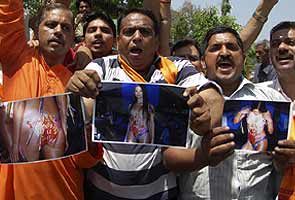
This image shows some Hindus in India protesting against a swimsuit (or rather protesting against the designer of the swimsuit) containing the image of Goddess Lakshmi.  Hindus were clearly offended by the swimsuit.  No necessity here to explain why they would be. 


Where am I heading with this?  Well, there are 2 aspects to the issue of offensive acts or remarks.  There is the perpetrator and his/her act/remark.  There is then, the reaction of the group of persons maligned by the act/remark. 


The Perpetrator

The person that made the offensive remark or gesture could have done so privately with no intention for the remark or gesture to be communicated in public.  That person could have done so publicly with the intention to shock or offend.  Alternatively, although the person made the remark or gesture in public, he/she did so without realising that it is capable of offending/hurting someone. 

Whilst the perpetrator enjoys the freedom (or ought to be permitted to enjoy the freedom) to say what he wants, we do recognise that some types of speech can cause harm to society (not merely causing offense).  Incitement to commit acts of violence, incitement to commit murder and generally any form of incitement to commit criminal offences should rightly be prohibited.  The person making remarks or gestures must be prohibited by law from inciting crimes.  But, I believe that speech that is capable of offending groups or communities should not be banned. 

Whilst advocating freedom, I do not advocate irresponsibility.  It is axiomatic that the freedom enjoyed by a person must be used responsibly.  Whilst I might advocate the freedom of speech as a matter of law, I strongly believe that this freedom is one that comes with great responsibility.  My blog itself gets its name from Article 14 of Singapore's Constitution (Freedom of Speech and Expression).  I have repeatedly maintained the need for liberalisation of our laws insofar as freedom of speech is concerned. 

If the law permits me to speak freely, I would still not feel that I have a right to say anything I want.  If I may be permitted to do so, there is an ancient Tamil saying from Thirukkural: 

இனிய உளவாக இன்னாத கூறல்
கனிஇருப்பக் காய்கவர்ந் தற்று

Uttering insults whilst there are constructive words is
equivalent to eating unripe fruits when ripe ones are available. 

With a soft word, a kind utterance and a gentle smile, we generate goodwill and harmony around  us.  With harsh words, insults and derogatory comments we manifest sourness and spread hate and misunderstanding.  It is important to remember that the freedom to say what we want should be used responsibly to ideally create a positive environment around us all the time or at least to avoid creating sourness. 

Of course, sometimes when we state the truth, it can hurt.  I am not exhorting the idea of being untruthful.  But, even truth can be presented in a way that is less harsh.  One can be critical without being hurtful.  Sometimes, we have to state the truth forcefully in the face of state power or in the face of social injustice.  But, stating the truth forcefully can be done with compassion and understanding.  Even in the political context, leaders such as Mohandas K. Gandhi, Martin Luther King and Bishop Desmond Tutu were capable of rendering forceful anti-establishment rhetoric without violence of thought, speech or action. 

The responsible use of free speech is an ideal.  However, irresponsible use of free speech is not uncommon in those societies that provide for legal protection of speech.  That a person says something irresponsible, however, should not be the basis of legally censoring him. 

That brings me to Amy Cheong.  She has made some facebook remarks that have been objectively acknowledged by many individuals (politicians, public figures and citizens) as being offensive.  In Singapore, her comments could be construed as falling within the definition of Sedition under the Sedition Act.  A seditious tendency is defined in s.3(1) of the Act as including a tendency to promote feelings of ill-will and hostility between different races or classes of the population of Singapore.

I am not a big fan of this provision in the Sedition Act although I understand the historical context of its origin.  In many Western democracies hurling racial and religious insults is not considered an offence even though it might be offensive to those that are the targets of those insults.  Having said that, one should not condone such behaviour.  The state has no business in proscribing such conduct.  But, the individuals in such a society must aspire to moderate their speech in way that would not be hurtful.   It is for this reason that I do not consider it proper for Amy Cheong to say the things that she said (though she should not be legally prevented from doing so).  

The perpetrators should examine themselves.  The ones that use hate speech and peddle hateful perspectives should question themselves and see where these views are coming from.  They should see for themselves the hurt that they cause to others.  Freedom of speech brings with it the need to express responsible views.  Those that put out their views for public consumption must consider how those views would impact the rest of the community. 

Whether it is Amy Cheong, Shimun Lai, the director of "Innocence of Muslims", Lisa Burke, Sun Xu or any other person engaging in objectively offensive activity, they have to reassess themselves and the hatred that they peddle.  Racist viewpoints and racial stereotypes are often a product of ignorance, limited exposure and re-inforcement of prejudiced perspectives through anecdotal evidence. 

The victims of the insult

Those that end up at the receiving at of the stick when it comes to offensive words/actions have to ask themselves how they want to react.  To begin with, some of us are easily offended as opposed to others.  Some of my fellow Hindus would be really riled up by the images above.  The bikini design would have been particularly offensive.  As the protest image indicates, enough people were upset in India to engage in demonstrations and even Court actions.  Some would react with anger and would then let it pass as not being uppermost on their agenda.  Some would feel offended and yet decide that there is no point in pursuing the perpetrators legally or otherwise.  Yet others like me would brush it aside as inconsequential and not really take offense. 

My own perspective is that the insults, malicious comments, racist views, sacreligious actions and other negative acts are incapable of defining the person that I am.  I don't construct my identity through the perception of others and I don't draw comfort from the high regard that others have of me.  I am comfortable with my own identity on the basis of who I am.  Objectively insulting words/actions have little impact on me.  Something offensive comes my way.  I read, I hear, I observe, I ponder upon it and then I release it.  I do not see the need to react to it.  I wasn't always like this and when I was younger i used to get riled up over quite a number of racist remarks and actions.  Perhaps, age has caused me to mellow down.  Perhaps, I have simply come to recognise that no amount of external attempts by others at constructing an image of me is going to change who I am. 

I believe that those of us that advocate the freedom to criticise the state and its policies should acknowledge the freedom of others to make comments, however negative.  We will not accept incitement to crime.  But surely we can live with the messiness of the rude and crude persons amongst us.  If a person is racist and denies us a job or school or university admission on account of our race, we should rightly make that an issue to be remedied even through the use of the law.  If it just a racist comment or insult, I am sure we can grow a layer of thick skin and not acknowledge or give credence to the racist's comments.

In response to some of the hateful stuff that has been posted, some people have thrown insults and strongly worded condemnations at the perpetrators.  The perpetrators should have expected it.  There is nothing to be shocked about the reaction of anger.  It doesn't lie in the mouth of the perpetrators to suggest that victims of the insult are overly sensitive.  After all, you are being spared the long arm of the law and you merely need to contend with vitriol. 

As for the victims of the insult, I would hope that everyone would exercise restraint.  Whilst anger is understandable, violence is not justifiable.  (Earlier this year I had blogged about my views on the Shimun Lai incident when she made remarks about Indians  http://article14.blogspot.sg/2012/03/shimun-lai-whats-her-crime.html)

The Amy Cheong Affair


In Singapore, in relation to the Amy Cheong affair, the online response has been to turn on Amy Cheong like a lynch mob.  I understand the angry reaction.  But, I fail to see the need for raising the matter up to Amy Cheong's employer (NTUC).  Someone has also filed a police report.  Did we really need to resort to such measures.  Amy Cheong might have made racist remarks (some would say classist as well) but should that be the reason for having her sacked?  Just imagine if every person that makes a racist remark were to be dismissed by the employer.  Where would that leave us as a country. 

I am sure that many of us will realistically acknowledge that racist views are pretty common in Singapore and it is merely a case that much of these views have not been publicly articulated (except when those views are peddled as 'hard truths' by a certain elderly gentleman) or there have been no real avenues for the articulation of these views till now.  Today, with the availability of social media, it is possible for one's narrow-minded views to go viral.  Should every company in Singapore sack its publicly racist employee?

From what I have seen online, some individuals that have in the past written pretty nasty stuff about 'PRC' individuals and FTs, have now turned holier-than-thou and are hurling brikbats at Amy Cheong. 

Some of our Ministers that had advised Singaporeans to be accomodating towards Sun Xu have now condemned Amy Cheong's FB post and even applauded NTUC's decision to fire her. 

Firstly, we have to recognise that no human being is perfect.  Everyone has some level of stereotypical views about other races, religions, communities, nationalities, etc.  Even the best amongst us would have at some point in time expressed racial/racist comments.  We have to have the wisdom to understand that the real racism that we want to fight is the kind that deprives communities of opportunities.  Insults cannot break our bones. 

Secondly, if we must respond to insults, it would be best to do so by pointing out to the person the error of his/her ways.  There is no necessity to descend into the gutter with that person. 

Thirdly, (and this is why I decided to blog on this matter) we have to ask ourselves whether an employee should be sacked on account of his/her facebook comments (however racist they may be)?

Was NTUC right in sacking Amy Cheong? 

On Sunday night when I saw Amy Cheong's FB post going viral, I thought to myself how sad it is that this nation is still finding it difficult to rise above race.  I then came across Amy Cheong's apology (which curiously was a PAP style apology that says, "I am sorry that my actions hurt you" as opposed to "I am sorry about what I did.").   I noticed that there were those calling on NTUC to take some action against her.  I expected NTUC to state that they do not approve of what Amy Cheong said and that they have asked her to deliver a public apology.  I was honestly caught off-guard on Monday when I saw the breaking news online that NTUC had fired Amy Cheong. 

There must be an unfair dismissal somewhere in there.  How did a comment on FB spiral out of control to a point where the very next day (being the 1st working day of the week), the employers sacked the writer on the spot.  Whatever happened to giving notice of termination?  Fine.  It is possible that the contract would have provided for some eventuality that would entitle the Employers' to terminate forthwith.  Assuming that the condition for immediate termination was pertaining to discipline or for bringing NTUC into disrepute, it is still shocking that within a period of less than 24 hours NTUC was able to arrive at a decision that the relevant contractual provision had been infringed.  No due process.  No attempt to notify the employee of the intention of NTUC to fire her on account of the allegation.  No attempt to afford the employee an opportunity to explain herself or to make amends. 

In its swiftness, NTUC probably estimated that it would seize this opportunity to perform a public relations coup.  I can imagine that the close association between the PAP leadership and the NTUC would have meant that criticism of Amy Cheong would have tainted the NTUC and that tainting would then have tainted the PAP as well.  There must have been a flurry of activity within the Cabinet and the decision must have been taken to sack Amy Cheong.  A calculation could have been made that this would portray Lim Swee Say (PAP Minister and Labour Chief) in a good light as a decisive individual willing to make the right decision.  It would have been calculated that this would add to  PAP's reputation for a no-nonsense approach to race related issues. 

Of course, I could be wrong.  Lim Swee Say could have acted on his own and felt that this was the right thing to do. 

Whatever the reason for the sacking, it is truly a step in the wrong direction and a very bad precedent to be set for all employers.  The National Trade Unions Congress, more than any other company, institution or organization should be intimately aware of and highly protective of the rights of employees.  Instead, NTUC (or Lim Swee Say) has acted in a high handed fashion in the manner of a large corporation willing to run roughshod over its employees. 

Apart from the question of whether NTUC conducted a proper investigation of the issues at hand before sacking Amy Cheong, there is the issue of whether a person's personal Facebook posting should be the basis of an employer's decision to sack that person.  It would have been a different matter if Amy Cheong had in the course of her employment insulted a customer by using a racist statement.  (Recently, a SMRT bus driver was disciplined (not sacked) for referring to a passenger as Ah Kua.)  Clearly, Amy Cheong's comment was not made in the course of employment. 

What could NTUC have done?  Since a police report had been made and assuming Amy Cheong was being investigated for sedition, NTUC could have suspended her pending the criminal proceedings.  If she was eventually convicted, NTUC could then have relied on an appropriate contractual clause to terminate her. 

Now that NTUC has decided to behave like a high handed employer, what kind of example does that set?  Well, I guess some of the more cynical amongst us would say that NTUC was never really a worker's union.  It was a body set up to manage workers' expectations whilst bending over backwards for business/corporate interests.   I am, therefore, not surprised, after some reflection, that NTUC sought to 'save face' and to avoid the ire of the lynch mob. 

The reaction against Amy Cheong was speedily and irrationally turning against NTUC and had the potential to turn against the PAP.  Perhaps, Amy Cheong was the sacrifical lamb. 


Monday, June 20, 2011

Black Sunday: A New Dawn?: A test for the post GE 2011 government

Under Section 5 of the Public Order Act 2009, a public assembly shall not take place unless notice of it has been given to the Commissioner under Section 6 and a permit has been granted under Section 7.

Effectively, any public assembly without a permit would constitute an offence.

So, what constitutes a public assembly? The Public Order Act 2009 makes the assembly of a single individual an offence. Although linguistically it seems impossible to evisage the assembly of one, the law can get away with the creation of fiction for convenience.

Section 1 of the Public Order Act spells out the definition of an 'assembly':

"assembly" means a gathering or meeting (whether or not comprising any lecture, talk, address, debate or discussion) of persons the purpose (or one of the purposes) of which is —
(a) to demonstrate support for or opposition to the views or actions of any person, group of persons or any government;
(b) to publicise a cause or campaign; or
(c) to mark or commemorate any event,
and includes a demonstration by a person alone for any such purpose referred to in paragraph (a), (b) or (c);


If a group of friends decide (let's say) to commemorate the death anniversary of JBJ by gathering at a public place, an offence would be committed. In fact, if I 'gathered' alone at a public place to commemorate an event, that would also constitute an assembly under the Act.

The definition is broad enough to cover any kind of 'protest', 'demonstration' or public display of views.

Into this restrictively drawn statutory arrangement waltzes 'Mandy Mary'.

I first came across this person via a facebook group. I was aware that 'she' was organising (or at least appeared via facebook to be a prime mover) the Black Sunday event. A successful Black Sunday event took place to register disapproval of MP Tin Pei Ling. This took place at the Starbucks outlet at Parkway Parade on 29th May 2011. I became aware of this event the day after it took place via some discussion with facebook friends. And then another Mandy Mary inspired Black Sunday event cropped up. This time it was at Wisma Atria at a Starbucks outlet on 12th June 2011.

By now, Mandy Mary had become emboldened enough to turn this into a 'movement'. There is a facebook page for 'Black Sunday Movement' now.

What do I think of these events? Do they fall foul of the law? Are the organizers and participants taking too much of a risk?

Two crucial issues:
1.Were they gathered for one of the stated purposes in the statute under the definition section of the Public Order Act as set out above?
2.Would a cafe constitute a public place for the purpose of the Public Order Act?

Under Section 1 of the Act 'public place' is defined as follows:

"public place" means —
(a) any place (open to the air or otherwise) to which members of the public have access as of right or by virtue of express or implied permission, whether or not on payment of a fee, whether or not access to the place may be restricted at particular times or for particular purposes, and whether or not it is an “approved place” within the meaning of the Public Entertainments and Meetings Act (Cap. 257); or
(b) a part of a place that the occupier of the place allows members of the public to enter, but only while the place is ordinarily open to members of the public;


This definition is broad enough to cover a restaurant or cafe where the owner of the premises grants an express/implied permission to the customer to have access to the premises.

With the Black Sunday Movement promoting a cause and the event being held in arguably 'a public place', (The Public Order Act definition is arguably broader than the reference to a 'public place' in the Public Entertainments and Meetings Act), I wouldn't be surprised if the authorities decide to charge the individuals involved.

But, I am surprised. Pleasantly as well.
I am surprised because no action has been taken. Nobody has been called up for investigation. Yes, some men in blue were seen at the location of the second event but apart from a photographer who was asked for his ID, nobody appears to have been troubled.

In my heart, I quietly hope and pray that this is the new dawn. Quietly, and without fanfare, freedom awakens in our land.

If our Prime Minister had truly taken to heart the voice of the people during the election campaign this year, he would have realised that the change that needs to be instituted is not going to be merely cosmetic. It would not do for him or his party to pay lip service to change. It would not do for him or his party to merely manage public perception through information management. He would have realised that the citizens of this country have reached a level of political maturity that demands that the tight-fisted approach of years gone by cannot work any more.

Politics in this country has changed at a fundamental level this May. The more you seek to control, the more you lose electoral control.

If this has dawned on our PM and his party colleagues, we might be witnessing the beginning of a new reality. Events like Black Sunday are pretty harmless. All they do is publicise a cause. No rebel-rousing speeches. No spirited chanting. Not even any placards. A silent and nuisance-free way of expressing dissent. I am sure the individuals composing the present Cabinet can live with this and tolerate its existence. After all, they are now living with and tolerating so much of dissent online. Whilst doing that, I am sure they are beginning to realise how harmless this kind of dissent really is.

The key for the PAP government is to battle dissent with clear, cogent and rational argument. They can't get away with killing dissent with a sledgehammer. Those days are gone. People have finally felt the sense of empowerment that their vote is capable of giving them. Silencing regular dissent would translate into more votes lost for the PAP. Engaging dissent constructively may in fact win back some votes for them. For the hardcore opposition supporter this might not sound like a good thing. In fact, one might even secretly wish that the PAP would not change its ways. If they don't change their ways, they would lose more votes.

But, PM Lee might have already made the prudent calculation that some level of restraint in the use of the law and a greater level of engagement in honest debate with the public would actually be the win-win solution for the PAP as well as for the people. More easing of control might actually result in more electoral clout for the PAP. This could be his opportunity to script a future for our country truly with the people as co-authors. Public assembly could be a start. There are so many other areas where control could be eased.

I am speculating. Who knows what the future holds?

But, these are interesting times in our nation's history.

The Black Sunday Movement could be the sign of a new dawn for us all.

Thursday, August 05, 2010

What did Shadrake really say?

What did Shadrake really say?

I haven’t read the book. So, I think it would be really premature to judge on the contempt of court charges.

I have previously written about my views on criminal defamation. Looks like things are moving slowly on that front. But, it is really contempt of court where the action is at. As the law stands right now and as it has been interpreted by the Courts so far, contempt law would be based on English Common Law as it existed at the time that our Constitution was adopted.

If Shadrake avoided any allegation against the judiciary or if he refrained from imputing any wrongdoing or partiality on the part of the judiciary, the contempt charge may be difficult to make out. But, this is not entirely clear to me right now. It is entirely possible that the author might have taken a wild swing at the judiciary. That would be quite consistent with sensationalistic writing that some ‘investigative journalists’ are prone to and quite legitimately some of us would suspect that even Shadrake might have been guilty of. (Again, without reading the book I am really speculating here.)

For Shadrake to be on safe ground, the book must have referred to the cases in a factual reporting style and any allegation of unequal treatment under the law must have avoided allegations against the judiciary. Such a method of writing could have been accomplished without difficulty in relation the drug cases that Shadrake has reportedly addressed in his book. Based on Alex Au’s review of the book in his Yawning Bread blog, the following cases have been examined:

Vignes Mourthi case: The issue here appears to be evidence that was unavailable at the trial. Apparently, a key prosecution witness was involved in some impropriety and evidence of credibility of this witness was not available at the trial of Vigness Mourthi. I wouldn’t lay any blame on the judiciary. From my reading of the review by Alex Au, it doesn’t appear that Shadrake was blaming the judiciary.

Amara Tochi case: This case is more of an indictment of the reversal of the burden of proof in the Misuse of Drugs Act rather than an indictment of the judiciary. This is what opponents of the mandatory death penalty have been saying all along. The judge’s hands are tied. Once the presumption in the statute kicks in, it is virtually impossible for the Defendant to prove his position. Again, on the face of it, this case cannot possibly be an indictment of the judiciary.

Julia Bohl case: This is a trafficker against whom CNB appears to have had a good deal of evidence. However, in what is allegedly a deal between the German government and the Singapore government, the charge against Julia Bohl described a quantity of cannabis that was below the statutory presumption. Now, this is definitely a scandalous allegation. But, in any event, this is also not an allegation leveled against the judiciary. What has allegedly transpired could not be a stain on the judiciary.

I am not going into, and I should not go into (given the fact that I have not read the book), each of the other examples raised by Alex Au in his review of the book. A quick glance of each of the instances mentioned reveals that there may not have been any imputation against the judiciary to begin with in the book. This is something that I can ascertain for myself only if I read the book.

If the content of the book had the ‘inherent tendency’ to create prejudice, the contempt offence could be made out. The inherent tendency test is satisfied if a statement "conveys to an average reasonable reader allegations of bias, lack of impartiality, impropriety or any wrongdoing concerning a judge in the exercise of his judicial function." Whether any allegations were true is not an issue that can be raised as a defence. If Shadrake had merely dealt with individual cases by highlighting that different offenders were charged differently and this resulted in the inconsistent application of the death penalty, I don’t see how the contempt charge could be made out. It is, at most, an indictment of the law enforcement end of the system and in no way impugns the judiciary or its integrity.

Of course, the sneaking suspicion that I have is that somewhere along the way Shadrake might have made a sweeping statement that might have tied the judiciary to the inconsistency in the application of the death penalty. If he had done that, the contempt charge would be made out easily. This, I would not know until I have read the book.

I am left wondering…. What, exactly, did Shadrake say?

Wednesday, July 28, 2010

S.35 of the Films Act is Unconstitutional

I am sure that constitutional scholars would agree with me when I assert that a strong case can be made for the view that Section 35 of the Films Act is unconstitutional.

This is the provision under which the video recording of Dr Lim Hock Siew’s speech was prohibited recently.

The relevant part of Article 14 of our Constitution that deals, inter alia, with Freedom of Speech is as follows:


“14. —(1) Subject to clauses (2) and (3) —
(a) every citizen of Singapore has the right to freedom of speech and expression;
……………
(2) Parliament may by law impose —
(a) on the rights conferred by clause (1) (a), such restrictions as it considers necessary or expedient in the interest of the security of Singapore or any part thereof, friendly relations with other countries, public order or morality and restrictions designed to protect the privileges of Parliament or to provide against contempt of court, defamation or incitement to any offence;
………………. “


Section 35 of the Films Act reads as follows:
35. —(1) Notwithstanding the provisions of this Act if the Minister is of the opinion that the possession or distribution of any film would be contrary to the public interest, he may, in his discretion, by order published in the Gazette prohibit the possession or distribution of that film by any person.

S.35 is a blanket provision giving the Minister discretion to prohibit any film that he considers to be contrary to public interest. One ought to ask the rather important question whether s.35 is unconstitutional in the first place. The Constitution protects freedom of speech. The permissible reasons for limiting free speech is spelled out in Art 14(2)(a):
- security of Singapore
- friendly relations with other countries
- public order
- morality
- parliamentary privilege
- contempt of court
- defamation
- incitement to any offence

‘Public Interest’ is not on the list of reasons that the Constitution prescribes. The Films Act is, prima facie, in contravention of Art 14 of the Constitution by placing limits on Freedom of Speech and Expression in a manner that was not permitted. Of course, if the validity of s.35 were called into question in a court of law, an argument could be made out that ‘public interest’ in that provision was intended by Parliament to be a reference to the ‘security of Singapore’ or ‘public order’ or ‘morality’ or for that matter (whilst we are at it) an argument could be advanced that ‘public interest’ should be construed (though it would be an extremely strained construction) as any matter that would be in consonance with the grounds for restriction spelled out in the Constitution.

There is one possibility that a Court of law might consider s.35 to be a blatant infringement of the Constitutional right of Freedom of Speech and Expression. Equally, there is the other possibility that ‘public interest’ can be read to be consistent with the Constitution if one construes that Parliament intended public interest to include the grounds set out in Art 14(2)(a) of the Constitution.

I am in favour of the first option. Any restriction enacted by Parliament in relation to the Freedoms expressly provided for in the Constitution must be screened with suspicion by the Courts. The clear role of the Courts in the interpretation of laws is to err on the side of the Constitution. However, I understand that it is equally possible to adopt the argument that the s.35 of the Films Act is valid if one construes ‘public interest’ narrowly as being in consonance with the grounds in Art 14(2)(a) of the Films Act and not too broadly defined.

Working on the 2nd assumption that the Films Act can be construed to be valid (if ‘public interest’ is restrictively interpreted), then the power conferred on the Minister by s.35 cannot be utilised too broadly with unfettered discretion. S.35 permits the Minister to prohibit a film if it is in the public interest to do so. ‘Public interest’, construed restrictively, in order not to fall foul of the Constitution must relate to the matters set out at Art 14(2)(a).

- security of Singapore – Dr Lim was not exhorting any riot, uprising or terrorist action

- friendly relations with other countries – I don’t see anything in the speech that traverses this ground

- public order – hmm… again, no dramatic call to arms or instigation to riot or stuff like that. In fact, some might even say that the speech was monotonous and likely to be sleep inducing.

- Morality – Was Dr Lim doing a striptease? I must have missed that part.

- Parliamentary privilege – nothing that he said could be impinging on the privileges of parliament

- Contempt of Court – a remote case can be constructed around this limb. Dr Lim makes a reference to appearing before an Advisory Board headed by Judge Winslow. He comments as follows: “You see, the whole thing is a judicial farce. I mean, it's incredible that anyone has to face this kind of mockery, this kind of so-called justice, and the fact that a High court judge is being put as the chairman of this Advisory Board gives the public an illusion that there is judgement, there is justice. And I told him that if I were a High court judge, I would not lend credence to this mockery by my presence.” One could argue that this is a Contempt of Court. It appears that at that Advisory Board hearing Dr Lim was threatened with Contempt. Then, according to Dr Lim, Judge Winslow said: "No, no, let the doctor have his say, there's no question of contempt of court." In any event, it cannot be the case that every tribunal formed and constituted under the law could claim the ‘contempt’ jurisdiction. It may be that the High Court might claim contempt. Surely, the Advisory Board constituted under the ISA could not similarly claim a contempt jurisdiction.

- Defamation – There are some allegations relating to Lee Kuan Yew that could be construed as being defamatory. This is going to be a tricky one. Firstly, we have to construe ‘public interest’ as being inclusive of defamation. Whilst public interest could be moulded to be ‘national security’, ‘public order’, etc., it would be quite a stretch to say that ‘public interest’ in the Films Act was a reference to restrictions providing for ‘defamation’. Laws relating to defamation, invariably, protect private reputations. I would not lean towards the argument that there is a public interest in this though I can imagine that some would argue as such. Secondly, even if defamation can be a limb covered by ‘public interest’ in the Films Act, did the Minister in the exercise of his discretion consider ‘defamation’ as the basis of his decision? No.

- Incitement to commit an offence – I don’t see any instance of this in the speech.

One fact, observed by several bloggers, is that Dr Lim’s speech has not been banned. Dr Lim is not accused of any offence nor has he been sued. Instead, the video recording of the speech has been banned. This might be an unspoken acknowledgement of the legality of the speech. The Films (Prohibited Film) Order 2010 states:

. The Minister, being of the opinion that the possession or distribution of the following film would be contrary to the public interest, hereby prohibits the possession and distribution of that film by any person:
Title: “Dr Lim Hock Siew”
Director: See Tong Ming
Year of production: 2009


Rest assured that if any one of the 8 grounds stipulated in the Constitution were fulfilled, Dr Lim himself would be facing some legal consequences and his speech would similarly have been restricted, banned or subject to an injunction. The Prohibition Order itself does not set out the reason that constitutes ‘public interest’. The reason is set out in the Press Release from MICA dated 12 July 2010:


“The film gives a distorted and misleading portrayal of Dr Lim’s arrests and detention under the Internal Security Act (ISA) in 1963. The Singapore Government will not allow individuals who have posed a security threat to Singapore’s interests in the past, to use media platforms such as films to make baseless accusations against the authorities, give a false portrayal of their previous activities in order to exculpate their guilt, and undermine public confidence in the Government in the process.”

‘making baseless accusations’, ‘giving a false portrayal of activities’ & ‘undermine public confidence in the Government’ in the process. That’s the key. Not any one of the Constitutional reasons for limiting the exercise of Free Speech. But, these reasons provided in the media release from MICA.

That, in my humble opinion, is unconstitutional.

The Minister cannot claim unrestricted and total discretionary power. The statute grants him the discretion under s.35. The discretion must be exercised within clear constitutional parameters.

I believe that either s.35 of the Films Act is itself unconstitutional or if a court were to construe that provision to be consistent with the Constitution, then the act of prohibiting the video recording on the basis of the grounds revealed would be a contravention fo the Constitution. One cannot assert that just because the statute provides for ‘public interest’ as a ground, any assertion of a broadly defined public interest would suffice as a basis for the Prohibition Order.

As an aside, I felt that readers might benefit from reading the following extracts from Parliamentary reports of the 2nd reading of the Films (Amendment) Bill last year. Note that the amendment being debated was about the relaxation of the prohibition on party political films (s.33). But, MPs also addressed the catch-all nature of s.35.

A few interesting points: Siew Kum Hong and Thio Li An raised the constitutional point early in both their speeches. The constitutional issue was brushed aside by the Minister and the PAP MP without too much of a bother.
s.35 was pointed out as being too broad and as being an avenue to circumvent s.33. But, the Minister dismisses that with a rather puzzling stance.


Senior Minister of State for Information, Communications and the Arts (RAdm [NS] Lui Tuck Yew: during the 2nd reading of FILMS (AMENDMENT) BILL on 23 March 2009


“We should not prevent people from recording video clips of political events held in accordance with the law or from making factual documentary videos of political issues and events. But we must continue to have limits against undesirable political materials, for example, fictionalised accounts or political commercials, even though it may not be possible to enforce these limits completely. “

“With the amendments, the following will no longer be considered as party political films:

(i) Live recordings of events held in accordance with the law;
(ii) Anniversary and commemorative videos of political parties;
(iii) Factual documentaries, biographies or autobiographies;
(iv) Manifestoes of political parties produced by or on behalf of a political party; and
(v) Candidate's declaration of policies or ideology produced by or on behalf of the candidate.”


Thio Li An questioned the minister on section 35:

“Sir, I note that Section 35 which empowers the Minister to prohibit the possession or distribution of any film considered contrary to the public interest still applies. This is a catch-all clause, wide enough to catch party political films which the Board of Film Censors considers has passed the test of being non-partisan and unbiased. It is a very broad power. Will further guidelines be provided to limit the Minister's discretion in this respect, to prevent section 35 from being a backdoor way to ban films which are found to escape the jaws of section 33?”

Siew Kum Hong questioned minister on section 35:

The final point I would make on this Bill, is that it does not amend section 35, as recommended by AIMS. Section 35 allows the Minister to ban any film that he considers to be “against the public interest”, without giving any reason. AIMS had recommended that the permissible reasons for banning films under section 35 be spelt out clearly, that an independent advisory panel be formed to advise the Minister before a film is banned under Section 35, and that the Minister be obliged to give reasons for the ban. All three proposals have been rejected.

Ms Irene Ng Phek Hoong on the constitutional point raised by Thio Li An and Siew Kum Hong about the freedom of speech:

“I hear Prof. Thio Li-ann and Mr Siew Kum Hong talk in terms of freedom of speech. I think that is a worthy topic but I would urge the Members to perhaps move a separate motion on freedom of speech and deal with it holistically to do with publications, films and all other media, and not use that argument for the Films Act which is one aspect of freedom of speech.
And I think it is, in a way, confusing the debate to bring in what you call "a constitutional right" to freedom of speech. All of us value the freedom of speech. The question is: What serves society? And it is up to this society to decide what limits we place, what we think is valuable. I think it merits a deeper and wider debate.”


Minister RAdm Lui Tuck Yew’s response to the constitutional point:

Prof. Thio Li-ann had also queried about the Bill vis-a-vis article 14(2) of the Constitution and I know that Ms Irene Ng had suggested to her and others to table a proper motion to debate this. I am not a constitutional expert but my take on this is that I am fairly sure that this must have been deliberated quite extensively by our predecessors when the Bill was first moved in 1998. But, again, back to the fundamentals and principles which are to keep our political debates rational, non-emotive and serious to preserve the integrity of the election process, I think disallowing certain types of films does not affect the overall freedom of political debate in Singapore. My take is that there are sufficient avenues for political parties and individuals to get their views and manifestos across to the public. They can rely on the mainstream media. They can publish magazines, print newspapers if they are licensed to do so, host web pages online as well as debate about such issues in Parliament.

Minister RAdm Lui Tuck Yew’s response to the issue of using s.35 to circumvent s.33:

Again, same members have raised their issues and comments on section 35. Let me clarify a misconception that this is a so-called backdoor way to catch the rest of the films that would otherwise have passed, because section 35 is not against PPFs; it is not to be used against party political films. PPFs, unless they fall under the exceptions, will already be banned from the onset, and there is no need to apply section 35 to such films. Section 35 is meant and reserved for serious situations where due to the circumstances of the day, the possession or distribution of the film would actually be contrary to public interest - presenting a threat to national security, danger to racial or religious harmony, and perhaps affecting even the very fabric of our multi-racial, multi-cultural society. Members have noted that so far, we have only used section 35 once and that was on "Zahari's 17 Years", and the Minister had come up with a press statement to fully explain why he issued the ban. We did not want to impose on the Minister the need to make such a press statement or to have to explain every time he exercises the jurisdiction to impose such a ban. But, where possible, he will indeed do so. But for those who have forgotten what "Zahari's 17 Years " was all about, the film was a revisionist attempt to have a distorted and misleading portrayal of Zahari's arrest and detention. It was an attempt to exculpate himself from his involvement in communist activities against the interest of Singapore. He had posed a security threat for which he was detained under the ISA, and he now wanted to exploit the use of film to project false and distorted picture of his past actions, and that is why the ban was made. It was not a political film.


Res Ipsa Loquitur - The thing speaks for itself!