Pages

Showing posts with label constitution. Show all posts

Tuesday, June 11, 2013

The Broadcasting Act is fundamentally flawed

We've had our blackout online protest.  We have done our offline protest at Hong Lim Park.  The blogging community has made a loud enough statement to be heard.  But, as with many things in Singapore, though we might shout out loud, we may still not be heard. 

I was at Speakers' Corner on Saturday, 8 June 2013.  It was a remarkable job by the #FreeMyInternet chaps.  They managed to get themselves organized within a short time frame and got the message out to enough people to gather a decent crowd on Saturday. 

I know that the #FreeMyInternet movement made it very clear that their primary goal for the time being is the revocation of the MDA's latest licensing rules.  But, I am sure their ultimate desire is also to see greater freedom in terms of the traditional media as well. 

There is one thing that we need to be very clear about.  The current licensing rules are set out in the Broadcasting (Class Licence) (Amendment) Notification 2013.  By virtue of this notification, MDA can, at its discretion, remove any website from the Class Licence and require it to obtain a specific licence.  The problem is not really a result of this subsidiary legislation.  The problem is in the parent Act of Parliament itself.  Parliament has drawn up a provision that is so broad that it has authorised lawlessness. 

Under Section 8(2) of the Broadcasting Act,
"Every broadcasting licence, other than a class licence, granted by the Authority shall be in such form and for such period and may contain such terms and conditions as the Authority may determine"

This is equivalent to saying that the licence will be in 'x' form, for 'y' period and contain 'w' terms, where x, y and w will be determined by MDA. 

As for Class licenses, section 9 deals states the following:

9(1) The Authority may, by notification published in the Gazette, determine a class licence, being a broadcasting licence, for the provision of such subscription broadcasting services and other licensable broadcasting services as the Authority may specify.
(2) The Authority may include in a class licence such conditions as it thinks fit.
 
 
MDA may issue any form of class licence and impose any conditions. 
 
Sometimes when a legislative provision is vague and open to interpretation and there exists a danger that it could be interpreted too broadly, we might caricature that legislation by stating that Parliament could have simply given unfettered discretion to a public body to do as it pleases.  The Broadcasting Act has been drafted in such a manner that it literally gives that unfettered power to the MDA. 
 
In Chng Suan Tze v Minister of Home Affairs (1988), Wee CJ stated:
 
"All power has legal limits and the rule of law demands that the courts should be able to examine the exercise of discretionary power. If therefore the executive in exercising its discretion under an Act of Parliament has exceeded the four corners within which Parliament has decided it can exercise its discretion, such an exercise of discretion would be ultra vires the Act and a court of law must be able to hold it to be so."


Ordinarily, the kind of case that the Courts would face involves a government body that exceeds the discretionary power that has been given to it by an Act of Parliament.  Clearly, the Courts would restrain any government body that attempts to do so.  But, the relationship between the Broadcasting Act and the MDA is such that the "four corners" that the Chief Justice referred to in the quotation above is missing from the legislation.  The legislation literally states that the MDA can do whatever it wants.  How did Parliament enact such a law in the first place? 

For Parliament to make a law stating that the Executive arm of government may do as it pleases is as good as signing off on a blank cheque.  The Broadcasting Act is MDA's blank cheque.  It is the hallmark of the rule of law that a government must be subject to and act in accordance with the law.  But, the Broadcasting Act makes a mockery of this principle.  MDA can easily impose any kind of licensing conditions and still claim that it is acting in accordance with the law.  A law that facilitates absolute discretion is only a law in form.  It fails to fulfill its true role in restraining the arbitrary exercise of power. 

In a kingdom, when a king wields absolute power and is not restrained in any way by the law we say that the king is the law, meaning that there is no rule of law in such a state.  What if the king decides to subject himself to the law and he forms a Parliament that would make the law and that Parliament makes a law stating that the King may do as he pleases?  Would we say that there is the rule of law in such a state?  We wouldn't. 

The Broadcasting Act must not facilitate discretion and the arbitrary exercise of power.  It must restrict the MDA's power. 

Friday, June 07, 2013

It is not about the Internet alone. We need to free the media as a whole.

Singapore has come some way since the days of near absolute information control and a pervasive climate of fear.  As a teenager in the 1980s, I remember clearly the oppressive political environment within which alternative voices and opposition politicians were operating.  Even when engaging in coffee shop conversation, there was a tendency amongst many of us to speak less audibly when it came to politics (or not at all) or to cast glances at possible undercover ISD officers.  This was especially so in the wake of the arrests and detention of alleged Marxist conspirators in 1987.  There were many that believed in the official version.  There were many that didn't.  But, one thing was for sure.  We knew that Big Brother was watching. 

From the time that JBJ broke through in the Anson by-election in 1981, there arose a certain excitement and expectation that more alternative voices would enter Parliament.  In the years that followed, there was a growing interest in opposition politics and alternative news.  Those days, with absolute control of the print media being exercised by the state, there was very little by way of alternative sources.  Many of us read in between the lines to make up our minds.  Newspapers that appeared to display an independent streak quickly disappeared.  I managed to get much of my independant information from foreign publications or books available across the causeway. 

Growing up in Singapore against the backdrop of constant propaganda and an undeniably constant climate of fear, the last ten years or so of online information availability has been a truly liberating experience.  For those of us that crave for different perspectives in a debate, the internet has provided us with not only access to information but also an avenue to express our opinion.  There was the often inevitable problem that letters to forum page of the main English daily that were too critical or against the national narrative would not see the light of day.  Those amongst us that had alternative views or perspectives were effectively shut out from the 'national conversion' (to borrow the current national cliche) of the past.

Blogging has provided many articulate Singaporeans an avenue for free expression and other Singaporeans who crave for alternative news a source of information.  Online content providers such as The Online Citizen have emerged as political game changers in many ways.  I am sure that many Singaporeans were relying heavily on alternative online sources for information during the last General Elections in 2011.  My blogs traffic increased tremendously during the GE and also the Presidential Elections.  I can only imagine the kind of increase in traffic that sites like TOC would have experienced.  Singaporeans have been increasingly consuming news online and let's be honest about it, many Singaporeans could well be influenced by the opinion and commentary that they read online. 

When the MDA's new licensing regime was announced last week, I was a little hesitant to brand it immediately as a regressive step and to brand it as an attack on the larger blogging community.  I wanted to read the wording of the regulations to understand whether legally it was possible for MDA to clamp down on alternative news sites.  At first, based on the MDA press release I wrote speculatively about what the government might be trying to accomplish and how it might accomplish it from a legislative standpoint.  http://www.article14.blogspot.sg/2013/05/from-licensing-to-regulation-of-content.html
Subsequently, when the MDA issued the Broadcasting (Class Licence) (Amendment) Notification 2013, the framework of MDA's action became much clearer and I blogged on this here: http://www.article14.blogspot.sg/2013/05/making-sense-of-legislative-framework.html

The way that I see it the new licensing regime is sufficiently vague to allow for future licensing notices to be directed at sites such as TOC.  MDA has made assurances that the measure is not targetted at blogs.  The issue for me is not so much as to who is targetted now.  The question is whether alternative sites providing unfavourable content can be subject to licensing in the future.  During the Talking Point show that was aired on ChannelNewsAsia, Minister Tan Chuan Jin did allude to the fact that blogs reporting news could come within the ambit of the licensing requirement.  To be frank, TOC is a site that does not merely publish opinion and commentary on local events.  Some of their activities does involve news reporting.  During the last General Elections, we saw quite a fair bit of reporting from on the ground that was done by TOC.

Considering the fact that there are linguistic loopholes in the subsidiary legislation for the authorities to exploit, the blogging community has very little to go on except to hope that the PAP government will act in good faith.  The main reason for the online uproar is that the past political record of the PAP hasn't been positive from the standpoint of freedom of speech and expression.  Citizens are generally skeptical about the Ministerial assurances.  (Perhaps, as citizens we might have to wonder whether we are unfairly forcing the current generation of PAP leaders to bear the historical burden of their party.  I have reflected upon this often and tried my best to give the present PAP leaders a clean sheet to work from.  But, the historical baggage is difficult to erase from memory.) 

We don't know the real reason for the sudden announcement surrounding the introduction of the new licensing rules.  We suspect a hidden agenda.  We may or may not be right.  But, one thing is for sure.  If there had been a hidden agenda of gradually subjecting popular alternative sites to a regime of licensing (which involves financial constraints and take-down notices), then the uproar from the blogging community has certaintly acted as a persuasive force in preventing the MDA from taking such steps in the future.  If anything, a concession has been forced in the form of a public statement that the licensing regime is not targeted at bloggers.  It is a minor victory.  But, a victory nevertheless. 

If there was no hidden agenda, the bare mimimum that has been achieved this week is that the blogging community has sent a clear message that we value our limited space and are not willing to give it up easily.  Some of my friends asked me about the point of participating in a 'blackout' (on 6 June 2013) and whether it was a futile and self-defeating exercise.  My take on it is that if websites went on an indefinite blackout until the licensing regime is withdrawn, the blackout action would have been futile and stupid.  What was done yesterday was, in my view, symbolic.  It helped to demonstrate the broad cross-section of support that exists for the freedom of online space.  It was not merely the socio-political bloggers that participated in the blackout. 

Tomorrow, it is time to turn up at Hong Lim Park.  I am going down to show support.  I don't think that the task at hand is merely about reversing the licensing regime.  The current regulations as framed and as explained (defensively) appear unlikely to prevent online discourse and debate.  There are two broad tasks that we as a nation need to focus upon:

1.  Firstly, we have to recognise that the Broadcasting Act enacted by Parliament grants to the MDA too broad a power to institute a licensing regime with any restrictive conditions of licensing whatsoever and all of this can be done without any need for Parliamentary debate.  Just as MDA has introduced the current licensing regime, the MDA can replace it and introduce another licensing regime with entirely different conditions.  The Broadcasting Act has given too much discretionary power to the MDA and discretionary power with improper or no legal contraints is always a dangerous tool in the hands of those that might be bent on abusing that power.  To prevent such future abuse the Broadcasting Act must be amended to take away the general power of the MDA to set licensing conditions in a discretionary fashion. 

2.  Secondly, the traditional print media in Singapore has to be freed up.  The Newspapers and Printing Presses Act has to be either amended or repealed.  The key control mechanisms in this Act that prevent our mainstream media from acting in an independant fashion must be removed.  I have previously blogged about the legal structures that limit the press:  http://article14.blogspot.sg/2012/05/media-in-singapore-structural-problem.html
Minister Yacoob Ibrahim spoke about creating a parity of mainstream media and the online media.  Rather than taking the regressive step of introducing controls upon the online media to bring it on par with our MSM, we should take the progressive step of removing the controls on our traditional media.

Anyone interested in understanding the mechanics of legal control in relation to the press should read this book by Francis Seow entitled "Media Enthralled" 


In my reading of the current political situation I would not approach it with a sense of doom and gloom.  I believe that the political awakening of our citizens that has been going on over the last few years will be met and matched by a gradual political rehabilitation of our politicians.  As a country we have every reason to be optimistic since citizens are beginning to show a willingness to stand up for issues that affect the broader community instead of pursuing their own selfish goals.  The juggernaut of the popular desire for greater freedom has started moving.  Nothing can stop it now.  Singapore in 2013 is very different from the Singapore of the 1960s or the 1980s.

We take our pledge seriously and believe in it entirely.  We will strive towards a "democratic society based on justice and equality."

Sunday, December 30, 2012

2012: Constitutionally speaking

2011 was a watershed year in the politics of Singapore.  With the General Elections and Presidential Elections sending strong signals to the ruling PAP and with the empowering effect of social media, the scene was set for an interesting 2012.

Much has happened in the political arena.  The PAP would probably place emphasis on the National Conversation as a major political highlight.  Most citizens would probably remember this year as the year of sex in politics and the civil service.  I am sure there must be plenty of other mainstream and social media perspectives on the year that has just whizzed past us.  I don't plan to cover the same ground.  Perhaps a survey of Constitutional developments might be of some interest.

From a Constitutional standpoint, this has been an interesting year.  There have been some developments in the law and not all of them are positive from the perspective of citizens' rights. 

THE HOUGANG BY-ELECTION CASE

This was a case that was waiting to happen.  There have been several instances in the past when the ruling PAP has avoided by-elections.  Ever since the dramatic loss of the Anson seat to the Workers' Party in 1981, the default mode of the PAP has been to resist any calls for a by-election when a seat became vacant. 

Prior to the Hougang by-election case, there was one attempted Constitutional challenge when the Bukit Batok seat fell vacant in 2008 due to the death of Dr Ong Chit Chung.  A claim was filed in Court and eventually withdrawn when the claimant (a Bukit Batok resident) decided not to proceed with the case after his lawyer J.B Jeyaretnam passed away.  Bukit Batok was part of a GRC and so the legal issues there were slightly different.

http://article14.blogspot.sg/2008/07/is-constitution-redundant.html

When Mdm Vellamma instituted judicial review proceedings in relation to the PM's discretion in calling for by-elections, it is probably true to say that tremendous political pressure fell on the PM's shoulders.  In a GRC it was possible for the PM to claim that the other MPs would 'cover' the responsibilities of Dr Ong.  But, Hougang is a single member constituency and clearly the PM could not go on a default mode of givng a template response.  http://article14.blogspot.sg/2012/02/bye-yaw-and-now-for-by-election.html

With the application for leave being granted by the High Court and the attempt by the government to have the case thrown out being unsuccessful, there must have been a significant fear in the PM's office that the Constitutional interpretation would work to constrain the PM's discretion.  A by-election was called and I honestly expected that Mdm Vellamma would drop the case.  But, the case proceeded nevertheless.  http://article14.blogspot.sg/2012/04/houngang-by-election-case-decision-to.html
http://article14.blogspot.sg/2012/05/hougang-by-election-26-may-2012.html
http://article14.blogspot.sg/2012/05/hougang-by-election-case-may-be.html


The final judgment by the High Court is most unfortunate for the citizens of Singapore and for the status of our country as a democracy.  In a highly technical approach to the reading of our Constitution, the High Court ruled that the PM has unfettered discretion in deciding on whether to hold a by-election.  I disagree with the Court's reasoning and I have set that out my views here: http://article14.blogspot.sg/2012/12/the-hougang-by-election-case-belated.html

As a direct consequence of the decision, the legal position today is that a vacant Parliamentary seat need not be filled and it can remain vacant till the next general election. 

Since Mdm Vellamma lost her case, the AG requested for an order of costs against her.  The default mode in the Court is that 'costs follow the event'.  That is just lawyers' language for 'legal costs to be paid by the losing party to the winning party.'  Incindentally, judges do have discretion to deviate from this norm and this has been done in the United Kingdom.  (Our Rules of Court are modelled on the English Rules.) 

In a landmark ruling the same High Court judge that dismissed Mdm Vellamma's case found in favour of Mdm Vellamma on the costs issue.  As her case involved a matter of public interest, the Court saw it fit to rule that no costs would be payable even though she lost the case. 

As a consequence of this ruling, Singaporeans have been given the hope that they can safely proceed with judicial review on matters of general public interest and will not be penalised in costs if they lose the case eventually. 

THE IMF LOAN CASE

There is something seriously wrong about the politico-legal order in our country when we have an official rationale for the existence of an Elected President (as an additional check against potential Executive abuse of the reserves) and at the same time a rather cavelier attitude on the government's part when it comes to giving out loans to foreign institutions. 

Most observers reading our Constitution would walk away with the impression that any loan given by our government to a foreign entity is required to be subject to Presidential scrutiny.  But, what appears logical to an ordinary individual can often be seen very differently by lawyers.  This was one such instance.  Though personally I am in favour of subjecting loans by the Singapore government to Parliamentary scrutiny (at the very least), the truth is that the High Court judgment in this case is one that is, at least, consistent with the background to Art 144 of the Constitution.  I would have preferred a different approach by the Court by relying on the need for restrictive interpretation of the Constitution when it comes to Executive powers so that the Rule of Law can be preserved. 

Today, as a result of the IMF loan case, our government needs to seek Presidential approval for the giving of a guarantee and the raising of a loan.  But, there is no need for such approaval for the giving of a loan and the raising of a guarantee.

Another issue arising out of the High Court's decision in this case concerns 'locus standi'.  The Court has ruled that the applicant Kenneth Jeyaretnam had no locus standi to bring this claim because the claim was in relation to a public right and the claimant had to show that he suffered some special damage.  This is effectively a bar on any future claim by a citizen alleging any breach of Article 144. 
http://article14.blogspot.sg/2012/10/the-day-constitution-died-again.html

The effect of this case is that in future, the Executive might breach Article 144 by raising a loan or giving a guarantee without Presidential or Parliamentary scrutiny and citizens would be left without legal recourse.

THE GAY RIGHTS CASE

Tan Eng Hong v AG as decided by the Court of Appeal represents a significant postive step in the interpretation of our Constitution.  At the present stage of the proceedings, there hasn't been any final determination on the Constitutionality of s.377A of the Penal Code.  But, the Court of Appeal has made two rulings of significance. 

S.377A is a pre-independance provision and it pre-dates our Constitution. The AG attempted to argue that s.377A cannot be declared to be void because it is a pre-1965 law.  The Court of Appeal has rejected this. http://article14.blogspot.sg/2012/08/from-gay-rights-to-rights-of-all.html


It is now clear that all statutes that violate the Constitution can be declared to be void and it does not matter whether the statute existed prior to the Constitution.  

The second significance of this case is that the very existence of an unconstitutional statute can sometimes give rise to the violation of the rights of an individual.  So, even if a person has not been prosecuted under s.377A, that person can still bring an action to challenge the Constitutionality of the law. 

The case has general significance in all cases involving the validity of statutes (where there has been a contravention of the Constitution).  A citizen does not have to wait to have his rights violated before bringing a challenge against the statute. 
http://article14.blogspot.sg/2012/08/rights-come-alive-tan-eng-hong-v-ag.html


All of these three cases are still alive.  The decisions in the Hougang by-election case and the IMF case have been appealed against.  Tan Eng Hong will go before the High Court for a determination on the constitutionality of s.377A. 

There is much to watch out for in 2013. 

Happy new year. 

Tuesday, October 23, 2012

The day the Constitution died (again)

To begin with, we don't have much of a Constitution to speak of.  Ours is not a liberal Constitution peppered with extensive safeguards against the abuse of power.  Our Constitution does attempt to limit the exercise of power and there are many restrictions on what the respective organs of state may or may not do.  But, there are enough provisions that allow the state to claim expansive powers and enough provisions to allow for the restriction of citizens rights. 

But, whatever we might say about our (amendment-ravaged) Constitution, the fact remains that it is a document that is a starting point for any discussion in law about the extent of the state's power and the extent of the citizen's rights.   There are 'silences' in many provisions that enable legroom for a pro-citizen instead of a pro-state interpretation. (Just realised that 'pro-state' unhyphenated is prostate.  There is an accidental link between intellectual alignment with the powers that be and a part of the anatomy near the testicular region. Sorry about this unnecessary and irrelevant digression. :-) )

That brings me to the IMF loan case.  Kenneth Jeyaretnam, the leader of the Reform Party, brought an application to the High Court for the Court to rule on the legality of the Singapore government's decision to pledge a loan to the IMF.  I wasn't surprised by the decision of the Court.  The Court has ruled as follows:


"Art 144(1) was obviously intended to apply to the raising of loans and not the giving of loans. It follows that the approval of Parliament and the concurrence of the President are not required for the Loan. As such, the present application did not disclose a prima facie case of reasonable suspicion in favour of granting the remedies sought and it could not be said that there appeared to be a point which might, on further consideration, turn out to be an arguable case in favour of granting to the applicant the relief claimed. On this ground alone, the application for leave must be dismissed."

At issue in the case was the question of whether the government required Presidential/Parliamentary approval for the raising and giving of loans.  Kenneth contended that approval is needed for both.  The government contended that approval is only needed for the raising of a loan and not the giving of a loan.  The reason for the contention is the mode of interpretation to be employed.  Kenneth's Counsel argued for a literal interpretation of the Constitution relying on the ordinary dictionary meaning of the words employed.  The government relied on a purposive interpretation. (This is a technique of statutory interpretation where a law is interpreted on the basis of the objectives of Parliament in enacting the provision; i.e. looking at the 'purpose' behind the provision.)

The Court has obviously accepted the purposive interpretation.  The actual provision in question is:

"Article 144.
—(1) No guarantee or loan shall be given or raised by the Government —
(a)except under the authority of any resolution of Parliament with which the President concurs"


The Court is of the view that Article 144 prohibits the giving of a guarantee and the raising of a loan and not the other way around.  I have blogged about this earlier and have mentioned that this is a technical legal possibility.  http://www.article14.blogspot.sg/2012/06/singapores-pledge-of-us-4-billion-to.html

So, no surprises as to the result.  If so, why do  I say that the Constitution has died.  Well, there is another concern that I have about the High Court decision.  This is a far more serious matter with far-reaching consequences.  The Court has decided that Kenneth Jeyaretnam does not have the locus standi to make a claim.  (locus standi - the standing of the party.  the question as to whether the person has the right to make a particular claim in court.)

Ordinarily, if the case is one involving a private interest, there is little difficulty in establishing locus standi.  But, if the issue is one of public interest, the law hasn't been clear in Singapore.  The English Courts (from whom we adopt this concept) have moved ahead to give a broad application for locus standi in public interest cases.  Tan Lee Meng J stated the following at paragraph 42 of the judgment:


"The English position on locus standi in relation to the enforcement of public rights has become more liberal. In Inland Revenue Commissioners v National Federation of Self-Employed and Small Businesses Ltd [1982] 1 AC 617, Lord Diplock stated (at 644) as follows:

It is not, in my view, a sufficient answer to say that judicial review of the actions of officers or departments of central government is unnecessary because they are accountable to Parliament for the way in which they carry out their functions. They are accountable to Parliament for what they do so far as regards efficiency and policy, and of that Parliament is the only judge; they are responsible to a court of justice for the lawfulness of what they do, and of that the court is the only judge. "


The judge went on to look at the Malaysian position in Government of Malaysia v Lim Kit Siang.  In the end, the decision of the Court was to decide along the lines of the Malaysian case.  (In any event, the Malaysian case appears to have been given a nod to by our Court of Appeal in PP v Tan Eng Hong recently.)

On that basis, the High Court has now decided that Kenneth does not have the locus standi to pursue this case:


"an applicant in a case involving a public right should certainly be required to show that he had suffered special damage as a result of the public act being challenged and that he had a genuine private interest to protect or further."


The impact of this decision is that in future, any judicial review case involving a public interest will require special damage to be suffered by a citizen before it can be brought before the Court.  And so, one possible avenue of ensuring Constitutional governance is closed.  And so too, our Constitution has died. 

Of course, one might just as well cynically conclude that it was not a living document to begin with.  To be alive, the Constitution must not merely be a bunch of words on a piece of paper.  To be alive, the Constitution must be imbued with the spirit of a people and the values of a nation.  With so much to question about whether we have a coherent set of values or that there is a certain Singapore spirit and in fact, with so much to question as to whether we are even a coherent collection of individuals capable of being collectively referred to as a 'people' and even so much to question whether we are a 'nation', the question of a living Constitution probably doesn't arise.  If something is not alive, it can't die, can it?


Thursday, September 13, 2012

Everybody's talking about talking

The hottest topic of the season on the local blogosphere is the 'National Conversation'.   Everyboy's talking about why we need to have the Nat-Con, what is the government's agenda, how we can contribute to it, etc, etc.  If it was intended to be the National Distraction, I think it is succeeding.  Nat-con is the political equivalent of a viral YouTube video.  (I am having images in my mind of PM doing a dance a la Gangnam Style.)

I also suspect that just like a viral video, in this fast-paced, low-memory-capacity age, this Nat-Con phase will die out soon enough. 

In the meantime, what are we missing out? 

Well, the Auditor General has dropped a bombshell and almost nobody has noticed the explosion with the lone exception of Kenneth Jeyaretnam.  Kudos to Kenneth for having had the patience to run through the AGO's report which is available here: http://www.ago.gov.sg/doc/ar-1112.pdf  Most of us, including myself, would tend to give boring financial stuff a miss.  (I guess it is good to have a finance guy in the opposition.)

Kenneth has done an excellent job on his blog in highlighting a Constitutional breach by the Ministry of Finance.  http://sonofadud.com/2012/08/30/auditor-general-mof-breached-constitution-article-144-in-january-2012/

The relevant part of the AGO's report that highlights the Constitutional breach goes as follows:

"President's Concurrence Not Obtained for Promissory Note Issued

33.   The Constitution of the Republic of Singapore (1999 Revsed Edition) includes safeguards to protect the past reserves of the Government.  One such safeguard, set out in Article 144 of the Constitution, requires the President's concurrence for the granting of certain loans and guarantees. 

34.   AGO found that the Ministry of Finance did not comply with Art 144 of the Constitution when it issued a promissory note without obtaining the required President's concurrence.  The promissory note for US $16.34 million was issued on 4 January 2012 to the International Development Association.  In March 2012, the Association encashed US$2.94 million from the note.

35.  The Ministry explained that the President's concurrence was not sought because of an administrative oversight stemming from an officer's lack of familiarity with the relevant processess needed for such a transaction, which occurred infrequently.  Following AGO's observation, the Ministry took immediate steps to rectify the matter. 

36.   The Ministry subsequently obtained the President's concurrence and issued a fresh promissory note in place of the one issued on 4 January 2012 which is invalid.  There was no draaw on past reserves as the Ministry had made the cash payment of US$2.94 from its own operating expenditure budget for the financial year 2011/12.  The Ministry has reviewed its internal processes and tightened its standard operating procedures to prevent similar occurrences in the future."


Art 144 is of particular interest to me as it involves one of the powers of the Elected President that is clearly acknowledged by everyone along the entire political spectrum in Singapore to be the discretionary power of the President.  Whilst there might be argument about other powers (whether stipulated or not in the Constitution), it is clear that the President is not in any way constrained by the Cabinet in relation to Art 144. 

When the decision of the Singapore government to grant a loan to IMF was announced on 20th April 2012, I blogged about the possibility that Art 144 may have been infringed:
http://article14.blogspot.sg/2012/04/that-us-4-billion-to-imf-is-it.html

I followed that up with another post where I speculated about the possible government defence.  There is an Alice-in-wonderland argument (passable as a matter of legal logic even if it may defy common sense) that was used by the government in 1997 when confronted by questions from JB Jeyaretnam about a loan to Indonesia.  I have addressed this here: http://article14.blogspot.sg/2012/06/singapores-pledge-of-us-4-billion-to.html.  The gist of the government's argument (as presented by the then Attorney General) was that the Constitution prohibits the raising of a loan and the giving of a guarantee without the President's consent and that it does not prohibit the giving of a loan or the raising of a guarantee.  Art 144 is as follows:

Article 144.
—(1) No guarantee or loan shall be given or raised by the Government —
(a)except under the authority of any resolution of Parliament with which the President concurs;
(b)under the authority of any law to which this paragraph applies unless the President concurs with the giving or raising of such guarantee or loan; or
(c)except under the authority of any other written law


I am not sure if the AG's chambers will resurrect this old argument in the IMF loan case (Kenneth Andrew Jeyaretnam v Attorney General).  The way that their Affidavit is drafted, there is little indication of whether they would assert that the giving of a loan is not prohibited by th Constitution. 

Given the fact that the Auditor General considers any loan advanced without Presidential approval to be unconstitutional and void, (and given the fact that even the Ministry of Finance appears not to have disputed that in the case of the Promissory Note to the International Development Association) any argument by the Attorney General in the IMF case that the giving of a loan does not require Presidential approval will be highly inconsistent.  It is clear that the MOF thought that the lack of Presidential approval for the promissory note was an oversight.  It is also clear that the Attorney General in 1997 argued that no Presidential approval was needed for the loan to Indonesia. 

It will be interesting to see how the arguments play out in Court. 

As for words and the meaning of words and the causing of words to mean a thing other than the meaning of words, here is something from Alice in Wonderland:


'And only one for birthday presents, you know. There's glory for you!'
'I don't know what you mean by "glory",' Alice said.
Humpty Dumpty smiled contemptuously. 'Of course you don't — till I tell you. I meant "there's a nice knock-down argument for you!"'
'But "glory" doesn't mean "a nice knock-down argument",' Alice objected.
'When I use a word,' Humpty Dumpty said, in rather a scornful tone, 'it means just what I choose it to mean — neither more nor less.'
'The question is,' said Alice, 'whether you can make words mean so many different things.'
'The question is,' said Humpty Dumpty, 'which is to be master — that's all.'

Thursday, August 30, 2012

Rights come alive - Tan Eng Hong v AG

A couple of days ago I wrote a post on the legal significance of the Court of Appeal decision in Tan Eng Hong v AG (2012).  The point that I highlighted was on the interpretation of Article 4 of our Constitution.  This is a follow-up post.

There is another significant ruling made by the Court of Appeal in this case and it would have far reaching consequences for other Constitutional cases. 

The Court of Appeal has effectively stated that in some instances, the very existence of an unconstitutional law is sufficient to give rise to the violation of constitutional rights.  The AG was contending that there must be a present prosecution under the particular law before it can be asserted that there was a violation of constitutional rights.  The Court of Appeal has flatly rejected this:


 "At the same time, and for the avoidance of doubt, we state conclusively that we also reject the proposition that a subsisting prosecution under an allegedly unconstitutional law must be demonstrated in every case before a violation of constitutional rights can be shown. A law is either constitutional or it is not. The effects of a law can be felt without a prosecution, and to insist that an applicant needs to face a prosecution under the law in question before he can challenge its constitutionality could have the perverse effect of encouraging criminal behaviour to test constitutional issues. Even though a violation of constitutional rights may be most clearly shown where there is a subsisting prosecution under an allegedly unconstitutional law, we find that a violation may also be established in the absence of a subsisting prosecution. In certain cases, the very existence of an allegedly unconstitutional law in the statute books may suffice to show a violation of an applicant’s constitutional rights."

Thus, if Parliament enacts a discriminatory criminal offence, a person can challenge the law even though he/she may not have been prosecuted for the offence.  This applies generally to all offences and not merely s.377A.  VK Rajah JA goes on to explain:

"We add that while there is no right not to be prosecuted, there is a right not to be prosecuted under an unconstitutional law. Persons who act in ways that may cause them to be liable under an allegedly unconstitutional law are in the unenviable position of waiting to see whether a prosecution will be brought against them despite the alleged unconstitutionality of the law. The waiting and the uncertainty in itself can be said to be a form of suffering, "

Monday, August 27, 2012

From gay rights to the rights of all Singaporeans

Tan Eng Hong v AG (2012) SGCA 45 is a case of immense significance and students of Constitutional Law will no doubt be referred to this case on the interpretation of Article 4 of our Constitution. 

As much as there has been much talk about the 'victory' for the gay community in getting past the first hurdle in this attempt to have s.377A of the Penal Code declared void,  the fact is that this Court of Appeal decision has already become a landmark in relation to Article 4.  Whether the proceedings eventually lead to a declaration that s.377A is void or not, is something that we will have to wait and see. 

The Article 4 issue

Interestingly, the specific issue of whether Art 4 can be relied on was not raised at the High Court and the AG raised this argument only on appeal at the Court of Appeal.  So, thanks to the AG's Chambers we now have an authoritative pronouncement on the application of Article 4. 

What does Article 4 say?

Article 4
This Constitution is the supreme law of the Republic of Singapore and any law enacted by the Legislature after the commencement of this Constitution which is inconsistent with this Constitution shall, to the extent of the inconsistency, be void. 


The gist of the AG's argument was that if a legislation enacted after 1965 were to be inconsistent with the Constitution, then that unconstitutional legislation can be declared to be void.  But, where the offending legislation was already in existence before 1965, then Article 4 cannot be used to render the legislation void.   Section 377A of the Penal Code is a colonial invention and if the AG's argument was accepted, then all pre-independance laws will be immune from Constitutional challenge. 

The Court of Appeal rejected this argument and upheld the principle of the Supremacy of the Constitution:

"The supremacy of the Constitution is necessary for the purposes of the Constitution to be protected as it ensures that the institutions created by the Constitution are governed by the rule of law, and that the fundamental liberties under the Constitution are guaranteed. Therefore, we find that the supremacy of the Constitution cannot be dependent on when a law was enacted: constitutional supremacy must apply equally both to laws which pre-date and laws which post-date the enactment of the Constitution "


A very literal reading of Article 4 of the Constitution would have led the Court of Appeal to a very different decision and the AG might have succeeded it immunising much of our laws from Cosntitutional control.  Given that there has been no previous case in Singapore on this issue, the Court of Appeal surveyed several Malaysian cases (not entirely consistent decisions) and arrived at the conclusion that Art 4 applied to both pre-independance and post-independance laws.  In the words of the Court:

"We thus find that the mere accident of vintage should not place an unconstitutional law which pre-dates the Constitution beyond the potency of Art 4"

Let us not underestimate the significance of what has happened.  Gay men may not have gained a victory yet.  Singaporeans, in general, definitely have. 

(I have simplified the analysis of the Court in an attempt to highlight the significance of the case.)


Friday, May 11, 2012

Hougang by-election case may be withdrawn from the Court


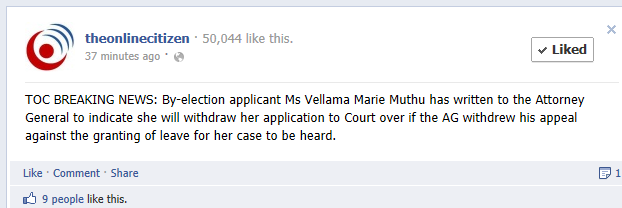
It appears that Mdm Vellama Marie Muthu is seeking to withdraw her case if the AG were to drop the appeal. A proposal has been forwarded to the Attorney General's office by Mdm Vellama's lawyer that upon withdrawal of her application and the AG's appeal, a consent order be drafted and recorded in Court.

Firstly, I believe that the application for the mandatory order has become unsustainable by virtue of the PM's decision to call for the by-election. If at all there is a live issue for the Court to determine, it is in relation to the declaratory orders sought by Mdm Vellama.

Mdm Vellama's application involved the following:

(a) Declaratory orders:

(i) That the Prime Minister does not have unfettered discretion in deciding whether to announce by-elections in Hougang SMC; and

(ii) That the Prime Minister does not have unfettered discretion to decide when to announce by-elections in Hougang SMC and must do so within three months or within such reasonable time as this Honourable Court deems fit; and

(b) A Mandatory Order
- enjoining the Prime Minister to advise the President to issue a Writ of Election mandating by-elections in Hougang SMC pursuant to Article 49(1) of the Constitution of the Republic of Singapore (1985 Rev Ed, 1999 Reprint) and Section 24(1) of the Parliamentary Elections Act (Cap 218, 2011 Rev Ed) and to tender such advice within three months or within such reasonable time as the Honourable Court deems fit.


As the PM has already advised the President to issue the Writ of Election, (b) above is rendered nugatory.

The question of whether the PM has unfettered discretion in deciding whether to announce by-election or in deciding when to announce such by-elections still remains an important Constitutional issue that is undefined and speculative given the gap in our Constitutional and statutory provisions on by-elections. This being the case, I do not think that the declaratory orders are less significant now that the PM has called for the by-election. (Of course, the wording of the declaratory order should be amended in the application to remove the reference to Hougang SMC. There is a generic question as to whether the PM has unfettered discretion in relation to whether and when to announce by-elections in any single member constituency.)

What would happen if the matter proceeds? The application for leave is in the first place being made on account of the mandatory order sought and by virtue of Order 53 of the Rules of Court. The declaratory orders are also being sought under Order 53 and they ride on the mandatory order. If the Court of Appeal rules that leave to appeal would not be granted on the mndatory order, then the application would fail and Mdm Vellama's Counsel has the option of filing a fresh application for the declaratory orders under Order 15 Rule 16 of the Rules of Court. This application, being solely for declaratory orders, would not require the leave of court.

This could be one way to proceed. However, I understand that the letter sent by Mdm Vellama's lawyer alludes to the fact that the Constitutional clarification must await some future date when such matter may arise. That is as good an indication as one may get on whether a fresh application would be made for the declaratory orders. It is plain that Mdm Vellama would not be pursuing any clarification via a fresh set of proceedings.

Since Mdm Vellama has proposed withdrawal, I would expect that the AG (and presumably the PM) would decide to take up the offer and drop the appeal. That would be the politically prudent step to take to avoid any possible fallout.

In any event, I think that Mdm Vellama deserves the respect of every citizen in Singapore. There are some people commenting online about her wasting time in making the Court application in the first place. This is what I have to say: Even if she has been put up to it by some others with a political interest in this situation, it takes a lot of guts to stick one's neck out like this. For that alone she deserves respect. She is a Singaporean that has shown that she meant every word of the pledge that we unashamedly take... "to build a democratic society based on justice and equality". In fact, those people that choose to take our national pledge and still deride the efforts of Mdm Vellama are hypocrites of the highest order. The rest of us, proud citizens, salute her!

In a way, this is our own little Bersih... A cleaner takes the PM to court to clean up our electoral law.

Sunday, April 22, 2012

That US 4 billion to the IMF: Is it unconstitutional?


On 20th April 2012, the Monetary Authority of Singapore announced that Singapore will give a "bilateral loan of US$4 billion to the International Monetary Fund (IMF), as part of the broader international effort to provide the Fund with sufficient resources to tackle crisis and promote global economic and financial stability."

Let me just state at the outset that I am not going to question the wisdom of such a move. I can see the need for the global community to rally together to hold steadfast against any future economic crisis. Some would question whether this is nothing more than an exercise in futility. In fact, in the United Kingdom (where the government has pledged 10 billion pounds), several ruling party MPs have started questioning the wisdom of providing such a backup to the IMF. Peter Bone (MP from the Conservative Party) said: "We might as well put £10billion in the nearest litter bin.” There is a sense in which this move is seen as money down the drain and an exercise in futility even if it may appear to be well-intentioned.

The Shadow Chancellor, Ed Balls (of the opposition Labour Party) had this to say: "The IMF has a vital role to play in the global economy and should have the resources to do that job, but it should not be bailing out the eurozone when the euro area countries are not doing their own bit to help themselves." "The IMF cannot and should not become the de facto central bank of the euro area." "The IMF is being put up to step in and play the role that the European Central Bank should be playing - a strategy which cannot work and is self-defeating by highlighting the lack of a proper ECB firewall." I can see the validity in this proposition that IMF should not do ECB's job.

Meanwhile, back in Singapore, we have mundane news reports of a mere 4 billion US dollars being pledged to the IMF. I am rather curious about the status of this loan commitment from a legal standpoint. Under our Constitution, there are some restrictions on loans and guarantees provided by the government. Article 144 of the Constitution is as follows:

Article 144.
—(1) No guarantee or loan shall be given or raised by the Government —
(a)except under the authority of any resolution of Parliament with which the President concurs;
(b)under the authority of any law to which this paragraph applies unless the President concurs with the giving or raising of such guarantee or loan; or
(c)except under the authority of any other written law.
(2) The President, acting in his discretion, may withhold his assent to any Bill passed by Parliament providing, directly or indirectly, for the borrowing of money, the giving of any guarantee or the raising of any loan by the Government if, in the opinion of the President, the Bill is likely to draw on the reserves of the Government which were not accumulated by the Government during its current term of office.


The present issue of the loan to IMF comes under Clause 1(b). The Constitution makes reference to specific laws under which loans may be given and one such statute listed at Clause 3 is the Bretton Woods Agreement Act (Cap 27). Subscription payments to the IMF and other monetary commitments to the IMF are covered by the Bretton Woods Agreement. Given this fact, the Constitution clearly prohibits at Clause 1(b) above any loan given to the IMF without the President's consent.

I wonder if the President was consulted. I wonder if he has given his consent. Given that this is one of the areas of the President's discretionary powers and given the fact that he is an Elected President, I would expect some transparency and accountability here simply in the form of an official request for the President's consent and the President's communication of such consent with reasons stated. This would ensure that the people can judge the President's record when it comes to the next Presidential Election. What decisions did he make in relation to his discretionary powers? How did he justify those decisions? Are the justifications acceptable? These are important questions and can't be brushed aside on the bare assertion that our President is like the Queen of England and that he carries out his functions behind closed doors. Our President is Elected (and not appointed or a hereditary title holder) and these are part of his discretionary powers for which he was elected.

Thus I have 2 issues with the current loan to the IMF. (1) A guarantee or a loan without the President's consent will be unlawful. (2) If the President has consented, can we have an official statement from Istana?

Thursday, March 15, 2012

Is an unrestrained discretion compatible with the Rule of Law?

The official position in Singapore has always been that we respect the Rule of Law. When attempts by human rights organisations or foreign governments were made to run us down, our government has stood firm and insisted that we do respect the Rule of Law.

But, what does the Rule of Law entail?

A basic premise is the view that all exercise of power is subject to the law. I, as an individual, have no right to exert power over you in such a way that I might harm your property, your person or your life. Where I may attempt to do so, laws may legitimately be in place to prevent me from so harming you. This is reflected in a variety of criminal offences and civil liability. Equally, the state has no right to exert power over any of us except as it might have been lawfully authorised to do so.

At this juncture, we can take this in two directions. Firstly, the state is justfied in punishing us by depriving us of our life, liberty or property if we have breached a law that has been clearly stipulated. Secondly, the state is justified in exercising a general power of decision making in a way that affects our rights or activities so long as the same is done in accordance with the law.

The key here is the fact that the law is used as an objective and neutral intermediary between the state and the citizen. The state seeks justification for its actions in the law as predefined. The citizen demands that the state's power be exercised solely within the ambit of the predefined law.

This is all well and fine if the predefined law is in fact clearly defined. What if the law is vague? What if the law provides an area of discretion? What if the area of discretion is so wide as to render the law redundant?

Example 1:
In the event that a Parliamentary seat shall fall vacant, a by-election shall be held and towards this end a Writ of Election shall be issued by the President within 3 months of the date that the seat fell vacant.

Example 2:
In the event that a Parliamentary seat shall fall vacant, a by-election shall be held and towards this end a Writ of Election shall be issued by the President within a reasonable time.

Example 3:
In the event that a Parliamentary seat shall fall vacant, a by-election shall be held.

Example 4:
In the event that a Parliamentary seat shall fall vacant, the seat shall be filled by election.
In exercising his power to issue a writ of election, the President shall act on the advise of the PM.

All of the above examples contain discretion. The first example is restrictive and binds the President to issue a Writ of Election within 3 months. The second one restricts the exercise of discretion to a reasonable time. The third example doesn't stipulate a restriction. But, by requiring a by-election to be held, it does not leave it too vague to allow for an interpretation that might result in the election being postponed till the next general election. The fourth example appears to give a broad discretion for the seat to be filled and for this to be done in accordance with the PM's advise.

The broadest way of interpreting the 4th example is to say that the law provides that it is the absolute and unfettered discretion of the PM to determine when he would call for the by-election. Being an unfettered discretion as to timing, it might even be postponed all the way to the end of the Parliamentary term.

Although the 4th example is not on the exact terms as our Constitutional arrangement for by-elections, it is nevertheless similar. Our Constitutional arrangement is something that I blogged about here: http://article14.blogspot.com/2012/02/by-election-when-not-whether.html"

I beleive that the extent of discretion provided in the Constitution does not go as far as to permit the PM to decide whether a by-election should be held. But, it is however broad enough to be interpreted as giving him a broad discretion to decide when the by-election should be held. This is where the problem comes in. A discretion that is unrestrained and so broad is one that renders the rule nugatory. Unrestrained discretion is ultimately an afront to the Rule of Law.

Assuming that I am the King of this country and I were to declare that I will govern according to law, the expectation would be that my discretion would no longer be the basis of exercise of power. Power will now be exercised in accordance with law. But, what if I have a law that says: "Whatever the King determines to be the appropriate tax to be levied upon the people from time to time in his absolute discretion shall be the lawful tax." Such a law gives so broad a discretion to me that the law may as well not exist. The law negates itself.

Some of the broad interpretations of our Constitution as proposed by PAP leaders provide for such a possibility that the Constitutional guarantee of Parliamentary representation is rendered nugatory. Where possible, in upholding the Rule of Law, those that interprete the law (i.e. the judiciary) must adopt a restrictive interpretation on the exercise of discretion. Thankfully, in Singapore we have the Interpretation Act to assist us in relation to issues of timing. So, I believe that the PM's discretion to decide on the timing of the by-election should be restricted both by having regard to the Interpretation Act as well as by having regard to nothing less than the foundational and organizing principle of any rule-based society: the Rule of Law.

Sunday, February 19, 2012

Bye Yaw, and now for the By-Election

Anson was a long time ago. CV Devan Nair vacated his seat in Parliament before his elevation to the position of President. J B Jeyaretnam participated in the by-election for the Anson constituency and recorded that historic win against the PAP. 1981 seems like a distant memory now. The PAP stranglehold on Parliament had been punctured. There was a lone voice catapulted into the legislature willing to champion the cause of the people against the mammoth PAP government.
We had not progressed that much from then. At the very best (before 2011), the opposition managed 4 seats in Parliament. But, for the most part, it was just 2 seats. It was, therefore, fitting that last year (being the 30th anniversary of the Anson victory) another milestone was crossed in Singapore's electoral history. The fall of a GRC was a big psychological boost for the opposition and its supporters. It has also ushered in an unprecedented boldness and a willingness express views fearlessly.

The GRC itself was one of the methods by which the ruling party managed to keep the opposition at bay. There is no doubt in my mind that if the GRC system had never been introduced, the PAP would have lost more seats in earlier elections. (My views on the mechanics of domination exercised through the GRC..... http://article14.blogspot.com/2009/06/uniquely-singapore-papmandering.html )

Throughout this period from the 1980s to the present, the PAP has also been careful to avoid by-elections. To me, the most disappointing moment was when the Bukit Batok MP, Ong Chit Chung, passed away. There was a conflict between the Constitution and a statutory provision and in my view the Constitution ought to prevail. They made no Constitutional amendment and they just gave elaborate excuses and convinced the masses that no by-election was necessary. (I had blogged about this before.... http://article14.blogspot.com/search/label/Bukit%20Batok ) In the end, Bukit Batok went without a member of parliament for nearly 3 years (July 2008 to May 2011).

And now, we have an opposition MP that has vacated his seat. A by-election has to be called. The problem is that our laws are silent as to the time limit for calling a by-election. Pursuant to the Constitution, when an MP is sacked by his Party, the MP's seat falls vacant. Under the Parliamentary Elections Act, the President has to issue a Writ of Election. No time limit is set for this. Under the Constitution, this is one of those powers of the President that does not come within his discretion and it is for the Cabinet to advise him. The problem now is the PM seems to think that there are pressing national issues and so he seems to suggest that a by-election is not within him immediate focus.

This is an area that has to be legislated. I hope that this issue is not left as a mere discretion and a certain timeline be set for by elections in the future. We could do it by legislation or if our politicians are mature enough a multi-party code can be devised where political parties can agree to hold by elections within a fixed time frame when there is a casual vacancy.

It is totally untenable to leave the question of a by-election hanging in the air and in fact it is irresponsible to let Hougang residents hanging in there without a member of parliament.

Wednesday, January 11, 2012

Death by prosecutorial discretion

The rather uncomfortable fact surrounding the mandatory death penalty for drug trafficking in Singapore is the fact that the presumption of trafficking operates on the basis of the possession of a specified quantity of a prohibited drug. Prosecution does not prove that you are a trafficker. Prosecution proves that you are in possession of a specified quantity of drugs. The law artificially designates you are a trafficker and you stand to be convicted if you cannot prove otherwise.

Firstly, the reversal of the burden of proof (i.e. making the Defendant prove certain facts instead of the Prosecution) on its own raises questions of the right of a private citizen to a fair trial. There may be justifiable reasons for such reversals in limited situations. I am not opposed to reversals of the burden of proof on all occasions. But, the use of this evidential technique in drug trafficking cases, where the failure of the defendant to discharge his burden places him on death row, cannot be described as anything other than a form of injustice. That injustice is, of course, firmly a part of our Misuse of Drugs Act.

Complicating this injustice enshrined in our statute books is the application of prosecutorial discretion. Let me make this clear. I am not opposed to the exercise of discretion by the prosecution. It is a necessary feature of every mature legal system that discretion be given to prosecuting bodies to decide on whether to prosecute at all or to prosecute for any number of given offences. It is also not uncommon that if a person had stolen a mobile phone and a wallet, he is then charged only for the theft of the mobile phone. Such exercise of prosecutorial discretion is not considered as odd, exceptional or an abuse of process. In fact, it is a necessary feature of the proper administration of justice that a prosecutor should be able to exercise discretion.

But, the difference between charging a person for the theft of a mobile phone and a wallet as opposed to charging him for the theft of a mobile phone alone is not substantial. On the other hand, the difference of 0.01g of cocaine in a charge sheet for a drug trafficking offence is as dramatic as either having a noose around your neck or being granted what is effectively a 'prosecutorial pardon'.

This stark difference was played out in the case of Ramalingam Ravinthran. This was a case where his co-accused was charged with trafficking in 499.99g of cannabis and 999.99g of cannabis mixture conveniently shy of the mandatory death penalty by 0.01g. That is just decimal points away from death. Ramalingam himself was charged for the trafficking of quantities that triggered the death penalty. In the end, the facts were such that the charges arose from a single bag containing 5,560.1g of cannabis and 2,078.3g of cannabis mixture. Not only did the prosecution artificially slice the contents of the bag by charging the defendants in the way it did, it also placed one man on death row whilst granting the other his life.

The Court of Appeal has delivered its verdict in the Ramalingam case. Based on the Straits Times report it is not entirely clear as to what was the precise ambit of the decision. It is reported: "IT IS not unlawful for the Attorney-General to artificially reduce the amount of drugs specified in a trafficker's charges, to differentiate from those of his accomplice. Nor is it unconstitutional."
On the other hand, it also reported: "Still, the exercise of prosecutorial discretion is subject to legal limits - the A-G cannot act arbitrarily. This means the A-G must ensure like cases are treated alike. And in cases where several offenders are involved, the A-G must not unlawfully discriminate against an offender."

It is difficult to surmise from the news report itself as to the precise position of the Court. I would have to read the 48 page judgment itself to ascertain the legal position.

I gather roughly from the report that the court has gone for the position that the power of the prosecution to exercise discretion is lawful and constitutional. However, the manner in which such discretion is exercised may be called into question. If that is indeed the position, the decision should be welcomed. (I say this fully aware of the fact that it provides no comfort to either Ramalingam or his family.) It prevents arbitrary decision making on the part of the prosecution and forces prosecuting bodies to consider carefully their reasons before differentiating between two defendants in the same case or for that matter (arguably) two defendants in entirely separate cases where the circumstances might be similar.

I shall read the judgment first before commenting further on this case.


Monday, June 20, 2011

Black Sunday: A New Dawn?: A test for the post GE 2011 government

Under Section 5 of the Public Order Act 2009, a public assembly shall not take place unless notice of it has been given to the Commissioner under Section 6 and a permit has been granted under Section 7.

Effectively, any public assembly without a permit would constitute an offence.

So, what constitutes a public assembly? The Public Order Act 2009 makes the assembly of a single individual an offence. Although linguistically it seems impossible to evisage the assembly of one, the law can get away with the creation of fiction for convenience.

Section 1 of the Public Order Act spells out the definition of an 'assembly':

"assembly" means a gathering or meeting (whether or not comprising any lecture, talk, address, debate or discussion) of persons the purpose (or one of the purposes) of which is —
(a) to demonstrate support for or opposition to the views or actions of any person, group of persons or any government;
(b) to publicise a cause or campaign; or
(c) to mark or commemorate any event,
and includes a demonstration by a person alone for any such purpose referred to in paragraph (a), (b) or (c);


If a group of friends decide (let's say) to commemorate the death anniversary of JBJ by gathering at a public place, an offence would be committed. In fact, if I 'gathered' alone at a public place to commemorate an event, that would also constitute an assembly under the Act.

The definition is broad enough to cover any kind of 'protest', 'demonstration' or public display of views.

Into this restrictively drawn statutory arrangement waltzes 'Mandy Mary'.

I first came across this person via a facebook group. I was aware that 'she' was organising (or at least appeared via facebook to be a prime mover) the Black Sunday event. A successful Black Sunday event took place to register disapproval of MP Tin Pei Ling. This took place at the Starbucks outlet at Parkway Parade on 29th May 2011. I became aware of this event the day after it took place via some discussion with facebook friends. And then another Mandy Mary inspired Black Sunday event cropped up. This time it was at Wisma Atria at a Starbucks outlet on 12th June 2011.

By now, Mandy Mary had become emboldened enough to turn this into a 'movement'. There is a facebook page for 'Black Sunday Movement' now.

What do I think of these events? Do they fall foul of the law? Are the organizers and participants taking too much of a risk?

Two crucial issues:
1.Were they gathered for one of the stated purposes in the statute under the definition section of the Public Order Act as set out above?
2.Would a cafe constitute a public place for the purpose of the Public Order Act?

Under Section 1 of the Act 'public place' is defined as follows:

"public place" means —
(a) any place (open to the air or otherwise) to which members of the public have access as of right or by virtue of express or implied permission, whether or not on payment of a fee, whether or not access to the place may be restricted at particular times or for particular purposes, and whether or not it is an “approved place” within the meaning of the Public Entertainments and Meetings Act (Cap. 257); or
(b) a part of a place that the occupier of the place allows members of the public to enter, but only while the place is ordinarily open to members of the public;


This definition is broad enough to cover a restaurant or cafe where the owner of the premises grants an express/implied permission to the customer to have access to the premises.

With the Black Sunday Movement promoting a cause and the event being held in arguably 'a public place', (The Public Order Act definition is arguably broader than the reference to a 'public place' in the Public Entertainments and Meetings Act), I wouldn't be surprised if the authorities decide to charge the individuals involved.

But, I am surprised. Pleasantly as well.
I am surprised because no action has been taken. Nobody has been called up for investigation. Yes, some men in blue were seen at the location of the second event but apart from a photographer who was asked for his ID, nobody appears to have been troubled.

In my heart, I quietly hope and pray that this is the new dawn. Quietly, and without fanfare, freedom awakens in our land.

If our Prime Minister had truly taken to heart the voice of the people during the election campaign this year, he would have realised that the change that needs to be instituted is not going to be merely cosmetic. It would not do for him or his party to pay lip service to change. It would not do for him or his party to merely manage public perception through information management. He would have realised that the citizens of this country have reached a level of political maturity that demands that the tight-fisted approach of years gone by cannot work any more.

Politics in this country has changed at a fundamental level this May. The more you seek to control, the more you lose electoral control.

If this has dawned on our PM and his party colleagues, we might be witnessing the beginning of a new reality. Events like Black Sunday are pretty harmless. All they do is publicise a cause. No rebel-rousing speeches. No spirited chanting. Not even any placards. A silent and nuisance-free way of expressing dissent. I am sure the individuals composing the present Cabinet can live with this and tolerate its existence. After all, they are now living with and tolerating so much of dissent online. Whilst doing that, I am sure they are beginning to realise how harmless this kind of dissent really is.

The key for the PAP government is to battle dissent with clear, cogent and rational argument. They can't get away with killing dissent with a sledgehammer. Those days are gone. People have finally felt the sense of empowerment that their vote is capable of giving them. Silencing regular dissent would translate into more votes lost for the PAP. Engaging dissent constructively may in fact win back some votes for them. For the hardcore opposition supporter this might not sound like a good thing. In fact, one might even secretly wish that the PAP would not change its ways. If they don't change their ways, they would lose more votes.

But, PM Lee might have already made the prudent calculation that some level of restraint in the use of the law and a greater level of engagement in honest debate with the public would actually be the win-win solution for the PAP as well as for the people. More easing of control might actually result in more electoral clout for the PAP. This could be his opportunity to script a future for our country truly with the people as co-authors. Public assembly could be a start. There are so many other areas where control could be eased.

I am speculating. Who knows what the future holds?

But, these are interesting times in our nation's history.

The Black Sunday Movement could be the sign of a new dawn for us all.

Wednesday, June 15, 2011

We the people can make our President speak

The debate on the President's powers is taking a healthy turn. I'm glad that netizens are weighing in with good arguments one way or the other. A truly heartening aspect of this discussion is that most views are expressed within the ambit of the current constitutional framework as set out in our written Constitution. Nobody has illusions about the powers that are provided for.

The Ministry of Law's press statement is an accurate rendition of the relevant constitutional provisions. For those readers that don't plan to labour over the Constitution, I would recommend the MinLaw statement for a useful guide.
http://www.news.gov.sg/public/sgpc/en/media_releases/agencies/minlaw/press_release/P-20110610-1/AttachmentPar/0/file/Press%20Statement%20from%20Minister%20%28Law%29%20-%20Elected%20President%20_10%20June%202011_.pdf
We can potentially debate about whether the Constitution itself ought to be amended to give the President express powers in additional areas or to remove the constraints placed by the Cabinet's advice in the exercise of certain powers (e.g. Clemency). But, that would be a different kind of debate.

The present debate, as it is shaping up, is about whether the next President should speak up on policy issues or not. Traditionally, the head of state in a commonwealth country has been fashioned after the British monarch. There is no historical controversy in the assertion that our first President was in many ways a replica of the British monarch. His power was essentially more ceremonial than actual. As with the Queen, our unelected President lacked the constitutional legitimacy to speak up.

Singaporeans had never debated about the extent to which a President should exercise his powers because we never really saw him as having any legitimacy to wield any power.
Two things have changed from the 1990s onwards - today's President is elected and today's President earns an obscenely high salary. There is, therefore, a popular perception that the will of the people must be voiced in some way by the President and the President must be worth the money that he is being paid.

The expressly stated powers of the President in our Constitution do not traverse the area of his right to speak and express his views. Yes, he is not in a position to veto most bills and he is not in a position to veto policies. But, the Constitution is silent on his right to express a view. In such instances we have to resort to the political conventions surrounding the office of the President. Being a carbon copy of the British Queen, the original office of the President was governed by conventions that applied to the queen. An unelected person has no legitimacy to chide the elected leaders for their policies. Similarly an unelected person has no legitimate role in criticising the legislation passed by an elected parliament.

The conventions surrounding the British monarchy were easily transplanted into our constitutional arrangements. But, it still remains true that those were conventions and not strict provisions in our constitution.

Those of us advocating an expanded role are relying on the elastic nature of conventions. Once the Head of State is elected the game changes considerably. (In fact, one of the drawbacks of the creation of the elected presidency was the failure to appreciate the potential impact of the electoral mandate on the office itself. The complacent PAP government did not anticipate that an Elected President might one day challenge and question the PAP itself). Constitutional law does not reside in a vacuum. Political currents can be sufficiently strong to push through major shifts in the way certain officeholders may carry out their functions. This can happen without necessarily amending the Constitution and at the same time by avoiding any offence to existing constitutional provisions.

There is room to manoeuvre. We want our next President to use that room.
If ever there is to be a political moment in our nation's post-independence history where the power of the people's voice was strong enough to effect change, this is it. The push-back by the people against the PAP was loud and clear in May 2011. The PAP (to its credit) did not react with a heavy hand. It is responding through a reassessment of itself.
This displays that there is an important threshold that the PAP leaders are themselves prepared to cross. Criticism need not be crushed. It can be the basis of constructive analysis instead of building a culture of group-think.

I firmly believe that if there is sufficient public support for a vocal presidency, the winning candidate may carry with him a powerful electoral backing with which he can re-shape the office.

The current Cabinet ministers may possess sufficient wisdom to permit a slightly expanded role for the President. Who knows?

In a country where we are accustomed to the rules of the game being changed by the PAP, it is about time that the people play a part in changing the rules.

Summarising my previous blog post and the current post, my premise for an expanded role is this:
a) There are powers that the President can exercise discretion on
b) There are powers that the President is required to exercise in accordance with the advise of the Cabinet
c) There are no limitations or constraints on the President’s ability to publicly express his opinion
d) Public expression of opinion rendered in a gentlemanly fashion would at most piss off the government of the day but it would not result in a constitutional crisis
e) Dissenting views are a healthy aspect of a mature democracy (and we are on the way to maturing as a democracy)
f) By expressing his views, the President is not going to emerge as another power centre as his functions are still clearly demarcated

Thursday, June 09, 2011

Reshaping the Presidency

Prior to the creation of the Elected presidency, the President of Singapore was pretty much a carbon copy of the British monarch. His constitutional role as the Head of State was largely ceremonial.

However, the introduction of constitutional amendments in relation to the office of the President culminated in the adoption of a hybrid version of a Head of State. Is out President identical to the Head of State in the British system? My answer is: no. And of course, at the other end of the spectrum, our President is not at all like the American President whose executive powers are enormous. The Prime Minister and the Cabinet continue to be wielders of executive power in Singapore.

I was reading a couple of blog posts on the nature of the President's powers.
"Many things a President cannot do." from the blog: Thoughts of a Cynical Investor
http://atans1.wordpress.com/2011/06/08/many-things-president-cannot-do/
and
"Will a President that speaks up cause a SIngapore Constitutional crisis?" from the blog: Thoughts of a Singapore statistician
http://singstatistician.blogspot.com/2011/06/will-president-that-speaks-up-cause.html

Cynical Investor makes the assertion that the office of the President is so limited in terms of its constitutional role that there is not much that any Elected President can really do. His contention is that the President cannot, without provoking a constitutional crisis, address the many policy issues that some of us expect to be aired.

To be fair, the office of the Elected President was introduced as a safeguard primarily in relation to the reserves. So, many of the express powers given to the President involve some direct or indirect control over the use of the reserves. Cynical Investor is not off the mark when he states:

So, if for example Tan Kin Lian becomes president, he cannot speak out on of the need for a minimum wage, on the honesty and integrity of financial advisers, or whether lawyers, doctors and architects overcharge for certain services. He definitely cannot publicly ask the AG to look into prosecuting financial institutions or land bank businesses for “cheating” the public.


But, a small correction is in order... Article 22G of the Constitution provides for the President to direct the CPIB to carry out investigations despite the refusal of the Prime Minister. This can, turn out, in appropriate circumstances to be a potent power.

22G. Notwithstanding that the Prime Minister has refused to give his consent to the Director of the Corrupt Practices Investigation Bureau to make any inquiries or to carry out any investigations into any information received by the Director touching upon the conduct of any person or any allegation or complaint made against any person, the Director may make such inquiries or carry out investigations into such information, allegation or complaint if the President, acting in his discretion, concurs therewith.


Singapore Statistician contends that there is Constitutional space for the President to be independent and vocal despite the appearance of a limited function under the Constitution.

I shall now throw my 2 cents' worth into this conversation.

Firstly, what exactly does the Constitution provide? What can the President do? And what are the things that he cannot do?

The COnstitution provides for certain powers that are discretionary and others that the President exercises on the advise of the Cabinet. Many of us would remember the arguments in the Yong Vui Kong case as to the power of the President to grant clemency. The judiciary has interpreted that the President ought to act on the advise of the Cabinet and not exercise his discretion as he deems fit. In my view, this was not a clear-cut issue as some commentators had made it out to be. It was always open to interpretation and Yong Vui kong's case now settles the interpretation (at least for the time being). (I had expressed my view on this issue here: http://article14.blogspot.com/2010/08/clemency-and-constitution.html )

Let's leave the non-discretionary powers of the President aside. There would be something of a constitutional 'crisis' if the President acts against the advise of the Cabinet in relation to, for example, clemency.

If we focus on the areas of Presidential discretion we would notice that there is plenty of room for an individual President to stamp his personal style in the decision-making process. There is nothing preventing a President from expressing his views on policy and legislation in a firm, vocal and open manner.

Let's consider the granting of the Presidential Assent in relation to certain Bills passed by Parliament. I want to draw a quick comparison with the British monarch. She has legal power based on her Royal Prerogative to refuse to grant the Royal Assent. Yet, by convention (political practice) she always grants the Royal Assent. Our President has, under the Constitution an effective veto against certain Bills. Is there any political rule or practise that is capable of restraining our President from exercising his discretion? The British monarch is an unelected person and a hereditary title holder. She and her predecessors had for a long time acknowledged the superiority of the Parliamentary will. Today, we speak of the will of Parliament as the will of the electorate. Therefore, in the context of the UK the unelected monarch must give way (for want of political legitimacy) to the will of Parliament (the Lower House being an elected body).

In Singapore, the position of our President is constitutionaly different. Considering only the discretionary powers of the President, we can make out a cogent case for a vocal Presidency. This case is based solely on the enhanced legitimacy of our Head of State as an elected individual. Where both parliament and the President are elected, both can claim legitimacy by virtue of an electoral mandate. The constitutional provisions envisage the possibility that the President in the exercise of his discretion may pave the way for a deadlock. Any potential constitutional deadlock is untangled through a number of procedures one of which is a 2/3 majority resolution by Parliament.

When the President either grants or refuses to grant the Assent, there is a strong case for the contention that the President ought to make his reasoned arguments available for Public scrutiny.

It is a facet of (and even a strong expection in) modern governance, that laws ought to be made publicly and debated and reasoned out in an open manner. Our Parliament has been doing this from its inception. The Elected President is, arguably, in a position of political accountability towards the electorate. Therefore, apart from those occasions where he is exercising a discretion, it would be constitutionally useful for an assertive President to explain the reasons for his actions or even to express his disagreement even though a constitutional provision may provide him with no discretion.

Moving forward, a future elected President can choose to make his decisions and the attendant reasons public so that the process of law-making or executive decision-making is entirely transparent. Presidential candidates in this election can propose this as a change in the Presidential style. Note that this would not merely be a change in style but one with real substance.

By reshaping the Presidency into an office that explains its actions, the future President can use the opportunity to express his disagreement. Whether the Cabinet, Parliament or the President presents the clearer moral argument for a particular matter can ultimately be judged by the people. Of course, the reality is that whoever becomes the President and however much he may shout at the top of his voice and exercise his discretion, the current government can override the President's views and actions.

Realistically speaking, given the current composition of Parliament, there may be nothing concrete that can be accomplished by the President.

But, I firmly believe that what we are setting out to do now as a nation is to lay the foundation for a different kind of Presidency. The trend has to be set for future Presidents. Apart from exercising the Constitutionally prescribed function, the President can legitimately seek to be another voice against any potential abuse by the executive.

How far are the candidates willing to go to commit themselves to reshaping the Presidency? I am not calling for them to act unconstitutionally. But, working within the ambit of the Constitution, a President can actively and vocally exercise his discretion (sometimes agreeing, sometimes disagreeing) in a transparent fashion and give life to the potent power invested in him by the electorate.

I do not believe that an Elected President should wait for marching orders from the Constitution to open his mouth and speak up on policy issues. There is, after all, no gagging order imposed upon the President.